
 0
0
 0
0
b.1846-1920
In the early hours of the morning on 6th October 1900, Louisa Susanna Watson was found wandering in Great Quebec Street, Marylebone, by PC Edwin Lapworth who took her to Molyneux Street police station. On examination she was deemed to be a lunatic and ordered to be detained at St Marylebone workhouse.
On admission to the workhouse infirmary she was found to be of unsound mind, and suffering from bruising to both arms, heart disease, and emphysema. Her age was put at 40 (she was actually 54). After 3 weeks in the workhouse, she was committed to Hanwell Asylum and she remained in the asylum system until her death at Horton in 1920.
Beginnings
Louisa was born in Islington, London, in 1846 to Alexander Watson, a mason from Scotland, and his wife Elizabeth Craig, one of at least 12 children born to the couple. She was baptised at Islington Presbyterian Church on 10th January 1847.
Tracing her life through the census
In the 1851 census the Watson family were living at 20 Euston Place.
In 1861 they were at 211 Euston Road, and Alexander was described as an architect.
By 1871 there had been some upheaval in the household at 211 Euston Road. Mother Elizabeth had died; father Alexander had moved to South Wales to manage the stone quarry at Pwllypant near Caerphilly; an elderly uncle, Alexander McKenzie, and his wife Mary had moved in. The census reveals that six of the Watson children were still there including “Susanna”. (There is another possible census entry for her and it may be that she was enumerated twice: a Louisa Watson, 24, unemployed servant born at St Pancras, is recorded as a visitor in the household of Sophia Gascoyne in Islington. Sophia’s maiden name was Watson so it is possible that they were related.)
In the 1881 census there is a Louisa Watson, a general servant, in the household of Mary A Russell in Monmouth Road, Bayswater. This is probably our Louisa.
Louisa’s father Alexander Watson remained at Pwllypant for the rest of his life. He married Eliza Davies at Bedwas in 1873 and they lived together at Goodrich Cottage until his death in July 1893. Curiously he continued to be listed in London directories (as an architect) and on electoral rolls at 211 Euston Road until 1891.
Louisa is with her father in Pwllypant in the 1891 census; her age is recorded as just 30 (she would have been 44).
Admission to the Asylum
The medical examiner at Marylebone workhouse certified her condition thus:
“She is silly & rambling in her conversation saying that she is frightened & that everybody wants to rob & annoy her. She is unable to tell me how she came here & is full of grievances which are obviously delusions. She is most anxious that great care should be taken of some blue papers which she imagines she has given me.
Inability to hold rational conversation. She has great loss of memory. Does not know the day, month or year. She appears confused. She has delusions; inquires if she has been for both her dinner & supper & that whiskey is given her before going to bed. She fancies she has been sent out to take a walk and that she can see six boxes belonging to her in the ward.
Caroline Whiting, female attendant, H. Marylebone workhouse, informs me that the patient walks about in an aimless manner all day & most of the night, worrying & disturbing everybody. Every noise in the room overhead leads her to declare her boxes are being broken away & stolen.
Rose Booth, Attendant, female insane ward St Marylebone Workhouse, says that Louisa Susannah Watson is restless, wanders about the ward day & night. Apparently for the reason that she has delusions; fancies she sees her boxes. She has no memory & appears very confused.”
On reception at Hanwell Asylum, this was added:
“Dementia – She is quite simple minded & childish & her memory is most defective. She is occasionally noisy, childishly excited but she gives no trouble. She has valvular disease of the heart & on rare occasions syncopal attacks. There is a history of acute rheumatism previous to admission here as well as of intemperance. “
Her entry in the Lunacy Admission Register is endorsed “Private 17 July 1903” which suggests that from that time her family were arranging for improved conditions for her as a private patient. She appears to have been transferred back to pauper class shortly before her death.
Arrival in Epsom
We know that Louisa spent time in Long Grove, Manor, the Epileptic Colony and Horton between 1906 and her death in 1920.
On 30 November 1906, Louisa was transferred from Hanwell to Long Grove in Epsom.
In 1916, case notes inform us that she was moved to the Epileptic Colony in Ewell, while Manor was functioning as a war hospital.
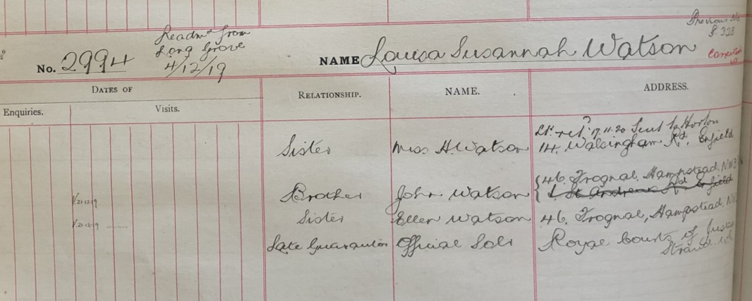
On 4 December 1919, a visitor’s book entry for Manor indicates that Louisa was resident there, having been transferred from Long Grove.
On 21 December 1919, she had visits from her siblings, Ellen and John Watson. Other visitors during her time in Manor included another sister, Miss H (Heloise) Watson and her ‘Late Guarantor and Official Solicitor from the Royal Courts of Justice on the Strand, London.
Louisa’s death certificate indicates that she died in Horton Asylum. It is clear that Louisa is an example of a patient who was moved around the cluster.
Death
Louisa died at Horton on 29 December 1920. The causes of death were stated as senility and syncope.
On her death certificate Louisa’s age was put at 60 in line with the asylum records. She was in fact 74. She was buried at Horton on 4 January 1921 in grave 78a.
Administration of her estate (just £85) was granted to her sister Heloise Jemima Watson in February 1921. Heloise herself was to die at Long Grove in 1933 (but she was not buried at Horton).
Copyright
If you use the published stories, partly or completely, written by volunteers of the Friends of Horton Cemetery charity (Reg. No. 1190518), please acknowledge the volunteer who wrote the story by name, acknowledge the Friends of Horton Cemetery expressly and its registration number, and include this link to the STORIES section of the website https://hortoncemetery.org/the…/horton-cemetery-stories/
Donate
Occasionally, people ask how they might financially contribute to our charity. There is a Donate link at the foot of each page of the website. All donations will be directed towards continuing efforts to restore and ultimately maintain Horton Cemetery. We thank you for your support.