
 0
0
 0
0
b.1844-d.1923
Childhood
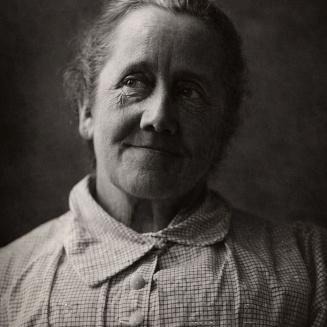
Mary Ann Hall was born Mary Ann Jefferies in Bath, Somerset in 1844. Her parents were James Jefferies, a mason’s labourer, and his wife Elizabeth (née Munday).
She was baptised at St James’ church in Bath on 16 June 1844.
In the 1851 Census, the family was resident at 1 Taylors Court in Bath. Mary Ann had an elder brother (Henry) and two young sisters (Sarah and Harriet). Their mother was working as a laundress to supplement the family income.
1860s
In 1861, aged 17, Mary Ann was employed as a house servant in the home of William Henry Andrews in the village of Hinton Charterhouse, near Bath
1870s
There is a possible sighting of Mary Ann in the 1871 Census in Scarborough (Mary Jeffries, age 27, from Bath).
At some point Mary Ann must have made her way to London, where she met her future husband.
Marriage
Mary Ann married Leonard Hall at St Andrew’s church in Islington in April 1876. At that time, Leonard was employed as a brakesman on the Metropolitan Railway.
Five years later, the 1881 Census recorded the couple at 22 Stanmore Street in Islington. From this we learned that Leonard (who was now working as a porter) was born in Leckhampton, Gloucestershire.
In the next census, in 1891, Mary Ann and Leonard were still in Islington, at 10 Matilda Street. Leonard was now employed as a labourer in wood. With them is a niece: Harriet E Gosling, aged 17, from Bath. Harriet was the daughter of Mary Ann’s sister Harriet and husband Charles Gosling.
Mary Ann and Leonard did not have any children of their own.
Separation, and dementia
By 1899, Leonard had left Mary Ann (allowing her 6 shillings a week), and her mental state had deteriorated. She was being looked after by a friend, Elizabeth Ann Franklin, who found that she was unable to cope: in February 1899 she formally requested that Mary Ann be taken to a place of safety. The accompanying medical certificate gave Mary Ann’s address as 20 Upper Park Place and stated that she was of unsound mind, with delusions of “stuff put in food”, and persecution. It was recommended that she be taken by cab to the insane ward of the workhouse.
At Marylebone workhouse Mary Ann was examined by Dr Bokenham who certified that she was of unsound mind and should be detained under care:
“She tells me that her husband is determined to get her done away with; that he pays people to go about & insult & lay traps for her; that he has committed bigamy and is trying to goad her into leading an immoral life & doing away with herself.
“Elizabeth Ann Franklin, 92 Earl St Edgware Rd, dressmaker, a friend, states that the patient has been coming to her for some time past, making altogether unfounded charges against her husband, saying that people are set to follow her and insult her & that they are also trying to make away with her by giving her poisoned bread etc. It is not true that the patient’s husband has committed bigamy.”
In early March she was removed from the workhouse to Grove Hall asylum in Bow.
In the archives of St Marylebone workhouse, we found the Relieving Officer’s expenses claim in respect of this case:
Christ Church A district
“Expenses incurred in the enquiry as to the state of mind of Mary Ann Hall, and in her removal to Grove Hall Asylum
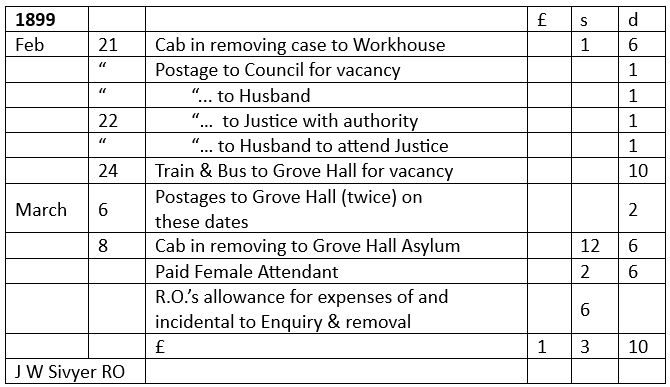
(transcription by Shaun Jones)
There are receipts attached, so we even know the name of the cab driver (Thomas Whiley) who conveyed her to Grove Hall, and the name of the female attendant (S Sivyer – possibly the wife of the RO).
In the asylum system
Mary Ann was transferred from Grove Hall to Manor asylum in June 1899. Her friend Elizabeth Ann Franklin visited her there twice in 1899, but no other visits are recorded.
Mary Ann remained at Manor for the next 17 years, but then when the asylum was requisitioned as a war hospital in 1916, she was transferred to Ewell Epileptic Colony. This colony consisted of eight separate villas, all named after trees, each holding up to 38 patients. Mary was moved from villa to villa, from “Beech” to “Pine” to “Elm” to “Chestnut” before being transferred to Long Grove in June 1918. She was re-admitted to Manor in January 1920, and then In October of that year she was transferred to Horton.
Death
Mary Ann Hall died at Horton on 16 April 1923, from senile decay, and was buried on 25 April 1923 in plot 276b.
What happened to her husband?
We found no evidence that Leonard Hall committed bigamy, but it seems likely that in the 1890s he had formed a relationship with a widow, Charlotte Towers, with whom he was living as a boarder in the 1901 and 1911 Censuses. By 1921 Leonard had returned to Gloucestershire. He was in the Cheltenham workhouse in that year’s census, and he died the following year.