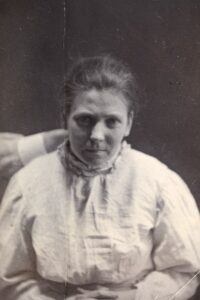
Alice Maud MOUND
1878-1913
Author’s note: we researched this story at the request of a family member, Shaun Crump, whose own research had found that Alice, her husband Philip, and his mother Emily had all died in the Epsom cluster of mental hospitals. Alice is the only one who is buried at Horton, but we are including information on Philip and Emily for completeness. We are very grateful to Shaun Crump for his tremendous help, which included a trip to the London Archives.
Early years
According to the official record, Alice was born at 29 Sidney Street, Islington, on 1 March 1878 (that date was exactly 6 weeks before registration of the birth on 12 April, and in these cases we sometimes find that the birthdate has been falsified to avoid a late registration fine.)
She was the youngest of four children born to Charles Gilbert, a picture frame maker, and his wife Ellen Eliza Waites. Alice’s siblings were Charles, Ellen, and Henry.
By the time of the 1881 census, just two years later, Alice’s parents appear to have separated. Her mother Ellen was living in Pulteney Street, Islington with her children and her sister Jane, while husband Charles was lodging with relatives in Berwick Street, Westminster.
In the mid-1880s Ellen Gilbert formed a relationship with William Parish: he was a witness to Alice’s sister Ellen’s marriage in 1887. In the 1891 census, Ellen is recorded as his wife, and Alice and brother Henry as his stepchildren.
Marriage, and a daughter
In 1897, Alice married Philip Augustus Mound, a gilder (carvers & gilders were the traditional makers of ornate picture frames). Alice was 19. Philip, a widower, was 29 and had a daughter Jessie (then aged 6) from his previous marriage.
Alice gave birth to a daughter, Phyllis Alicia in 1898.
Philip appears in London directories 1895-1900 at 18 Windmill Street. This is not the address on his marriage record or on Phyllis’s baptism record, so it is probably the address of his workshop.

At the time of the 1901 census, Alice, Philip and Phyllis were living at 66 Abbey Road, Kilburn, while Philip’s daughter Jessie was with his mother and sisters in their flat in Bendall House, Great James Street, Marylebone.
Hard times
We know from later medical records that things did not go well for Philip’s business in the 1900s, that they had little to eat, and that he was drinking heavily: “he drank in bouts of Rum & Ale” according to his mother.
We also know that Alice was suffering mental problems. She had contracted syphilis at some point (most likely from Philip who had been treated for syphilis around the time of their marriage) and in 1908 she had been diagnosed at Queens Hospital with General Paralysis of the Insane which is caused by late-stage syphilitic infection.
There are some curious entries in the 1911 census. Alice and Philip were residing with Alice’s sister Ellen and her husband Henry Ellis at 31 Pooles Park Road. To begin with, Henry Ellis included Alice and Philip on his census return as lodgers (with Philip’s occupation recorded as “Gilder”), along with Alice’s mother, and also a billiard marker named Francis Snelgrove.
Then he must have been told that Alice and Philip were completing their own household return, as he deleted them and reduced the number of rooms in his household from seven to five. Then on Philip’s own census return we see that he describes himself as a billiard marker rather than a gilder.
Daughter Phyllis, meanwhile, was living with her aunt Maud Studdert (Philip’s sister) in Lambeth, while stepdaughter Jessie was sharing a single room at 2 Moreton Place, Pimlico, with her grandmother Emily Mound and aunt Florence Mound.
Insanity
Around this time (April 1911) Philip received a blow to the head. This was information provided by his mother 12 months later, and we do not know the circumstances. However we do know that on 23 April, Philip was admitted to the infirmary at St John’s Road workhouse in Islington, and that from there he was sent to Claybury Asylum, where he remained for nearly three months.
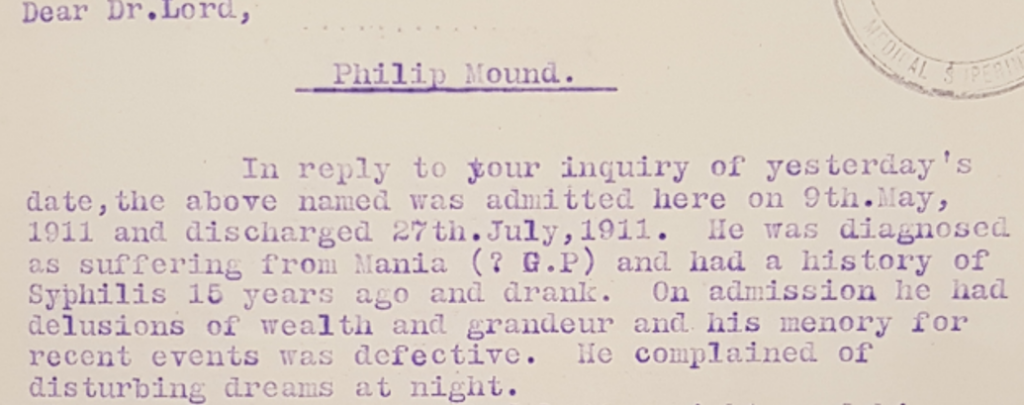
Eight months later, on 25 March 1912, Alice was admitted to the Fulham Road Workhouse and from there she was sent to the Manor asylum on 6 April. This seems to have had a profound effect on Philip who was himself admitted to the workhouse a week later, and from there transferred to Horton asylum on 22 April. The asylum records for both Alice and Philip show that they had been most recently living at 2 Moreton Place in Pimlico – where Philip’s mother, sister, and daughter Jessie had been living in a single room per the recent census.
The medical officer’s report on Alice’s insanity states that she was
very vacant in manner, foolish and simple in her conversation. No idea of time or place. Dirty in her habits. Has to be dressed and constantly attended to. Never occupies herself and very resistive when attended to.
At Manor, the cause of her insanity was recorded as acquired syphilis, and contributory factors were privation, starvation, prolonged mental illness, and vascular disease of the heart.
Visitors
The asylum address book notes that Alice received visits from her mother, her brothers and their wives, her sister, and two aunts.
Death
Alice died at Manor asylum on 17 September 1913. The recorded cause of death is surprisingly precise in the duration of her illness: “general paralysis of the insane, 5 years, 5 months and 11 days”. She was just 35 years old, and a widow, since Philip had died at Horton asylum the year before. Alice was buried at Horton on 22 September 1913 in plot 763b.
Philip Augustus Mound
1868-1912
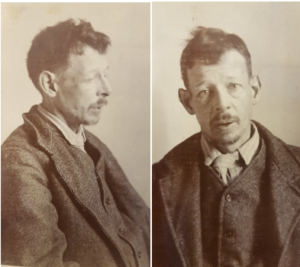
Philip photographed at Horton in 1912. Images courtesy of Shaun Crump
In Alice’s story we have recounted what we know of Philip’s life after their marriage in 1897 until his admission to Horton asylum in 1912. This piece is about the beginning and the end of his life.
Early Years
Philip was born on 27 January 1868 in Kentish Town. His parents were Robert Augustus Mound, a master carver & gilder, and Emily Harknell Hartgrove. He was the eldest of 7 children: his siblings were Edith, Sidney, Florence, Oscar, Ernest (died 1893 aged 13) and Maud.
In adulthood, Philip, Sidney and Oscar all followed their father into the trade of carving, gilding, and picture framing.
Philip’s first wife and child
In the late 1880s, Philip formed a relationship (we have not been able to find a marriage) with Jessie Schröter (née Braham), an operatic chorister and widow of the musician and composer Max Schröter, who had died in 1886. Philip’s father had been a witness at Max and Jessie’s marriage in 1881.
In the 1891 census, Philip and Jessie are at 66 Huntley Street in St Pancras, with Jessie’s son Max Schröter (10) and their new-born daughter who was then just one day old (Philip’s mother had been present at the birth).
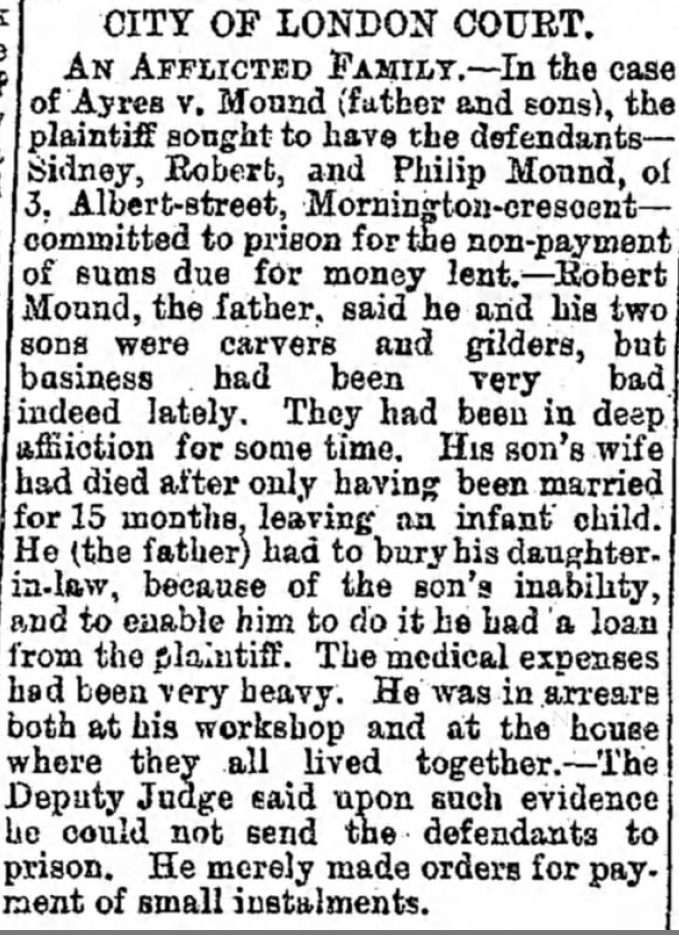
Sadly, Jessie died just over two weeks later from typhoid fever. Philip’s father Robert registered the death and organised her funeral (see press cutting below).
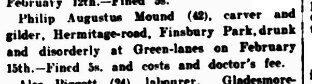
We know from this 1892 press report that business was not going well for the Mound family at the time:
Adult baptism
In 1894, at the age of 26, Philip was baptised at St Pancras parish church in Euston Road.
1897-1912
We’ve covered Philip’s life from 1897 to 1912 in Alice’s story above
Admission to Horton asylum
Philip’s mental state on admission to Horton in April 1912 was summarised as follows:
Consciousness is clouded, he is confused & thinks he is back at Claybury, comprehension is imperfect, association of ideas is incorrect & incomplete, reasoning powers are absent, memory is impaired & events are given in confused order, conversation is impossible & he is quite incoherent & gives no sensible answers. He is in a condition of acute mania & talks incessantly, absolute nonsense all the time. He is restless, noisy, destructive. All his movements are grossly exaggerated & his conduct uncontrolled, he is highly suggestible & everything distracts his attention when a question is forced on him, he seems unable to think, he rhymes, plays with words & shows marked flight of ideas. Hallucinations are probable but uncertain. He refuses his food & wants hand feeding with liquids.
Death
Philip died at Horton on 5 July 1912, from general paralysis of the insane. He was buried at Morden on 10 July.
Emily Mound
1849-1916
Philip’s mother Emily was admitted to Long Grove asylum from Fulham Road infirmary in November 1912 and died there from arterio-sclerosis on 13 September 1916. She was buried at Kensal Green cemetery.
Emily’s death was registered by her daughter Lily (Florence Lillian). In the 1921 census, both of Philip’s children (Jessie and Phyllis) were living with her in Maida Vale.