#5 West Park Asylum
West Park Asylum Epsom Cluster #5
- Construction: begun before the First World War; principal works resumed after the war
- Patients admitted: from 1921
- Formally opened: 20 June 1924
- Completed: remaining major buildings completed by 1926
- Main hospital closed: 2002
- Architect: William Charles Clifford Smith
- Original authority: London County Council
- Designed capacity: 2,096 patients
- Wards: 45
- Site: approximately 83.5 acres
- Original name: West Park Asylum
- Later names: West Park Mental Hospital; West Park Hospital
- Epsom Cluster: No. 5 – the fifth and final hospital of the Cluster
- Architectural plan: Modified compact-arrow arrangement with detached ward blocks and villas
The last great asylum at Epsom
West Park was the final piece of the extraordinary hospital complex created by the London County Council on the former Horton Manor estate.
By the time its first patients arrived, the Manor, Horton, Ewell Epileptic Colony and Long Grove had already transformed this part of Epsom.
West Park would complete the Cluster.
Planning for the fifth hospital began in 1906, with William Charles Clifford Smith responsible for the scheme. He was already closely connected with the development of the estate, having designed both the Manor and the Ewell Epileptic Colony.
The scale of West Park was enormous.
It was designed with 45 wards and accommodation for 2,096 patients, spread across approximately 83.5 acres.
It would become the eleventh psychiatric hospital opened by the London County Council – and its last great asylum.
A different version of the asylum plan
Although West Park shared characteristics with Horton and Long Grove, it was not simply another copy of them.
The hospital was arranged in a broad, curved arrowhead formation.
Its ward buildings were separate rather than being joined by the long main corridor characteristic of the earlier compact-arrow hospitals. Central services occupied the middle of the complex, while other accommodation was distributed around the site.
The wards were generally two storeys high and constructed in red brick with reinforced-concrete floors.
Beneath the hospital ran approximately one and a half miles of service tunnels, carrying the infrastructure needed to sustain an institution accommodating more than 2,000 people.
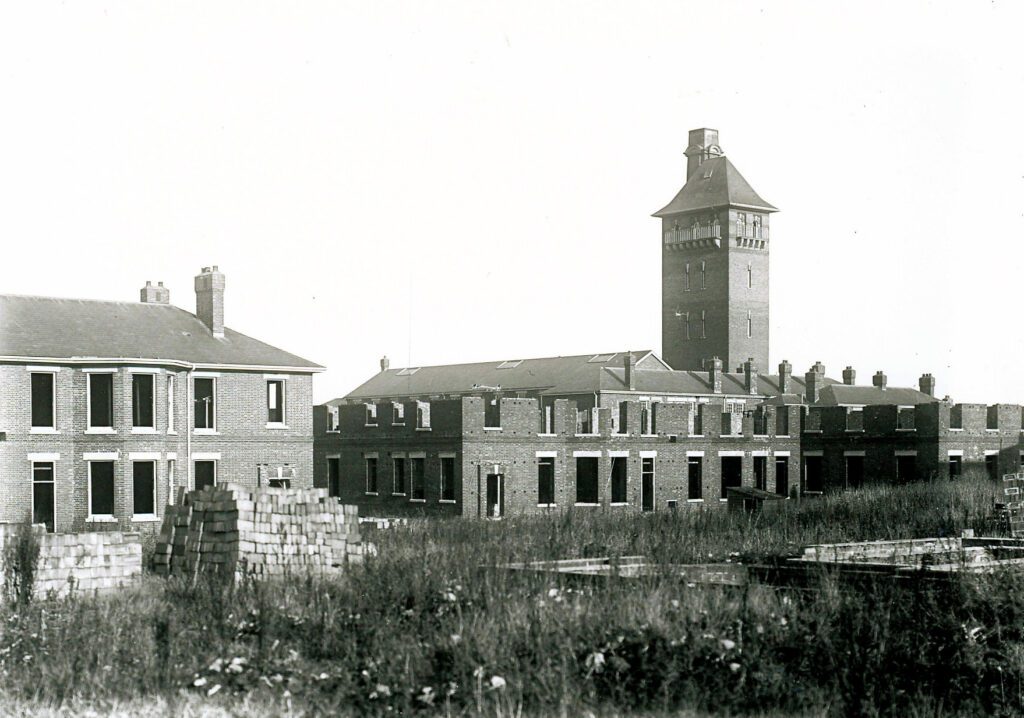
Dominating the complex was one of West Park’s most recognisable structures: its combined water tower and chimney.
Historic England records that the tower was designed in 1909 and constructed between 1913 and 1921 to Clifford Smith’s design.
The six-storey structure contained three large water tanks with a combined capacity of 25,000 gallons.
Unlike most of the former hospital, the water tower survives and is Grade II listed.
A hospital interrupted by war
West Park’s construction did not proceed as planned.
The intention had been for the new asylum to open in 1916.
Then came the First World War.
Building work was halted and the parts of West Park already constructed were taken over for military purposes. The Canadian military used completed buildings during the war, while construction of the asylum itself effectively came to a standstill.
The interruption lasted for years.
By November 1915 work had completely stopped, and materials and contractors’ equipment were subsequently removed for government use. It was not until October 1920 that the decision was made to resume construction.
West Park therefore became something unusual among the Epsom Cluster hospitals: an asylum whose construction straddled the First World War.
The institution conceived before the conflict would finally receive its patients in a very different Britain afterwards.
The railway reaches West Park
Completing an institution of this scale required huge quantities of building materials.
Fortunately, the London County Council already possessed a solution.
The Horton Estate Light Railway, originally developed in connection with the construction of Long Grove, was extended to West Park.
The final section reaching the water tower was completed in February 1921.
For the next three years, much of the railway’s traffic consisted of construction materials and equipment destined for the new hospital. Once building work was complete, the railway continued carrying coal and other supplies for the hospitals of the Cluster.
The railway therefore provides another physical link between Long Grove and West Park.
A system developed to help build the fourth hospital became instrumental in completing the fifth.
The first patients arrive
The chronology of West Park’s opening requires some explanation.
The hospital began receiving patients from 1921, before the entire complex was finished.
Construction continued around them.
The formal opening ceremony did not take place until 20 June 1924, when West Park was officially opened by John Wheatley MP, Minister of Health.
Even then, work was not entirely complete.
The infirmary, female acute wards, a male farm villa and the chapel were among the buildings completed during the following two years. Historic England consequently describes the hospital as being fully open by 1926.
This explains why different histories give apparently conflicting opening dates of 1921, 1924 and 1926.
They describe different stages in the same process:
1921 – patients began to be admitted.
1924 – the hospital was formally opened.
1926 – the remaining principal buildings had been completed.
More than 1,700 patients
West Park filled rapidly.
By 13 November 1925, 1,720 patients had been admitted.
Of these, 1,117 had been transferred from other institutions, while 603 had been admitted directly.
At that point they were under the care of six doctors and the Medical Superintendent.
Within only a few years, West Park was operating at the scale for which it had been conceived.
By 1931, recorded patient numbers had exceeded 2,100.
Like Horton and Long Grove, West Park had effectively become a small institutional town.
Life beyond the locked ward
West Park also opened during a period when some ideas about psychiatric care were beginning to change.
The traditional asylum remained a custodial environment, with locked wards, controlled entrances and restrictions upon patients’ movement.
But the so-called “open door” system was beginning to make an appearance.
By 1925, West Park had four open wards.
Forty-three male patients were permitted to leave the hospital grounds on parole, while another 219 were allowed to move freely within the grounds.
By 1928, ten wards were operating on an open basis.
This did not make West Park an open institution in the modern sense. Most patients remained subject to the legal and institutional controls of the period.
But it provides evidence of changes beginning within psychiatric hospitals even while the great asylum system was still expanding.
West Park Mental Hospital
In 1929, West Park Asylum became known as West Park Mental Hospital.
The change of name anticipated wider changes in mental-health law.
The Mental Treatment Act 1930 introduced voluntary admission to public mental hospitals and formally moved terminology away from the language of “asylums”.
The buildings remained the same, but the system in which they operated was beginning to change.
West Park, despite being the newest of the Epsom Cluster institutions, had been conceived under the old asylum system just as that system itself was beginning a long transformation.
Another war, another wave of patients
The outbreak of the Second World War placed enormous pressure upon the Epsom Cluster.
Horton Mental Hospital was requisitioned for the Emergency Medical Service, requiring its existing psychiatric patients to be moved elsewhere.
West Park was one of the hospitals expected to absorb them.
In the space of just two days, 400 patients were transferred from Horton to West Park.
West Park’s population rose to approximately 2,500, creating severe overcrowding.
At the same time, the hospital had to prepare for war.
Air-raid shelters and blast walls were constructed. Blackout curtains were installed and windows treated to reduce the danger from shattered glass. Sanatorium buildings were converted to other purposes, while the isolation hospital became a decontamination unit.
Ward arrangements were altered so that patients could sleep downstairs during air raids, further reducing the space available during an already overcrowded period.
The Maudsley comes to West Park
The war brought another important arrival.
The Central Pathological Laboratory of the Maudsley Hospital was evacuated from south London and relocated to West Park.
Finding space for it was difficult because the hospital was already coping with the influx of patients from Horton. The laboratory was eventually accommodated in one of West Park’s male wards.
For a hospital already operating beyond its intended capacity, the war therefore brought not only hundreds of additional patients but new medical functions as well.
West Park and the NHS
On 5 July 1948, the National Health Service came into existence.
West Park passed from London County Council control into the new NHS system.
The hospital remained very large.
Local historical figures record 2,174 patients in 1948, rising to approximately 2,545 in 1950. The published figures are themselves described as approximate and incomplete, so they should be treated as indications of scale rather than exact census totals.
What they demonstrate clearly is that the great institution created before the First World War remained heavily populated well into the NHS era.
But that would not last.
The asylum system begins to disappear
During the second half of the twentieth century, psychiatric care increasingly moved away from long-term treatment in enormous institutions.
West Park began to shrink.
By 1971 the hospital had 1,724 beds and approximately 1,580 patients.
In 1975 there were around 1,600 beds.
By 1979 the figure had fallen to 1,217.
The decline reflected a much wider transformation in British mental-health care.
The institution built to accommodate more than 2,000 people was gradually becoming unnecessary for the purpose for which it had been designed.
The last of the Cluster closes
The main West Park Hospital closed in 2002.
That date requires the same care as its opening date. Some healthcare services continued on parts of the wider site afterwards, which explains why later dates can sometimes be found for the final end of hospital use.
But the closure of the main psychiatric hospital in 2002 brought the working life of the fifth Epsom Cluster institution effectively to an end.
For a time, the enormous complex stood largely empty.
Much of it was eventually demolished as the site was redeveloped, although a number of buildings survived or were converted to new uses.
Most conspicuous among the survivors is Clifford Smith’s water tower, now protected as a Grade II listed building.
The end of an extraordinary experiment
West Park was the last of the five Epsom Cluster hospitals.
Its completion brought to an end a project begun when the London County Council purchased the Horton Manor estate in 1896.
Across that estate had risen five institutions:
The Manor.
Horton.
Ewell Epileptic Colony.
Long Grove.
West Park.
Together they provided thousands of beds for people sent from London and elsewhere.
West Park’s own history reflects how rapidly that system changed.
It was planned in the Edwardian period, interrupted by the First World War, formally opened in the 1920s, overcrowded during the Second World War, incorporated into the NHS in 1948 and eventually emptied as Britain moved away from large psychiatric institutions.
But closing the hospitals did not erase the lives of the people who had lived within them.
From West Park to Horton Cemetery
Patients died at West Park throughout its long history.
For those whose burial was arranged through the Epsom Cluster, Horton Cemetery could become their final resting place.
There they joined people from the Manor, Horton, Ewell and Long Grove.
That makes the cemetery something the five hospitals themselves can no longer provide.
The Manor has largely disappeared. Horton has been redeveloped. Much of Long Grove and West Park has gone. The surviving buildings at St Ebba’s represent only part of what once stood there.
And, as we have discovered particularly with Long Grove, the documentary record can also disappear.
Horton Cemetery physically connects all five institutions.
Its burial register brings together people who had been divided in life between different hospitals, wards, diagnoses and classifications.
Today, the work of the Friends of Horton Cemetery is helping to recover those people as individuals – tracing their names and, wherever surviving evidence allows, reconstructing the lives that existed before and beyond their admission to the Epsom Cluster.
West Park was the final hospital to complete that Cluster.
Its closure marked the approaching end of the institutional system.
The people buried at Horton remain part of its history.