#4 Long Grove Asylum
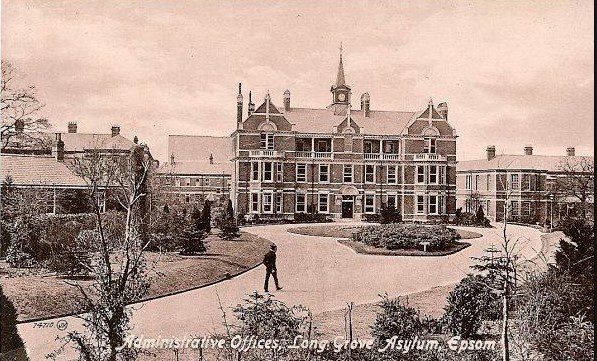
Long Grove Asylum Epsom Cluster #4
- Built: 1903–1907
- Opened: June 1907
- Closed: 1992
- Architect: George Thomas Hine
- Original authority: London County Council
- Capacity: approximately 2,149 patients
- Original name: Long Grove Asylum
- Later names: Long Grove Mental Hospital; Long Grove Hospital
- Epsom Cluster: No. 4 – the fourth hospital of the Cluster to open
- Architectural plan: Modified compact-arrow plan, based closely upon Horton Asylum
- First Medical Superintendent: Dr Charles Hubert Bond
The fourth hospital of the Epsom Cluster
By the time work began on Long Grove Asylum in 1903, the transformation of the former Horton Manor estate was well under way. The Manor had opened in 1899, Horton in 1902 and the Ewell Epileptic Colony in 1903.
The London County Council was not finished.
A fourth enormous institution was planned to the west of Horton Asylum, capable of accommodating more than 2,000 additional patients from London.
Construction took four years and Long Grove opened in June 1907 as the Tenth London County Asylum and the fourth hospital of what became known as the Epsom Cluster.
The name came from an area of woodland on the estate.
George Thomas Hine returns to Epsom
The architect was George Thomas Hine, who had already designed Horton Asylum nearby.
Long Grove was based closely upon Horton’s compact-arrow or échelon plan. Reusing an established design also enabled the London County Council to progress the project more quickly than developing an entirely new asylum plan.
It was not, however, an exact copy.
Historic England’s survey of Surrey hospitals records that Hine made a number of changes to the Horton design. The administration building was placed on the opposite side of the complex, and Long Grove incorporated a greater number of detached villas within its grounds.
About 500 patients were accommodated in villas rather than within the main interconnected hospital complex.
The result was an institution combining the huge scale of a conventional asylum with elements of the more dispersed villa system.
An abandoned plan for something different
Long Grove might originally have looked very different.
Architectural research records that the London County Council initially considered constructing the hospital using a more extensive villa system, with patients distributed among separate buildings rather than concentrated within a large asylum complex.
Those plans were abandoned.
Unlike the uncertain connection we encountered when examining the history of the Ewell Epileptic Colony, the architectural history of Long Grove specifically records the fatal Colney Hatch Asylum fire of January 1903 as influencing this decision.
The fire destroyed temporary wards at Colney Hatch and killed 52 female patients.
Following the disaster, the London County Council urgently needed replacement accommodation. Rather than proceed with an entirely new villa-based design at Epsom, it returned to George Thomas Hine’s existing Horton plan, which could be adapted for Long Grove.
Historic England’s survey records that:
“The need to build replacement accommodation as quickly as possible forced the LCC to repeat G. T. Hine’s échelon-plan”
Long Grove therefore provides a much clearer connection with the Colney Hatch disaster than can presently be established for the Ewell Epileptic Colony.
The resulting hospital retained elements of the villa principle, but its core was based upon the already proven Horton design.
Building another asylum the size of a town
Constructing Long Grove was an enormous undertaking.
The foundations were laid by Charles Wall Ltd, while the contract for the buildings above ground was awarded to Foster & Dicksee Ltd in October 1904.
At the height of construction in 1905, around 1,100 men were employed on the project.
Approximately 900 workers were recruited from London’s unemployed and travelled from Waterloo each day on special trains.
Getting the workforce to Epsom was only part of the problem.
The construction of the earlier hospitals had demonstrated how difficult it was to transport the vast quantities of bricks, cement, coal and other materials required for institutions of this scale along the local roads.
For Long Grove, the solution would permanently change the infrastructure of the entire Epsom Cluster.
The railway built for Long Grove
The contractors obtained authority to construct a railway connecting the building site with the London & South Western Railway at West Ewell.
The first trainload of bricks and cement arrived in April 1905.
A steam locomotive carried materials from the railway sidings to Long Grove, while a network of smaller tramways distributed building supplies around the construction site.
The railway had initially been created to solve the enormous logistical problem of building Long Grove.
But it proved too useful to disappear.
After construction was completed, the line was retained by the London County Council and developed into the Horton Estate Light Railway, supplying the hospitals of the Epsom Cluster with coal and other goods.
Long Grove therefore left a physical legacy extending well beyond its own boundaries.
A railway created to build one asylum became part of the infrastructure serving an entire hospital community.
Inside Long Grove
Long Grove was designed as a largely self-contained institution.
A central axis contained the principal service buildings, including the administration block, recreation hall, kitchens and main stores.
Male and female staff accommodation stood nearby.
A broad system of corridors connected the principal patient wards, while separate buildings within the grounds included infirmary and parole accommodation.
There was also a detached chapel, housing for senior staff and officials, workshops and an isolation hospital.
As at the other hospitals of the Epsom Cluster, the institution was divided substantially along gender lines.
The scale was considerable.
Surrey History Centre records that Long Grove accommodated 2,149 patients.
By the 1911 Census, only four years after opening, the hospital had more than 2,100 patients.
It was, in effect, another institutional community built on the former fields of the Horton Estate.
Dr Charles Hubert Bond
Long Grove’s first Medical Superintendent was Dr Charles Hubert Bond.
His name already forms part of the history of another Epsom Cluster institution.
Bond had been the first Medical Superintendent of the Ewell Epileptic Colony, taking charge when it opened in 1903.
In 1907 he moved across the estate to become Medical Superintendent of the newly opened Long Grove Asylum.
He remained at Long Grove until 1912.
Bond subsequently became a Commissioner in Lunacy and later a Commissioner of the Board of Control, becoming an influential figure in the administration of mental-health services in Britain.
His movement from Ewell to Long Grove also illustrates how closely connected the institutions of the Epsom Cluster could be, despite each having its own administration and patient population.
The women kept in isolation
One of the most troubling chapters in Long Grove’s history concerned women identified as typhoid carriers.
A person could recover from typhoid fever while continuing to carry and excrete the bacteria responsible for the disease, potentially transmitting the infection to others.
Before effective antibiotic treatment became available, this created a serious public-health problem.
Long Grove was the only hospital within the Epsom Cluster to accept such carriers.
Historical research has identified at least 43 women who were held in a secure isolation villa at Long Grove during the hospital’s existence.
Strict infection-control measures were used. Staff entering and leaving the unit followed barrier-nursing procedures, and toilets were flushed with boiling water in an attempt to limit transmission.
But isolation intended to protect public health could become extraordinarily prolonged.
Some of the women remained confined even after effective antibiotic treatments became available. Questions have subsequently been raised about the legal basis for their detention and whether some remained institutionalised unnecessarily.
In 2008, a BBC investigation brought renewed attention to their treatment and the conditions in which they had lived.
Their story is an uncomfortable reminder that Long Grove’s history cannot be understood simply through its architecture or medical intentions.
It must also include the experiences of the people who were confined there.
War comes to the Cluster
Unlike Horton, Long Grove was not emptied and converted into a military hospital during the Second World War.
Instead, it became one of the institutions required to absorb patients displaced from elsewhere.
When Horton was taken over for wartime medical use, patients were transferred to other hospitals, including Long Grove.
The war also brought another group of patients whose presence would remain visible long after hostilities ended.
Long Grove received substantial numbers of Polish patients.
Their connection with the hospital continued into the post-war years. Surrey History Centre records that around 300 Polish patients remained at Long Grove in 1951.
The surviving hospital archive includes records relating to this period and to patients transferred during the war.
From asylum to hospital
The institution’s name changed as terminology surrounding psychiatric care changed.
Long Grove became Long Grove Mental Hospital in 1918 and later Long Grove Hospital in 1937.
The creation of the National Health Service in 1948 brought another fundamental change.
On 5 July 1948, responsibility for Long Grove passed from the London County Council to a Hospital Management Committee under the South West Metropolitan Regional Hospital Board.
The institution that had been created as one of London’s vast county asylums was now part of the NHS.
But its population remained enormous.
Surrey History Centre records more than 2,000 patients during the post-war period, while local historical figures indicate that patient numbers remained above 2,000 into the 1960s.
A hospital begins to shrink
During the second half of the twentieth century, psychiatric care increasingly moved away from the large institutional model represented by Long Grove.
The hospital gradually contracted.
By 1971, Long Grove had 1,625 beds but 1,373 patients. By 1979 there were 1,183 beds, and by 1985 the number had fallen to around 750.
New forms of treatment and care developed alongside this decline.
By 1971, for example, a 36-bed Regional Adolescent Unit had been established at Long Grove.
The hospital was changing from the enormous institution that had opened in 1907, but its Victorian and Edwardian buildings had been designed for a system of psychiatric care that was itself disappearing.
The end of Long Grove
Long Grove Hospital finally closed in 1992, after 85 years.
Surrey History Centre records that its role was replaced by a smaller unit at Tolworth Hospital.
The abandoned buildings remained for several years.
Much of the former hospital was subsequently demolished, while a number of significant buildings were retained and incorporated into the Clarendon Park residential development.
Among the surviving structures is the former administration building, now known as Prospect House, with its prominent clock tower.
Parts of the landscape also survived, including mature trees and open spaces associated with the former hospital.
The Epsom and Ewell Borough Council designated the surviving core as the Long Grove Conservation Area, recognising the architectural and historic significance of what remains.
From Long Grove to Horton Cemetery
Long Grove existed for 85 years.
During that time thousands of people passed through its wards. Some stayed briefly; others spent many years within the institution.
And some died there.
For many of those whose burial was arranged through the Epsom Cluster, Horton Cemetery became their final resting place.
A history made harder to recover
For Long Grove in particular, recovering the stories of those people presents a serious problem.
Very few of the hospital’s original patient records are known to survive.
No substantial collection of Long Grove patient case books has been discovered. What has been located amounts to little more than a small number of surviving loose pages and fragments which were stored at another asylum due to patient transfers.
The case books and other hospital records were disposed of during the redevelopment and demolition of the former Long Grove site.
Their loss matters.
Case books can contain far more than an admission and discharge date. Depending upon the period and institution, they can preserve personal histories, medical observations, photographs of the patients, correspondence and details of a patient’s life before and during their time in hospital.
When records such as these disappear, part of the history of the people themselves disappears with them.
For the Friends of Horton Cemetery, that makes the task of recovering the stories of people from Long Grove considerably more difficult. Their lives must instead be reconstructed wherever possible from other surviving evidence – burial records, civil registrations, census returns, newspapers, military records and genealogical research.
The buildings of Long Grove have largely disappeared.
So too have many of its records.
Horton Cemetery is therefore more than simply the place where many Long Grove patients were buried. For some, it is one of the few surviving physical records that they were ever there.
Recovering their names and piecing together their stories gives those individuals something the destruction of their hospital records took away: a place in the historical record.