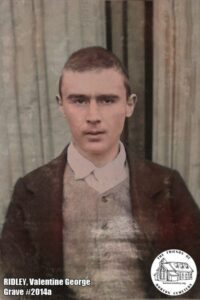
Valentine George RIDLEY
b.1892-d.1916
Valentine’s family
Valentine’s birth was registered in the 1st Q of 1892 in Greenwich, Kent.
No baptism certificate has been found to confirm his DOB or mother’s name but throughout his story his father is shown as George Ridley.
Valentine is the first of four children. His siblings were:
- Elizabeth (May) registered 1stQ 1894, no baptism certificate found.
- Mildred (Maud) 1895 – 1907, no registration or baptism certificate found.
- Florence Maude 1897- 1898 both events registered in Greenwich. She was baptised at St James Church, Hatcham, Lewisham, Kent on 1st July 1897.
The Work House
At just 6 years old, in 1897, we find Valentine and his sister Elizabeth in the Greenwich Union Poor School. Their father George is “in house”, that is, living in the workhouse. There is no mention of Valentine’s mother or his younger sisters. Later in October Elizabeth is released ‘c/o Father’.
In May 1898 Valentine and all three of his sisters were admitted, along with their father, to the Greenwich Union Work House, their address is given as Snead Street, New Cross which is shown on Booth’s Maps as “comfortable” two storey houses, with bay windows, usually shared by two families. Sadly, by August of that year Valentine was in the Brighton Road, School, Sutton. His father is now shown as ‘out of house on leave’. In June of this year Valentine’s youngest sister, Florence, was transferred to the Work House Infirmary where she died in October 1898, having lived a short sad life, so possibly George’s ‘leave’ was due to this event.
Periods of leave were granted to look for work, deal with family problems or celebrations. Someone like Valentine’s father George, became known as an “in and out” as they spent their lives in and out of the workhouse/infirmary.
The 1900s
The 1901 Census, taken on 31st March, shows all three children in the Banstead Road School, Sutton, but on 23rd Dec 1901 Valentine, Elizabeth and Mildred are discharged from the Brighton Rd School and returned to the Workhouse again. These two schools were run by the same authority and seem almost interchangeable.

The South Metropolitan School District, formed by an order of the Poor Law Board dated 12 March 1849, comprised at the date of its formation the St. Olave’s Union and the Parishes of St. Mary Magdalen, Bermondsey, St. Mary, Rotherhithe, and St. Giles, Camberwell. The Greenwich Union was added in October 1849.
Land for the Brighton Road School was purchased in 1851, the main building was erected in 1852-55 (a portion of it was destroyed by fire in 1856), and occupied from April 1855 to September 1902. Further land was purchased and additional buildings erected during the period 1865-1894. Land for the Banstead Road School was purchased in 1880, the building was erected in 1882-84, and occupied from September 1884 to May 1902.
Excellent information about life in the Workhouse, Infirmary and Schools is available on this website.
https://www.workhouses.org.uk › life › entry
On 28thOctober 1901 records show that Valentine and Elizabeth were admitted to the Frankham Street School, Lewisham by their father who, apparently, had no idea of their birth dates but it does say that they were living at 14 Hosier Street, Lewisham which Booth Maps say is “poor, labouring class”.

The Ewell Epileptic Colony
Thereafter we hear nothing more about Valentine’s life until, on 18th November 1909 he is admitted to the Ewell Epileptic Colony where he lived for the next 7 years. According to the 1911 Census he developed Epilepsy when he was 16 years old, just one year prior to being admitted. With no family to care for him we can assume that the Greenwich Union was happy to pass his care to the Epileptic Colony in Ewell.

On admission the doctor states that he is in good condition with a placid expression, brown eyes and dark hair. There are no signs of consumption; early signs of vascular changes are noted but “no other medicals problems”.
His mental state is assessed as generally good but with slightly impaired attention and his reasoning powers are “impaired by weak mindedness and confusion.” He does not suffer hallucinations or delusions but his sociability and sense of
propriety is poor.
The medical reports states that he “suffers from Epileptic fits. Very strange in manner before and after.” He “throws his bread and butter about the ward and rubs it on his face” The attendant reports that he wanders aimlessly about the ward
talking to himself. It is also noted that he has “cardiovascular degeneration”.
His father, George Ridley (inmate) of the Greenwich Union WH, is given as his next of kin. George gives his Valentine’s date of birth as 1893; he says all was well until Valentine was sixteen when he developed Epilepsy. Of his four children only Valentine and one sister are still living.
Valentine says that he never knew his mother or any other relatives, his father always told him that his mother “ran away.”
He and his sisters were brought up in the workhouse before being sent to the Sutton School aged 5yrs where he reached the 5th standard. He now reads slowly and with effort. He says that he learnt shoe making at the Sutton school and
wishes to continue the work here.
By December we find Valentine settled, and “working well in the shoe shop, he has gained in self confidence.”
January 1910…His seizures are few and mild and he is content and well behaved, but in February they have increased and he is “pale and pinched.” However he improved again but by May he is “dull and depressed and hardly associates with
other colonists.”
October 1910… report of S.R.C in L “An imbecile suffering from Epilepsy. Dull, nervous and weak minded. Memory poor, keeps to himself”.
In November we find Valentine working on the farm but he is reported with a “black eye following a fight with another colonist”. His fits continue to increase throughout 1911 until in August he is said to be “still working on the farm but “not of much use.” Following a “batch of fits” later that same month he became restless and was moved to a side ward and then
transferred to Pine (hospital ward).
In October of that year his reports show that he is deteriorating and notes “he cannot give the date” *considering his illness and the life he leads is it surprising that he doesn’t know what the date is! ) Although physically he is still in fair health.
Valentine contuse to work on the farm but is “of little use,” he is spending more time in and out of the hospital as his fits are still increasing and they leave him “quarrelsome.”
* I have seen from other records that troublesome patients are often put to bed in the hospital ward to stop them upsetting the ward. The final entry says “at his best he is a “willing but poor worker.” Sadly at this point we once again find “new ledger” written in his notes leaving us with a blank of 4yrs until his death. However, there are some loose notes available
so hopefully we will be able to fill some of the gap when we can access them.
Valentine Dies
Valentine died on 21st February 1916 and was buried in the Horton Estate Cemetery on 25th February in plot number 2014a, he was just 23yrs old.

2014a Colony Ridley Valentine George 23yrs 25 Feb 1916
The ‘Epsom Colony’, part of the Epsom Cluster of five mental hospitals’ had been opened in 1903 to care for “the Epileptic insane of the Metropolis”. This new approach housed patients in a collection of villas, avoiding the stigma of living in a mental asylum. The treatment consisted of a specially regulated diet and doses of potassium bromide, the first effective treatment for controlling epilepsy. The patients were expected to contribute to their costs by working on the hospital farm or in the kitchens, laundry or bakery, all of which supported the Epsom cluster of hospitals.
A sad and complex family
This is a sad and complex family. Valentine’s father George Ridley was born in Brighton and registered in Lewes, Sussex in 3rdQ 1848.
His parents were William, born in Northumberland (1810-1875/8) and Margaret Reed born in Cumberland (1808-1875). They married in St Philip’s Church, Liverpool on 14th June 1838 and had their first child, William Robert there in 1839.
A daughter, Elizabeth, followed in 1843 by which time they were living in Hull where they also had their son John James in 1847, before finally moving to Brighton, Sussex where George was born,
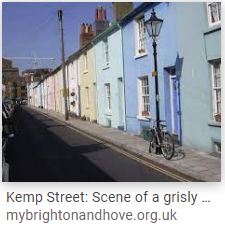
In the 1851 Census they are living in Kemp Street, Brighton. Only their two sons are shown on the census. William is shown as an Engineer.
They continue to live in Kemp Street and in the 1861 Census we see that John James is following in his father’s trade as an engine fitter.
William and Margaret continued to live in Brighton until their deaths.
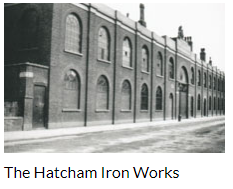
The 1871 Census shows that George is now also an engine fitter and he and his brother have moved to Deptford, Greenwich where they are lodging at 2, Pomeroy Place, Pomeroy Street, Deptford. According to Booth’s poverty maps this was a mixed/fairly comfortable area. Pomeroy Street came off the Old Kent Road and “had several courts off it” presumably including Pomeroy Place. There were also two Iron works. Hatchams Iron Works built steam engines and probably gave work to the local residents including George and his brother.
At some point John James moves on, possibly to marry, and in 1881 George is lodging alone at 10, Sidmouth Place, Greenwich, another mixed/poor area down by the Deptford Creek, surrounded by heavy, polluting industry, and then in 1886, aged just 38, we find him ‘destitute, no home’, admitted to the Greenwich Union Infirmary. In 1889 he apparently lived at 3, Creek Street, Greenwich but is shown ‘discharged supposed insane’ from the Infirmary.
On 27th June 1891 George, now 42 years old, marries Mary Anne Maria Pennell, aged 21, at All Saints Church, Hatcham, London. He is shown as an ‘Engineer’ and his father’s name is given as William.
Hatcham was a manor and later a chapelry in what is now London, England. It largely corresponds to the area around New Cross in the London Borough of Lewisham. The ancient parish of Deptford straddled the counties of Surrey and Kent and there came to be a doubt about which county jurisdiction the manor of Hatcham came under. In 1636, the matter was settled by placing it entirely within Surrey. Hatcham became part of Deptford St Paul when the parish was divided in 1730.
Thereafter we find no further mention of a Mary Anne Maria and George’s wife, when mentioned at all, is known as Mildred as here in August 1911.

Records show that from about 1897 George spent his life in and out of the Greenwich Workhouse and Infirmary. He is variously described as ‘destitute’ and ‘no home’. Sometimes he is alone, sometimes he has any number of his children with him ‘in house’. Sometimes his stay was brief but at one time he spent 2 years in the Infirmary/Workhouse.
In the 1901 Census George is in the workhouse and I have found a Mildred Ridley, aged 30, widowed and born in Norwich, Norfolk. She is a ‘foster mother’ at Hornchurch District Cottage Homes in Essex. I believe this to be the same person as Mary Ann Marie Pennell was born in 1870 in Norwich.
The 1910s finds George once again in the workhouse and this time we find a Mildred Ridley, now 37, born 1874 in Norfolk, widowed. She is working as an ‘Asylum attendant’ at the West Ham Borough Asylum, Ilford, Essex.
We can have no idea how long George and Mildred remained together. By 1911 two of their daughters were dead, one was in a children’s home and their son Valentine was in an Asylum. They seem to have had no sort of settled home life so perhaps it is not surprising that Mildred appears to have made a life for herself elsewhere. In 1912 George is again in the Greenwich WH Infirmary where he died on 1st September 1912.

Young Mildred fared little better. In and out of the workhouse and various poor schools she was eventually admitted to Greenwich and Deptford children’s home in Sidcup, Kent on 22nd July 1903. She died in March 1907 and was buried in St Mary the Virgins churchyard, Bexley, Kent on 6th March 1907.
Finally Elizabeth, for whom we cannot identify an exact date of birth but we know she was born in 1894, probably in Greenwich, Kent. Like her siblings she spent her entire childhood in the workhouse or poor schools until in the 1911 Census we find her, aged 16, as an inmate in Lambert House, Margate Rd, Ramsgate, Kent.


After that we have a number of possible marriages but without access to the 1921 Census, we have no way of checking which, if any, are our Elizabeth and so no way of finding her on the ‘39 Register and no death record. Let us hope that she, at least, had a better life.
Author’s note
I chose Valentine as my next subject because I thought that with a name like Valentine George Ridley it would be quite simple. How wrong I was.
Valentine’s parents seem to have had a reasonable start in life and George had a trade that was in high demand, but we see that he was already having problems at 38 which went on for the rest of his life. Could he also have suffered from Epilepsy or did the pollution of his work and living conditions affect his lungs?
Why did Mary Ann Maria marry a man twice her age? Why did she become Mildred? What did little Florence Maude and young Mildred die of? Where was the older Mildred throughout the ins and outs of the Work House/Infirmary. Where was Valentine between 1901 and 1909? And what happened to Elizabeth?
So many questions, I hope that when we can access Valentine’s hospital records some of these questions may be answered but I fear this is just one more fractured family. The saddest thing was seeing that George couldn’t tell the school his children’s birth dates and later the Workhouse and the Sidcup Home noted his place of birth was “not known”. I wonder if the children were able to keep any sort of connection.