Edwin SEATON
Edwin Seaton was buried at Horton on 25th September 1914 in Plot 1239b. Researching him, like many of the Horton patients, has been a challenge due to discrepancies in his age and a lack of records.
The first discrepancy I found was Edwin’s name. His case notes give his first name as Edwin but his death was registered as Timothy Edwin. I will refer to him throughout this story as Edwin.
Secondly Edwin’s age on admission was 44 (giving a birth year of approx. 1858), the death certificate gives his age as 71 (i.e. born approx. 1843) and the 1841 census gives his birth year as 1837.
And lastly, the case notes give his date of death as 21st September, but the death certificate states he died on the 19th. However, despite these differences, I believe this is the story of Edwin’s life.
Who was Edwin?
Timothy Edwin Seaton was born in Peterborough circa 1837 to Francis Michael & Mary Seaton (nee Meade).
At the time of the 1841 census, Edwin aged 4 is living in Boongate, Peterborough with his parents Francis & Mary and siblings John (14), Mary (12), Charlotte (8), Wiliam (6) and Emma (1). Edwin’s father is a butcher.
In the 1830s, Boongate was a “notoriously impoverished, semi-rural slum perched on the eastern edge of a rapidly changing Peterborough”. By the late 1840s/early 1850s, industrialisation and the railways had arrived causing the population to swell with a huge influx of labourers, navvies and ironworkers.
On the 1851 census, Edwin’s parents are still living in Boongate (with his siblings Charlotte, William, Emma, Alfred and Henry) but Edwin is not there and unfortunately, I have been unable to find him.
First Marriage and Children
We next come across Edwin on 8th January 1860 when he married Sarah HUNT at St. Mary, Islington. Edwin gave his address as 7 Little Cross Street and occupation as bricklayer. Sarah’s address was 15 Park Street. One of the witnesses was Edwin’s older brother, John Thomas. The following year finds the couple living in Arthur Terrace, Islington.
On 31st August 1861, Edwin & Sarah’s first child was born – he was named Edwin James and baptised on his birthday in 1862 at St. Mary, Islington. The baptism record gives the family’s address as Queen’s Road, Islington.
By the 1871 census, Sarah has given birth to three more children: Minnie (b1863), Emma (b1868) and Francis (b1870) and family had made their home at 9 Bolyn Road, Islington. Edwin is still working as a bricklayer. Sadly, in the 3rd quarter of 1872, Sarah died, followed in the 4th quarter by their son Francis.
How did Edwin cope with this double tragedy? It must have been very difficult for him to work and earn a living whilst looking after his two young daughters who were experiencing the pain of losing their mother and brother.
Second Marriage
On 21st December 1873, Edwin married Eliza GROOMBRIDGE at St. Mary, Islington. Edwin was still living at 9 Boylen Place and Eliza’s address was Arundel Place.
In 1875, Eliza gave birth to a son, Timothy Edwin but their joy was short-lived when he died aged 4 in 1880.
When the 1881 census was taken, Edwin & Eliza were living at 119 Boleyn Road with Edwin’s daughter Emma.
In 1882, Edwin finds himself in court for assaulting his wife, Eliza. I wonder why they quarrelled – was it about money, had Edwin been drinking or perhaps his health had started to decline?
Lloyds Weekly Newspaper – 26 February 1882
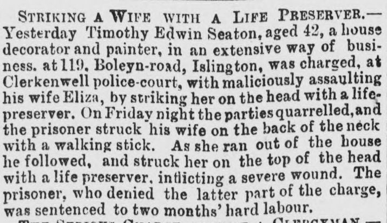
In Victorian Britain, a ‘life preserver’ as mentioned in the article above was the common term for a loaded bludgeon, club or cosh carried for self-defence against street muggers.
There was some good news in 1884, when Edwin’s eldest daughter, Minnie married Henry BENNETT at St. James the Great, Bethnal Green.
1891 census
When the 1891 census was taken on 5th April, Edwin & Eliza are living at 57 Wellington Road, Hackney together with Edwin’s daughter Emma.
The Workhouse
On 26th March 1901, Edwin appears in a Settlement Register when Hackney Union become responsible for his care following the merger of South Hackney and Stoke Newington.
The 1901 census (taken on 31st March) confirms Edwin’s admittance to Edmonton Workhouse and gives his age as 68 and describes him as a bricklayer.
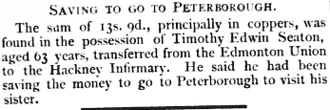
A couple of months later, on 14th June, Edwin is admitted to Hackney Workhouse and discharged to the infirmary on the following day. It’s not quite clear then what happens to Edwin, but a newspaper article dated 6th July describes him trying to travel to Peterborough where he had family.
Shoreditch Observer – 6 July 1901
The Asylum
On 11th April 1902, Edwin was admitted to the Horton Asylum. The Admission Notes gives his age as 44 but there is a comment in the notes from 1914 stating that he “looks much older”.
On arrival his diagnosis is given as dementia. He’s also described as “weak-minded, childish and emotional, and cannot orientate as to time.” He also suffers from “asthma” and has “a marked spartic condition of all his muscles, his speech is impaired, he has marked intention tremors, knee jerks exaggerated, and on the right side there is ankle clonus and a Babinski”.
Throughout the case notes, Edwin is described as having an “impaired memory” and being “disorientated”. In 1912, he’s confined to bed for two weeks because his asthma is bad. He often has “tremors and his limbs are spartic”.
On 14 September 1914, Edwin has bronchitis and is in bed. Just a few days later (on 19th or 21st) he died. The case notes state “he was sat up in bed very ill from broncho-pneumonia and when Nurse Caffyn entered the ward to resume charge, she noticed his jaw had dropped. Nurse Campbell had been very busy attending to a man two beds away and had not noticed any change in Seaton. A patient opposite said Seaton’s jaw dropped just before Nurse Caffyn entered the ward. Dr. Bartlett was there within 2 minutes or so and found patient dead …”
Author’s notes
Feeding these symptoms into to AI, it suggested that Edwin had a stroke, brain or spinal cord injury or was suffering from a degenerative disease. The notes mention “Babinski” and a google of this describes how a Babinski reflex can mean damage in the upper motor neurons and can be caused by a stroke or a spinal cord or brain injury.