
 0
0
 0
0
b.c1847-d.1909
The author introduces Margaret,
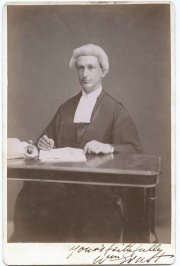
I couldn’t find much about her to begin with, so I looked into the life of her very regular visitor William Ernst Browning also known as William Ernst. He was a barrister, an author, and a judge in Jamaica. Married three times, divorced twice (he wrote a book on divorce law). His second wife cited his adultery with Margaret “Johnstone” at various locations in Jamaica and UK in 1885-92. Now there’s the makings of a good story!
When I was asked to research this patient’s life, there seemed to be very little to go on, except for her name and age, a lodging address (5 Upper Woburn Place), and marital status (a widow). The only other clue was that she had a male friend who visited her in very regularly when she was in Horton Asylum. When I did a little research on him, a love story began to emerge. The visitor was a barrister, author and a colonial judge. His name was William Ernst Browning, also known as William Ernst.
Origins
Margaret was born in Jamaica in 1847 or 1848. We do not know her maiden name. It seems that she married a man named Johnson or Johnstone, and was widowed before 1901. Her medical case notes record that her complexion was “very dark” and “sallow” so it is possible that she was of mixed race. She refused to have her photograph taken for the medical records so the description is all we have on her appearance.
An affair of the heart
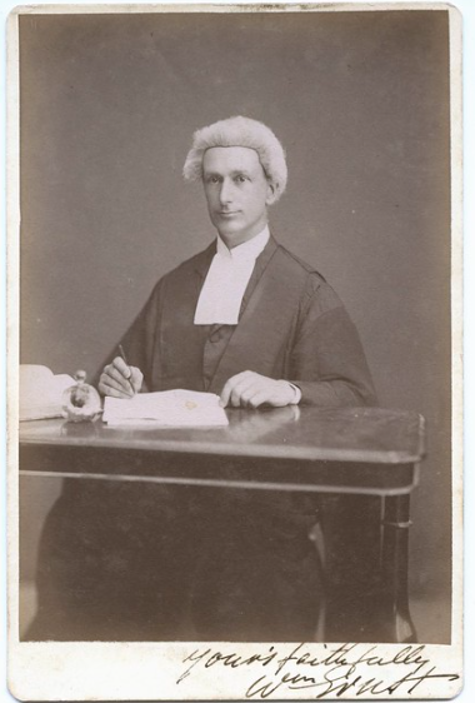
In the early or mid 1880s Margaret became involved in an affair with William Ernst Browning, who had come to Jamaica with his second wife Lucy in 1878 to take up the post of Judge for the Southern District (as William Ernst).
When Lucy divorced Browning in 1894, her petition contained a great deal of detail about his alleged adultery with Margaret:
“That between the months of January and July in the year 1885 the said William Ernst Browning of Moneague in the island of Jamaica committed adultery with Margaret Johnstone.
That from the month of July 1885 till the end of the year 1886 the said William Ernst Browning lived and cohabited with the said Margaret Johnstone at Moneague in the island of Jamaica and on board the Royal Mail Steamship “Moselle.”
That in and during the month of December 1886 the said William Ernst Browning visited the said Margaret Johnstone at the South Western Hotel in Southampton and at various times between December 1886 and December 1893 the said William Ernst Browning visited the said Margaret Johnstone at Pimlico and Woburn Place and other places in London and on divers such occasions committed adultery.
That between the months of January and June 1892, both inclusive, the said William Ernst Browning lived and cohabited with the said Margaret Johnstone at 32 Waterloo Road in the County of London and on divers occasions during the said period committed adultery with the said Margaret Johnstone at 32 Waterloo Road aforesaid.
Passenger lists for the steamer Moselle in 1886 have not survived but from this deposition it seems that Browning brought Margaret with him on that ship when he returned to the UK in 1886, and continued the affair.
In the 1891 Census there is a Madge Johnson aged 41 from Jamaica in lodgings at 38 Bedford Place in London. With her, (and sharing the same line on the census form) is a William Johnson, aged 59, born Brompton. The age and birthplace would suggest that this was in fact William Ernst Browning.
Insanity
We have found no further information on Margaret’s life in the 1890s but according to information given to doctors in 1902 by Browning, she was in Belgium in 1900 and spent two months in a mental hospital (maison de santé) in Brussels for eccentricity of conduct and delusions.
In 1901 she was in lodgings at 57 Guilford Street in London: aged 53, a church helper.
By May 1902 she was exhibiting more signs of mental illness and was admitted to the insane ward at St Pancras workhouse infirmary. The medical examiner there found that she was “depressed and melancholy looking, suspicious, makes long rambling statements in reply to questions & whilst engaged in conversation mutters to herself.”
It was recorded that Mrs Alice Charles, landlady, 5 Upper Woburn Place, said that “she laughs and talks to herself, tosses herself about and goes down on her knees & clasps her hands & prays by an open window”. Sophy Bryant, Superintendent female insane ward, said “She rushes about the ward in an excited manner, and then drops on knees & prays”.
Margaret was certified as insane on 27 May 1902 and admitted to Hanwell Asylum. Someone (presumably Browning) then undertook to pay for her treatment as a private patient and she was moved to one of the Epsom hospitals a few weeks later.
Taken out of the asylum – and returned
There are some entries in the medical records which were initially quite puzzling. In October 1904 there is a scribbled entry in the case notes “ transferred to single care – Relieved”. Then a new record was opened for her in September 1905 marked prominently in red ink “ Re-transferred from 151 The Grove Hammersmith”.
That Hammersmith address was just a boarding house, but it was where Browning’s ex- wife Lucy Ernst had been living prior to her death in 1902. Browning, alias Walter Ernst, was present at the death.
So it appears that Browning took Margaret out of the asylum system into his own care (this would have been possible as she was a private class patient) and placed her in the boarding house at Hammersmith where his former wife Lucy had been cared for in her final days.
This was just 4 weeks before Browning’s third marriage which was to take place in County Durham, in November. Possibly Hammersmith would be more convenient for future visiting than Epsom.
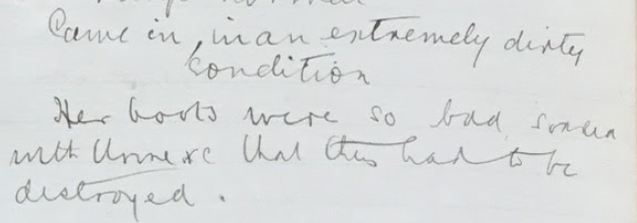
Evidently the Hammersmith arrangement was not a success, and Margaret was placed back in the asylum the following year. The medical records noted that she arrived in a filthy condition and her boots were so badly soiled that they had to be destroyed.
Death
Margaret’s mental condition continued to deteriorate and she developed pulmonary tuberculosis from which she died at Manor Asylum, on 31 May 1909. She was buried at Horton Cemetery on 4 June 1909 in grave 435b.
Copyright
If you use the published stories, partly or completely, written by volunteers of the Friends of Horton Cemetery charity (Reg. No. 1190518), please acknowledge the volunteer who wrote the story by name, acknowledge the Friends of Horton Cemetery expressly and its registration number, and include this link to the STORIES section of the website https://hortoncemetery.org/the…/horton-cemetery-stories/
Donate
Occasionally, people ask how they might financially contribute to our charity. There is a Donate link at the foot of each page of the website. All donations will be directed towards continuing efforts to restore and ultimately maintain Horton Cemetery. We thank you for your support.