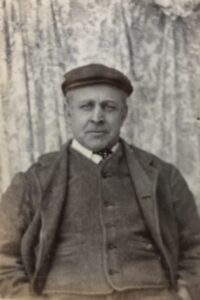
James Alfred HARRIS
We are grateful for the help of James’ great granddaughter Jane, and her detailed research, in tracing the story of his life.
Early years
James Alfred Harris was born on 3 August 1845 in Peckham, the youngest of three children born to Jacob Harris, a coachman, and his wife Mary Ann Broom.
He had an older sister Mary Ann, and an older brother William Henry.
In 1851 the family were living at 6 Camden Street, in Camberwell. Father Jacob was described in the census as a coachman and livery stable keeper.
Early indications of epilepsy
James’s father Jacob died from smallpox in 1852, aged 45. Around this time (according to information given by his sons in later life), James, at the age of 7, began to have fits, mainly at night, and this lasted until he was 13.
Royal Navy service
In December 1859, aged 14, James was enrolled in the Royal Navy as a Boy 2nd Class. The record shows that he was 4’8″ tall with blue eyes and light hair.

In the 1861 census he was one of 152 Boys on the training brig HMS Rolla, a tender to HMS Victory at Portsmouth.
By age 18 in 1863, he was 5’5″ tall and had a tattoo of a ballet girl on his right arm. James had an accident aboard ship at this age, falling from a great height, but was caught before reaching the deck and was “laid up” for a fortnight (according to his sons).
His surviving Royal Navy records are quite sparse. We know he was serving as an Able Seaman on HMS Royal Oak in 1871; and in 1873 he served on Duke of Wellington and Devastation before his discharge in October that year. His captains described his character as “Very Good”.
Later medical records list the illnesses he had while in the Navy: smallpox at Rio; yellow fever at Panama; scarlatina at Malta; fever and Ague in the Bahamas
Life after the Navy: marriage, and children
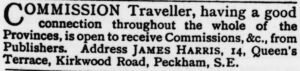
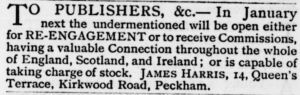
James married Edith Susannah Robinson at St John’s church in East Dulwich on 30 December 1878. His occupation was stated (as it would be in the 1881 and 1891 censuses) as “commercial traveller”. He was in the book trade, and in November and December 1882 he was advertising his availability in The Bookseller journal:
James and Edith had 7 children of whom 5 survived infancy. The surviving children were:
- Percy Alfred (1880)
- Ernest Arthur (1881)
- Florence (1884)
- William Henry (1890)
- Constance (1895)
In the 1881 census, the family (James, Edith and Percy) were at 14 Queens Terrace, Kirkwood Road, Peckham. Edith’s mother and four siblings were also resident at that address. By 1886 James and his family had moved up the road to 21 Queen’s Terrace (later renumbered as 132 Kirkwood Road) and they would remain there until the late 1890s, when they moved to 34 Willow Walk, Catford.
Insanity in the family
James’ brother William Henry Harris, who lived in Norfolk with his wife and 2 daughters, was certified insane in 1878 and died in Thorpe asylum in Norwich in 1882.
Depression, violence, delusions of persecution
In the 1890s, James’ business* was failing. The medical case notes record (from information provided) that James had been ill with ‘pneumonia and worry’ in 1897. By July 1898, his behaviour had become very troubling and at Lewisham workhouse he was ordered to be detained as a lunatic.
He is much depressed. He mutters to himself. He says a cloud comes over his brain at times & he cannot think. He is suffering from the delusion that a crowd of men are trying to do him an injury & to extort money from him.
Edith Susannah Harris, wife, 34 Willow Walk, Catford said that: “He is depressed & takes no interest in his business & cannot look after himself, he has attempted to shoot himself & me with a pistol. He has been very violent & raves in a rambling manner. He says people are after him & want to poison him.”
*His occupation was recorded as “shop keeper”. Every other record since he left the Navy in 1873 describes him as a commercial traveller. So the shop must have been a relatively new venture, and it seems that it was not successful.
Committed to the asylum, and the recurrence of epilepsy
James was initially sent to Barming Heath asylum near Maidstone where he spent the next few years before being transferred to Bexley in 1903, and later that year transferred to Ewell Epileptic Colony (St Ebba’s). While at Barming Heath and Bexley his epilepsy had returned.
In 1907 James was discharged to Long Grove asylum where he remained for the next 15 years.
The case notes that we have are all from St Ebba’s. There are very few surviving records from Long Grove.
Did James help prepare the census returns for Long Grove?
The staff at Ewell Epileptic Colony had noted that James was intelligent and made himself very useful in the office:
“is very helpful and willing, and being educated much above the average, is able to do valuable clerical work”
“he remains in good health – gets through a large amount of clerical work and entirely keeps the case books.”
It seems probable that he prepared the 1911 and 1921 census returns for Long Grove, as his name is first on their lists of male patients in both those censuses. This would then be an example of his handwriting.
 A comment here from his great granddaughter Jane: “I like to think that putting himself first showed that he still had some sort of resilience and self worth”.
Death
James died at Long Grove from cardio vascular degeneration on 1 September 1922.
What happened to his wife and children?
Wife Edith Susannah Harris died in February 1917 and is buried at Little Ilford cemetery.
Their eldest son, Percy Alfred Harris, an electrician, joined the Royal Engineers just 3 weeks after James was sent to Barming Heath in 1898. He served in the Boer War but on his return to the UK he tired of army life. He deserted twice, and on the second occasion he stole a fellow soldier’s bicycle and used it as security for a loan of money. He was arrested, convicted of theft and sentenced to three months’ hard labour. On release from prison he was discharged from the army in October 1901, and we can find no record of him after that. Was his life affected by what happened to his father ?
Ernest Arthur Harris was an engineer. In the Great War he served in Mesopotamia with the Mechanical Transport division of the Army Service Corps. After the war he volunteered to stay on in Iraq with the Civil Commission. He was awarded the MBE for his service there in 1922:

The London Gazette 29 December 1922 Supplement:32782 Page :12
Ernest died suddenly in Baghdad in August 1923 from cerebral congestion.
Florence Harris married William George Wright in 1911; they emigrated to Canada in 1919 (and per family sources, she hated it!). Florence died in Regina, Saskatchewan in 1961.
William Henry Harris was a brewer’s carman. He married Mary West in 1910 and they had two sons born before he enlisted in the Duke of Cornwall’s Light Infantry in December 1914. He served in France but developed valvular heart disease as a result of his service, and after a spell in the Royal Defence Corps he was invalided out of the army in January 1918. He died ten days later.
Constance Harris, who was only 3 years old when her father was sent to the asylum, married Laurence Bargrove in 1920. Laurence was a Royal Navy seaman. Constance died in Ilford in 1983.