Albert JACKSON
Albert Jackson c1862 – 1912
Albert Jackson was born c1862 and was the eldest sibling of Walter (born c1865), William, Christopher Henry, and Selina Alice.
Only William, Christopher, and Selina’s birth certificates have been found in the GRO birth records, which gave their mother’s maiden name as Hall. Despite searching for Albert and Walter’s birth certificates using Hall or Jackson, no GRO birth records were found. Neither was a marriage found for their parents William Jackson and Sarah Hall.
Albert’s brother William was born at home, 14a Grosvenor Street, Islington, on 24th August 1866. His father William was working as a dock labourer at the time.
 William’s birth certificate
Albert’s next sibling Christopher Henry was also born at home, 3a Grosvenor Street, on 16th May 1869. This time father William’s occupation was recorded as being a canal boatman.
 Christopher Henry’s birth certificate
The 1871 Census
Grosvenor Street was a densely populated street of Victorian terraced houses located just off New North Road/Canal Road in Islington. When the 1871 census was taken on the night of 2nd April, 3a Grosvenor Street was being shared by four families, including the Jackson family. The head of the family was recorded as being William Jackson, a labourer who had been born c1841 in Staffordshire, and his pregnant wife Sarah who had been born c1840 in Rochester, Kent. Their children Albert, Walter, William, and Christopher were listed as all being born in Islington.
A few months later, on 6th August 1871, Sarah gave birth again at home to their daughter Selina Alice. Her father William’s occupation was recorded as being a jobbing labourer.
 Selina Alice’s birth certificate
Albert’s mother Sarah was aged 38 when she died from bronchitis on 10th February 1879, and without her, the family unit started to fall apart.
 Sarah’s death certificate
Children Enter the Workhouse
On 12th October 1880, Albert’s 9-year-old sister Selina was admitted into the Islington Infirmary where it was recorded that her mother was dead and her father had deserted her. On 22nd October she was moved to the St Mary Islington Workhouse School in Hornsey Road where she was still living when the 1881 census was taken.
On 13th January 1881, William and his 11-year-old son Christopher, were admitted into the Shoreditch Workhouse as being destitute and the next day were discharged together into the infirmary. William was recorded as being a widower and ‘Lighterman’. At this point, William disappears from records until 1900.
Christopher was admitted on 14th March 1881 into the City Road Workhouse by a magistrate. Although it was not recorded, this could have been because he was found living on the streets. Christopher was discharged to PC 156 on 15th March 1881, but after this the trail for Christopher goes cold.
The 1881 Census
Albert was aged 19 and working as a storekeeper when the 1881 census was taken on the night of the 3rd of April. He was recorded as being a lodger at number 4 Grosvenor Street, but none of his other siblings were living with him and have not been found in the census.
On 28th July 1883, Albert was in Reading, Berkshire, when he attested into the Berkshire Regiment and given the regimental number 848. Albert stated that he had been born in Shoreditch, Middlesex and that he was a labourer.
His enlistment record shows that his apparent age was 19 years 7 months, but he was small for his age at nearly 5 feet 4 inches tall and weighing 126 lbs; his chest measurement was 34 inches, but his physical development was ‘Good’. His records also state that he was blue eyed and had brown hair with a fresh complexion, and that his religion was Church of England. Although he had been vaccinated during childhood, Albert was revaccinated on 31st August 1883. It was also noted that he had a scar on his right cheek and on his back. Strangely, he gave a brother named Edward Jackson as his next of kin, address unknown.
The following is Albert’s chronological timeline of his military deployments in the 1st Battalion Royal Berkshire Regiment:
- 28th July 1883 – Reading: Stationed at the military depot in Reading.
- 21st November 1883 – Chatham: Transferred to the major army barracks and naval dockyard at Chatham, Kent.
- 26th August 1884 – Australia: Deployment to Egypt & Sudan. Embarked on the troop transport ship Australia, bound for the Mediterranean.
- 7th October 1884 – Egypt: Transferred or arrived via the transport ship Egypt.
- 13th October 1884 – Cairo, Egypt: Arrived in Cairo during the height of the British Nile Expedition. He spent 6 days in the hospital here late in October for a minor skin and localized infection recorded as balanitis.
- 30th April 1885 – Suakin, Sudan: Deployed to the Red Sea port of Suakin. This was a highly volatile zone during the Mahdist War, known for its extreme heat and harsh conditions.
- 21st May 1885 – Return to Cairo, Egypt: Returned to Cairo from the Sudan expedition. Shortly after arrival, in June, Albert was hospitalized for 10 days with severe tonsillitis.
- 30th November 1886 – Ramleh, Egypt: Stationed at the Ramleh barracks near Alexandria before being reassigned out of Egypt.
- 22nd May 1887 – Malta: Arrived at the British island fortress of Malta.
- June 1887 – Malta Hospitalization: Albert spent 10 days in the hospital with a lingering fever caused by intense environmental exposure.
- September – October 1890 – Cottonera, Malta: After a few years of relative health, Albert suffered a severe physical and mental breakdown. He spent nearly two consecutive months at Cottonera Hospital dealing with severe digestive issues (dyspepsia and colic) caused by poor diet and suspected heavy drinking, which quickly escalated into melancholia (severe depression). This was treated with exercise, dieting, and sedatives when needed.
- 14th November 1890 – Habits: Temperate – Conduct: Good – Recommended for discharged suffering from melancholia.
- 22nd November 1890 – Malabar: Because of his declining mental health, Albert was placed on the troopship Malabar and sent back to England.
- 1st December 1890 – Netley, England: Arrived at the Royal Victoria Hospital at Netley, the British Army’s main psychiatric and convalescent facility.
The record concludes here, noting that although Albert’s mental state had “improved,” he was still weak minded and was consequently officially invalided out of the service on 31st March 1891.
The whereabouts of Albert when the 1891 census was taken five nights later on 5th April is unknown but, on 29th May 1891, he was found as a “wandering lunatic” on Tottenham Court Road in St Pancras and taken to the workhouse.
The Parish of St Pancras Poor Law Settlement papers record that Albert had previously lived for 23 years in 4 Grosvenor Street, Islington, and that he had recently been discharged from the army. It was also recorded here that his brother William Jackson was living at ‘3 Albion (sic) Cottages, Popham Street, Essex Road’, which suggests that Albert had known where his brother William was living.
It was agreed that 29-year-old Albert was suffering from dementia and on 14th June 1891, he was sent to be cared for in the London County Asylum in Banstead, Surrey.
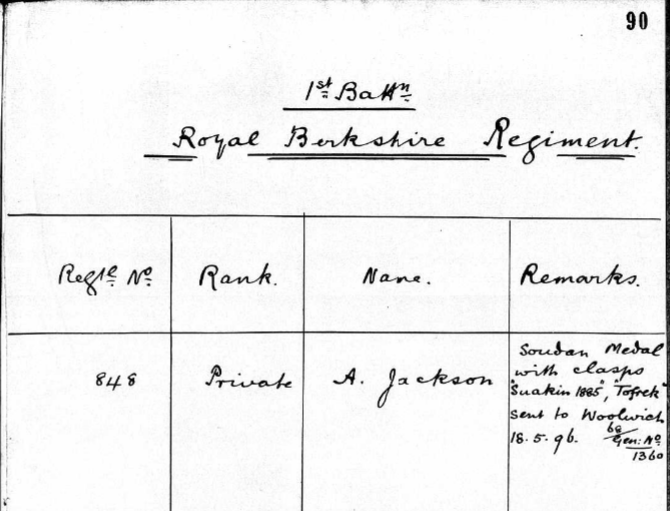
While Albert was there, the Royal Berkshire Regiment tried to send him his Soudan medal with clasps, Suakin 1885”medal, and Torfek medal to him. They were returned on 18th May 1896 to Woolwich as Albert’s whereabouts was not found.
Banstead Asylum- Kesteven Asylum – Long Grove
When the 1901 census was taken on the night of 31st March, Albert was recorded as still being a patient in Banstead Asylum but was recorded by just his initials ‘A. J.’, and that he had been an unmarried labourer before being admitted.
Albert stayed in the Banstead Asylum until he was transferred on 15th June 1903 to the Kesteven County Asylum in Sleaford, Lincolnshire. This asylum had been opened only for a year and had the compacity to hold 420 patients.
On 28th June 1907, Albert was transferred back south and admitted into the Long Grove Asylum in Epsom, Surrey. Records there described him as being single, aged 45, and that his general health was ‘Good’. They also noted that Albert was a former labourer who had had dementia for 16 years since he was 29 years old,
Albert Jackson “of St Pancras, formally a soldier” was aged 49 when he died in Long Grove Asylum on 28th December 1912 from dilatation of the heart. His body was buried in grave 2118b in the Horton Estate Cemetery on 1st January 1913.
 Albert’s death certificate
Albert’s father William
After disappearing from the records in 1881, 61-year-old William suddenly reappeared back in London on 5th December 1900 in front of the Parish of Paddington & Islington Guardians asking for settlement.
The information found within this document states that he was then living in the Paddington workhouse and was claiming that he had resided at 4 Grosvenor Street for more than 10 years prior to 1879. The Guardians were demanding evidence of this and wrote to his children William Jackson junior and Selina Berry for confirmation. Only Selina appears to have replied to the several questions asked, saying that she did not know all the answers as she had only been a young child when her father had left her.
She did however remember her brothers as Walter, William, and Christian (sic), and that they were all older than her. She also confirmed that her mother’s maiden name had been Sarah Hall. There was no mention at all of Albert, so maybe that was another indication that he was not William Jackson’s biological son?
Dated 24th December 1900, Selina’s evidence was enough for the Guardians to grant William the settlement he needed to receive help from the Islington & Paddington parish.
The following made interesting reading and explains where William had disappeared to after his wife’s death:
“Certif. of death of Sarah Jackson wife of the above shows date of 10 Feb 1879 at 4 Grosvenor St.
Daughter of pauper Selina Berry lives at 204 Loveridge Rd, West Hampstead.
Man supposed to have travelled with Day & Radford Wild Beast Show for 16 years after wife’s death & since has had no settled residence having been living past 4 years chgle (sic) to Hampstead and Chelsea at times.
Son William 1 Endley Buildings Essex Rd, City Rd.
Had children in Islington Selina 28, William 30, Walter 32, Christopher 20.
William Jackson’s name appears in the 1875 – 1879 Directories.
Mrs Woodhouse was previous tenant.”
No further records have been found for William.
What happened to Albert’s siblings:
Brother Walter Jackson: No further records were found for Walter after the 1871 census was taken, but it seems possible that he like his brothers, joined the army or navy following the death of his mother.
Brother William Jackson: From military records found, it appears that on 1st November 1884, William had been aged 18 years 4 months when he attested into the Norfolk Regiment and given regimental number 993. He was short like his brother Albert, at 5 feet 3 ½ inches tall but had brown eyes and dark brown hair. He also had many tattoos on his hands and wrists. Because he was considered under height, it was recommended that he joined the infantry.
After nearly six years’ service overseas in the East Indies, William was discharged as medically unfit on 21st June 1890 due to having been “injured by fork in left eye when Mess orderly…” Annoyingly the records do not include the whole report of the Proceedings of Court Inquiry.
William’s next of kin was recorded as being his brother William of 10 Grosvenor Street, St Peters Street, Islington. I suspect this should have been recorded as his father, William.
William must have met Elizabeth Geater soon after his discharge as when the 1891 census had been taken on the night of 5th April, William had been recorded as being a lodger with his “wife” Elizabeth Jackson at 3 Albany Cottages that was off Popham Street, Islington. This was the home of Elizabeth’s mother, Elizabeth Geater, and her five siblings. William and Elizabeth had eight known children, but they did not marry until 1931 due to her already being married to another man, Frederick Isaac Saunders.
Brother Christopher Henry Jackson: No further records found after 1881 when he was discharged from City Road Workhouse.
Sister Selina Alice Jackson: Selina was recorded as being a 10-year-old pauper scholar in the St Mary Islington Workhouse School in Hornsey Road in the 1881 census. She stayed there until she was nearly 14 years old and then sent on 12th November 1884 to the Shadwell Road Workhouse, Islington. Selina stayed there until she was discharged on 10th November 1885 to work as a servant. This position did not last and twenty days later she was back in the workhouse as destitute.
By the time the 1891 census was taken, Selina was working as a servant in a lodging house at 16 & 17 Downs Street, St George Hanover Square. At some point after this, it seems she married as the next record found was in her father’s 1900 Settlement record where it recorded that she, Mrs Selina Berry, had lived at 204 Loveridge Road, West Hampstead and at Anchor House, 55 Broomsleigh Street, Mill Lane, West Hampstead. Unfortunately, she was not living there when the 1901 census was taken, and no further records have been found to establish who Mr Berry may have been and what happened to either of them.