
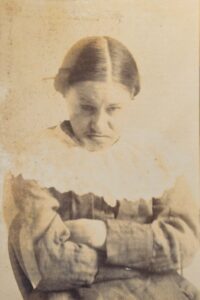
Jessie GRANGER
Jessie Granger
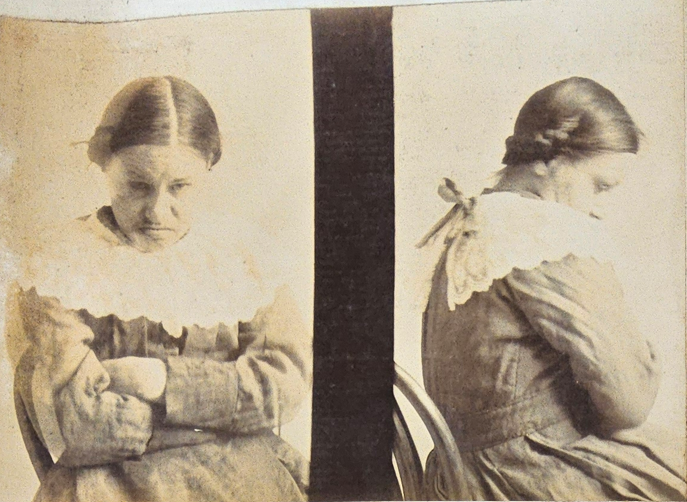
Jessie Granger was born in Marylebone, London, on 9 August 1872 and died at The Horton on 25 October 1913. More than a century later, archived documents allow us to reconstruct not simply how Jessie died, but what happened in her life. This account draws on census records, baptism records, asylum case files, workhouse admissions, and newspaper articles. Wherever possible, it follows the historical record while acknowledging where certainty is not possible.
Note: the records also show that the family name was sometimes recorded as Grainger.
1872 & before: The early years
Henry and Maria Granger married on 23 June 1867 and began building their family in Marylebone, London, where Henry worked as a house painter and decorator. Their first child Ernest arrived in May 1868, followed by Minnie, and the two children were baptised together in August 1870 at St Mark in Marylebone (where Minnie would later marry). Jessie was then born in 1872. For a brief period, the surviving records suggest an ordinary working-class household making its way in Victorian London.

1877–1884: A downward turn for the family
Everything changed in 1877. On 10 May, Henry Granger died at the family home 5 Randolph Road, aged just thirty-five. Jessie was only three years old. Maria was left widowed while expecting her fourth child, Harry Edgar Granger, who was born five months later in the same house.
The 1881 census captures a family adapting to this change of Henry’s death. They had moved and were living at 11 Violet Hill. Maria had started working and to support her four children as a waitress, her oldest child Ernest aged only twelve, had also entered work as a tailor. Minnie and Jessie remained at school and Harry was still a young child, his later school admission record from 1884 confirms the family remained at the same address for several years.
1889–1891: The first asylum stay and life beyond
In April 1889, aged sixteen, Jessie was admitted to Colney Hatch Asylum in London. She was discharged in January 1890 and appears to have returned to ordinary life.
The 1891 census records eighteen year old Jessie not as a patient, but as a dressmaker which is a small but important reminder that after her first admission she returned to an ordinary life. Jessie was back living with her family, they had moved again and were now in the borough of Hampstead. Maria, then forty-nine, continued working as a waitress and young Harry, aged thirteen, was employed as a newsagent’s boy – the whole household was working to enable a basic level of financial security for a late Victorian working class family in London. Documented on a separate record, we find Minnie working as a domestic servant in a nearby household. Later that same month, Minnie married Frank Harding from Tunbridge Wells in Kent, back at St Marks the family parish she (and her siblings) had been baptised in.
1896–1899: Bereavement and moving to Kent
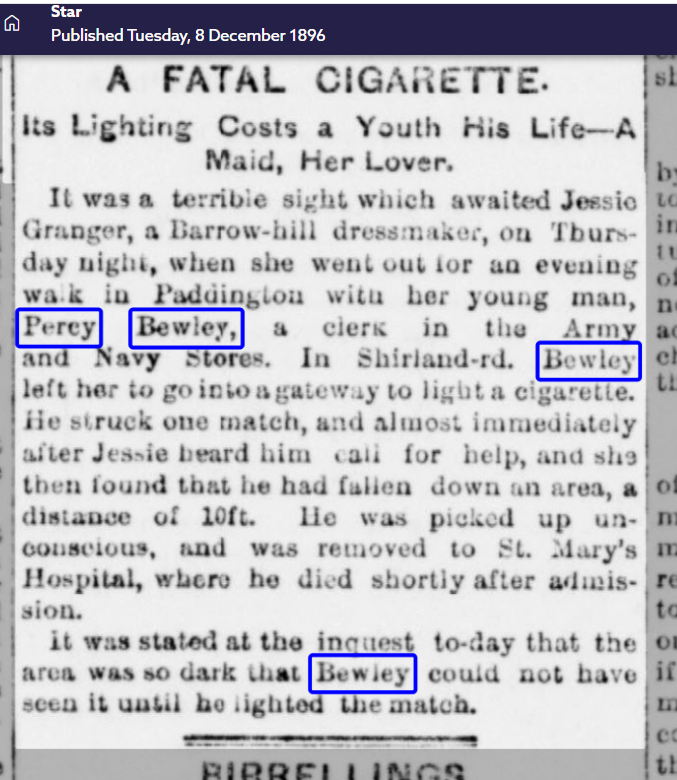
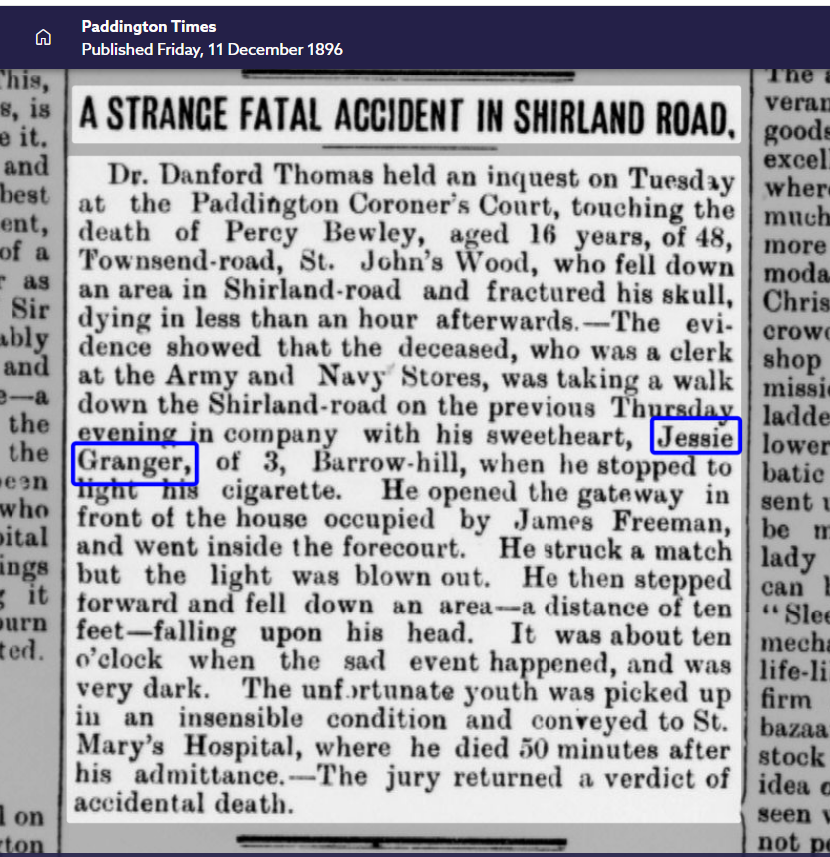
The following years brought two devastating losses in quick succession for Jessie. In December 1896, while Jessie was still earning her living as a dressmaker, she was out one evening walking with a young man called Percy Bewley. Their relationship was described in newspaper reports as either an acquaintance or her sweetheart. While lighting a cigarette he accidentally fell a considerable height and died very shortly after arrival at hospital from his injuries, Jessie was documented as the only witness to the accident.
Almost exactly one year later in December 1897, Jessie lost her mother Maria, who died aged fifty-five from heart related complications.
At some point after Minnie’s marriage and starting of her family, she moved to Tunbridge Wells in Kent with her husband and children. Although the exact timing is unclear, Jessie followed her there and found work as a domestic servant. It was a practical move, domestic service was one of the few occupations that commonly provided both employment and accommodation, offering Jessie both work and somewhere to live as she built a new life in Kent. But unfortunately, this move became the last chapter of Jessie’s life outside of institutional care.
1899–1913: The asylums

On 14 June 1899, Jessie, aged 26, entered Dartford Union Workhouse. It is likely that Minnie was involved in her admission, as she had provided a statement and remained Jessie’s recorded family contact throughout the following years.
Two weeks later Jessie was transferred to Barming Heath Asylum in Kent on 29 June 1899. On admission she was described as being in a state of mania, and her general health was noted as being very poor with signs of malnourishment.
One of the witness statements in Jessie’s admission to the asylum included the female workhouse attendant who had included this observation in her statement of Jessie: “[that she was] lost in her surroundings.”
Jessie’s admission record preserves one of the few moments where the documents record her experience almost exactly as those around her heard and interpreted it:
“Melancholy appearance and manner. She is under the hallucination that people are talking to her through the telephone. She hears voices telling her to keep quiet and lie down. She states the room is full of electricity and she cannot rest in consequence.”
In the late 1890s, telephones were still very rare, especially among working-class households. Her work in domestic service may have brought her into contact with one, but this cannot know this for certain. So what did the telephone mean to Jessie?
The case files document Jessie’s hallucinations and delusions in considerable detail, offering rare glimpses into how she experienced the world. One entry records the name and address of a person Jessie identified as a persecutor during or following one of her episodes. It is impossible to know if this reflected a real person, a remembered experience, or her altered perception.
She remained in Barming Heath Asylum until March 1902 when she transferred to Horton Asylum in Epsom. She remained there until a short transfer to Brookwood Asylum in 1911 before returning to Horton in 1912. On return to the Horton we then know more about Jessie again from her case file, her physical health was documented in a good condition, but her mental health was still deteriorating
“There appears to be definite clouding of consciousness & disorientation. Evident deterioration of all her mental faculties. She chides repeatedly with her own folder & gazes fixedly at the ground without any apparent apprehension of her environment & is incapable of carrying on anything approaching a conversation. She is reported to be irritable & ill‑tempered towards her fellow patients & is described as certifiably troublesome as being at times worse, abusive & obscene & given to being destructive but since admission here she has not shown affection deficiency.”
At this stage Jessie also had a new diagnosis: Paranoid Dementia.
The final years
By her return to Horton in 1912, the records describe a woman who had changed profoundly. Over time she became increasingly withdrawn, and staff noted that she spent much of her time in what they described as a ‘catatonic state’.
The language of Jessie’s admission echoes through her case books. The telephone first appears in 1899, alongside her belief that the room was “full of electricity.” By contrast, the final entries rarely return to those vivid descriptions. Instead, they record something quieter: increasing withdrawal, silence, and physical exhaustion.
Jessie died at Horton Asylum in October 1913 from heart and gastric-related illnesses. She was 41 years old and was buried in Horton Cemetery. Jessie had never married and did not have any known children.
The siblings
Jessie’s eldest brother Ernest, died while serving in WW1 in 1915. Minnie raised a large family and, from the available records, appears to have maintained a relationship with Harry, the youngest of the siblings.
The surviving records cannot tell us every conversation that passed between the Granger siblings or how often they met. What they do suggest is that Minnie continued to appear as Jessie’s family contact throughout years of institutional care, and that she and Harry remained connected later in life. Against a backdrop of poverty, bereavement and loss, those small traces of family continuity feel significant.
For more than a century, Jessie’s life survived only in archived documents. Read together, these scattered records reveal more than a catalogue of institutional care. They create the picture of daughter who grew up in a family marked by early loss, who became a young woman working to create her own financial security, and a sister whose connection with Minnie quietly endures across decades of paperwork.