My visit to the grave of Félix García | Eva Bosch
18 September 2026
Félix García or Félix Fernández González by Eva Bosch
It was a Saturday morning in early May 2021 when I met a kind volunteer from the Friends of Horton Cemetery at Ewell West station. He came to pick me up and drove me to a weird forest very close to a roundabout in Epsom.
It certainly looked like anything but a cemetery. A monument stood in front of some broken railings as a memorial to the soldiers buried there from the two world wars. Apparently, the owner of the cemetery would not allow the monument to be placed where the soldiers lay buried, and it had to be placed on the pavement outside.
The cemetery was no longer NHS property. It was sold in 1983 to Michael Heighes, a property developer. Heighes bought the land for commercial/property investment. There were apparently no conditions requiring him to maintain it as a cemetery. The decay started then, and it continues to be so.
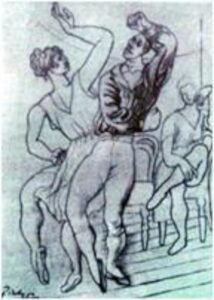
My interest in this cemetery is because a Spanish dancer whose real name is not certain but as a stage name was known as Félix García is buried there. Being an artist myself, I was curious to know what happened to that young flamenco dancer whom Picasso drew so beautifully dancing next to Véra Nemtchinova while he was in London with the Ballets Russes.
On 22 July 1919, Serge Diaghilev’s Ballets Russes gave the London premiere of Manuel de Falla’s El sombrero de tres picos (The Three-Cornered Hat) at the Alhambra Theatre. The ballet was based on Pedro Antonio de Alarcón’s novel, adapted for the stage by Gregorio Martínez Sierra and María Lejárraga, and commissioned by Diaghilev. Léonide Massine created the choreography and danced the role of the Miller, opposite Tamara Karsavina as the Miller’s Wife.
The famous Danza del molinero—the Miller’s Dance, or Farruca—was one of the great sensations of the ballet. Ernest Ansermet conducted the orchestra, while Pablo Picasso designed the scenery, costumes and celebrated curtain. It was an extraordinary collaboration between Falla, Massine, Picasso and Diaghilev, and the premiere was a spectacular success.
What was not acknowledged was Félix’s importance in this ballet. He was recruited by Diaghilev and Massine and brought to London to teach the particular dance, La Farruca, which he was a master of. He stayed at 72 Neal Street, very close to the church of St Martin-in-the-Fields, on the steps of which it is claimed that he was found frantically dancing naked because he had been made to believe that he would dance the role of the Miller. A few days before the premiere, he found out that Massine would be the star. He was then taken to a mental asylum.
The veracity of this story is questioned by researchers Estrada, and Hernández whose research is the source of most of my information.
Having said that, it is obvious why my curiosity about the fate of this young artist is so strong.
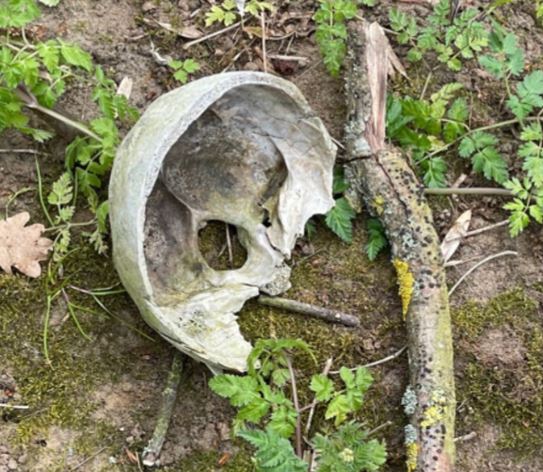
Because of trespassing laws, we could only look at the cemetery from the railings, but considering that there were many broken sections, it was very easy to see its appalling state and how the foxes and badgers had been digging among the 9,000 bodies that the cemetery contained. I could see, from a distance, some old shoes and a sleeping bag, probably belonging to a down-and-out who had found shelter behind the trees. I was also horrified to see the remains of a skull that an animal had taken a few metres from the railings.
It is my wish to recover the remains of Félix and take them back to Spain, where he belongs. The true story of what happened to this young man is uncertain, except that he lived until the age of 44 in a mental asylum in the south-east of Surrey, where I believe he was subjected to experimentation.
Sadly, most records from those asylums were destroyed.
Eva Bosch is a Catalan painter, writer and video maker born in Barcelona. At present Eva lives and works in London with regular visits to her atelier in Catalonia, combining her studio work with lecturing in the History of Art.