
 0
0
 0
0
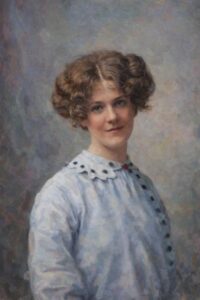
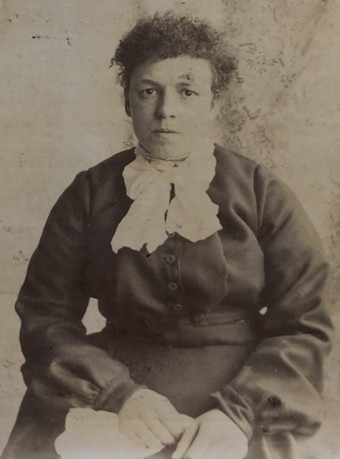
b.1882-d.1916
Grenville’s name is often recorded in official documents as Granville and gender as male. She is referred to in this document as Grenville Margaret to differentiate from her mother Grenville Collins
CHILDHOOD
Sunday 16th August 1889 found the Gowers family gathered together In St. Stephen’s Church, Villa Street, Walworth Common. It is not known if father Thomas William Gowers (hereafter referred to as Thomas Snr) or mother Grenville Henrietta Collins Gowers (neė Briggs) were regular church goers but on this occasion, they were in attendance to have their four children baptised.
Grenville Margaret, the eldest, had waited the longest to undergo this ceremony, having been born in on 21st January 1882. Next came Thomas Frederick William Jnr (b. 12th April, 1884), then Percy Sydney (b. 1st September 1886) and finally Frederick William (b. 8th June 1889). These dates of birth are all recorded on the baptism register.
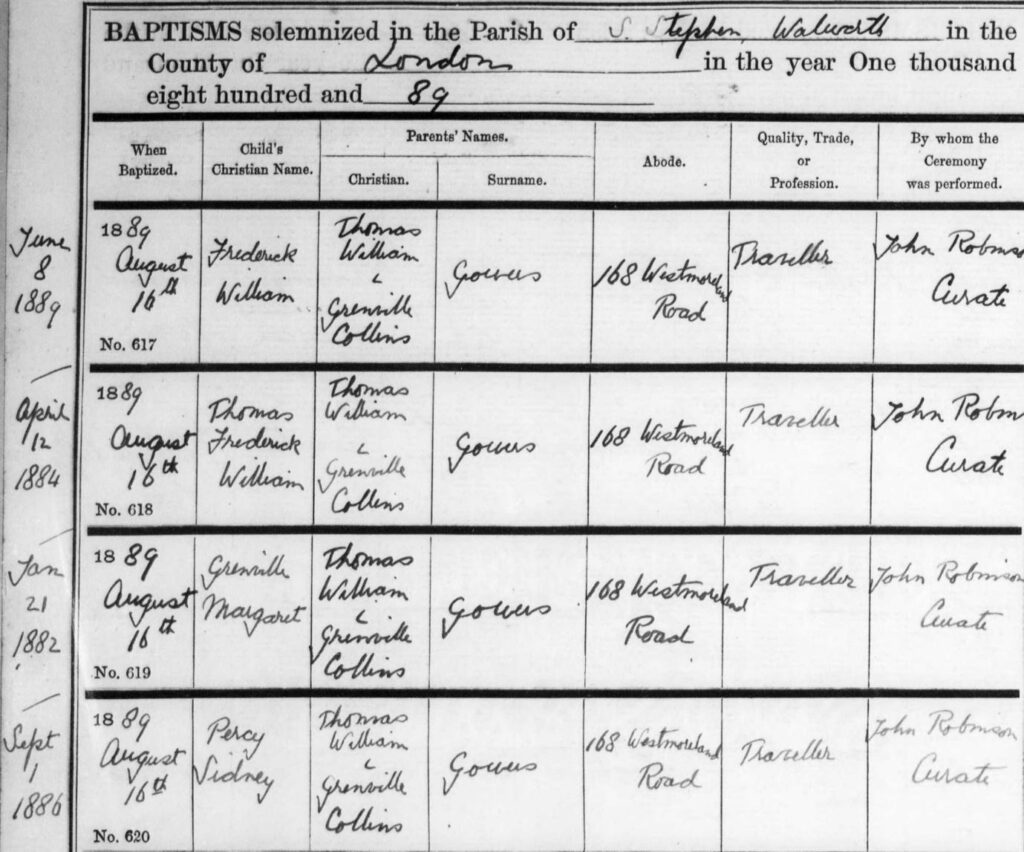
1889 Baptism for four Gowers siblings at St. Stephen’s Church, Walworth
A fourth brother, Albert Stephen Gower, was born in January 1892, too late to be part of the mass baptism. No subsequent record of his baptism can be found.
The church and the Gowers home address of 168 Westmoreland Road were demolished and the area redeveloped in the late 1950s.
There were three other families having their children, all babes in arms, baptised at the same time. It is easy to imagine a noisy if joyous occasion, with babies crying and younger children running around, having become bored with the proceedings. Adults and children would have been wearing their Sunday best, which in poverty-stricken Victorian London probably meant the clothes they wore every day, but washed and pressed specially for the event
It was not unusual in the Victorian era for families to have all their children baptised in one ceremony, for a number of reasons. Since the birth of their first child Grenville Margaret, the Gowers family had a number of different addresses and father Thomas Snr had a number of different occupations, indicating an unsettled existence for the family. His occupation on the baptism register showed that he was a traveller, presumably going door to door selling items.
Poverty was rife in Victorian London and families where often forced to undertake moonlight flits to escape the tallyman debt collectors and slum landlords. Other than spiritual contentment, the rites of baptism may have bestowed a veneer of respectability on the family, given them access to parish funds for the poor or enabled more chance of access to church schools for the children.
According to her admission records to Ewell Epileptic Colony (hereafter referred to as The Colony) Grenville Margaret had been diagnosed with epilepsy when she was two years old and may have found such a noisy exciting church service to be stressful for her.
FAMILY
At the time of Grenville Margaret’s parents’ wedding in 1881, Thomas Snr’s occupation was shown on his marriage certificate as dairyman. He lived with his parents and siblings at 57 South Island Place, which runs between Brixton Road and Clapham Road, South London.
On his marriage certificate Thomas Snr’s father, Stephen, was shown as a cow keeper and dairyman. Stephen Gower and his growing family had been shown as living at the same address for three successive census returns, so were probably in reasonably settled circumstances.
On the same certificate the bride’s father Frederick Briggs was shown as a solicitors’ clerk, which may indicate a disparity in social standing between the bride and groom.
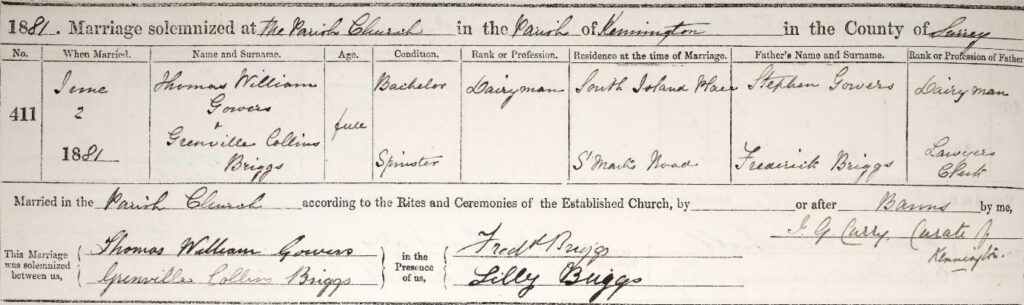
1881 Marriage certificate of Thomas Gowers Snr and Grenville Collins Briggs in the Parish church of Kenningon
It may seem odd that Thomas and his father worked in the dairy trade in an area which was already built up and suburban, but because of the lack of domestic refrigeration at this time, milk was sold almost straight from the cow, travelling in churns on the back of a cart.
A cursory look at the census returns between 1861 and 1891 shows another cow keeper (James Fleming) in South Island Place, as well as two cheesemongers. There were more dairymen registered in census entries relating to Brixton Road, just round the corner from Thomas Snr’s home.
If there was no back yard or other outdoor space to house the animals, cows were kept in the cellar or hauled up to the attic. Cleanliness, smells and animal welfare left a lot to be desired for both the animals or humans living on the premises. The Rinderpest epidemic and other bovine diseases, coupled with animal welfare legislation driven by the RSPCA (established in 1824) led to restrictions on the keeping of cows in unhygienic conditions. Development of the rail system into London from the country also made timely transport of milk much easier.
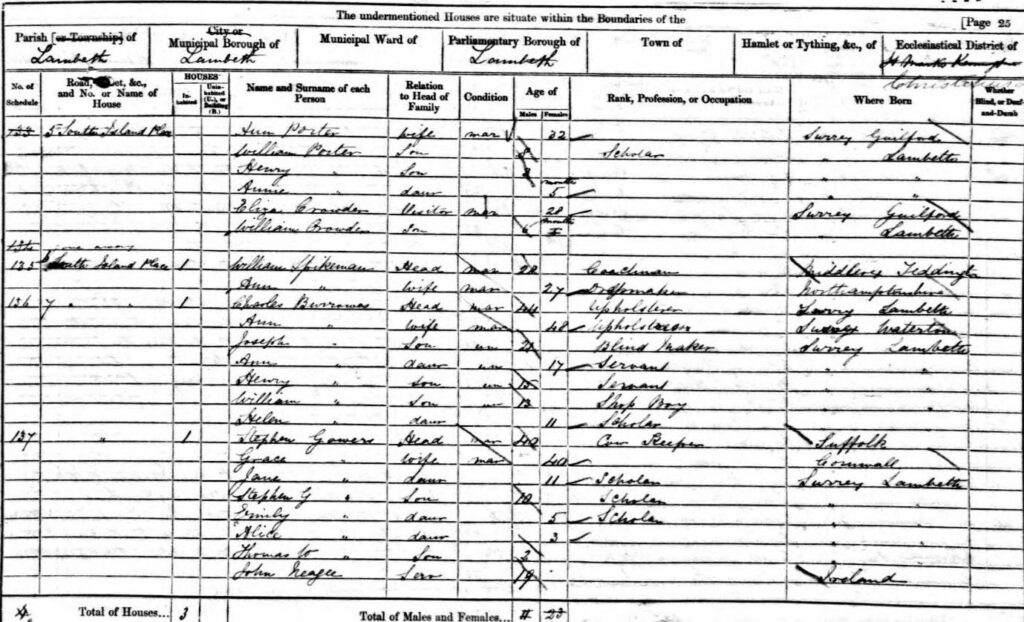
The 1871 Census, the Gowers in South Island Place, keeping cows for a living.
SCHOOLS
On 30th June 1890, when Grenville Margaret was 8 years old, she was shown on the school register of Peckham Park School, Friary Road, Peckham. This was a three storey Victorian building which still exists, but is now a Harris Academy.
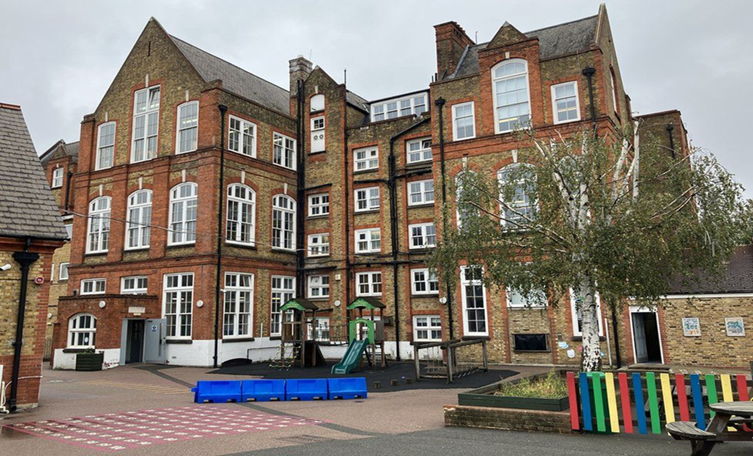
Peckham Park School, where Grenville Margaret went to school from the age of eight years
The Education Act 1880 mandated that education should start at 5 years of age but no further school records could be found for Grenville Margaret.
In 1893 legislation increased the school leaving age to 11 years, so it is likely that she finished school in 1893. Her home address was recorded as 12, Marmont Road, Peckham, a short walk from the school. It is unknown how her epilepsy might have affected her education.
She told staff at The Colony that after leaving school she carried out household duties in the home, possibly looking after her younger siblings. From the age of 15 years, she worked for about 9 months at home folding cigarette papers, and although the wages were likely to be minimal, it would have provided a useful additional source of income for the family.
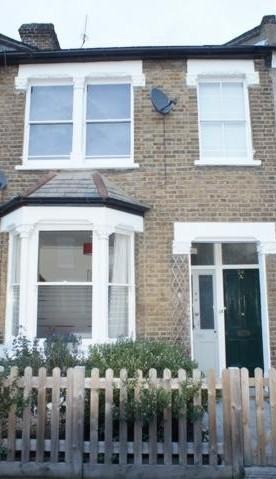
By 1895, the family had moved to 24A Whately Street and on 22nd August brothers Percy and Frederick were registered at Heber Road School, in East Dulwich, again a short walk from their home.
This school building is also three storeys, typical of the late Victorian era and is still in use as a school now.
24A Whateley Street, East Dulwich
THE WORKHOUSE
On Tuesday 15th August 1899, a week before her mother died of tuberculosis, Grenville Margaret was admitted for the first time to the Constance Road Workhouse, Camberwell.
Grenville Margaret’s case notes on her admission to The Colony state that her father had no choice but to send his daughter to the workhouse at this time, as she was unsafe to be left at home with her younger siblings (then aged between 7 and 15 years) because of her regular fits.
As her mother was also clearly dying, nursing her when Grenville Margaret was having seizures would be untenable.
Grenville Margaret was still an inmate in the Camberwell workhouse on the 31st March 1901, when the 1901 census was recorded. Barely 2 months later, on Friday 24th May 1901, she was released from workhouse at her own request.
Details from the 1901 Census show that by this time her father and brothers were living at 4, Darrell Road, East Dulwich. It seems likely that this is where Grenville Margaret went but on Thursday 13th June 1901, only 3 weeks later, she was again admitted to Constance Road workhouse. Her admission entry bears the words ‘alleged insane’.
ASYLUM ADMISSIONS
From information shown on her last workhouse record Grenville Margaret was transferred to Cane Hill Asylum on 26th June 1901. Enquiries with Croydon Archives have revealed that large swathes of patient notes for the relevant period no longer exist, so no additional information can be gleaned from this period which Grenville Margaret spent in Cane Hill Asylum.
Similarly, the patient notes for Manor Asylum for the period 26th June 1904 to 15th November 1904 are missing so we are at a loss as to why Grenville Margaret was moved on two occasions. Whatever the reason, it is likely that the workhouse and Cane Hill Asylum had little in the way of specialist knowledge in the treatment of epilepsy. That being said, The Colony probably only had contemporary treatments and medication to form a fairly basic treatment plan for the ailment.
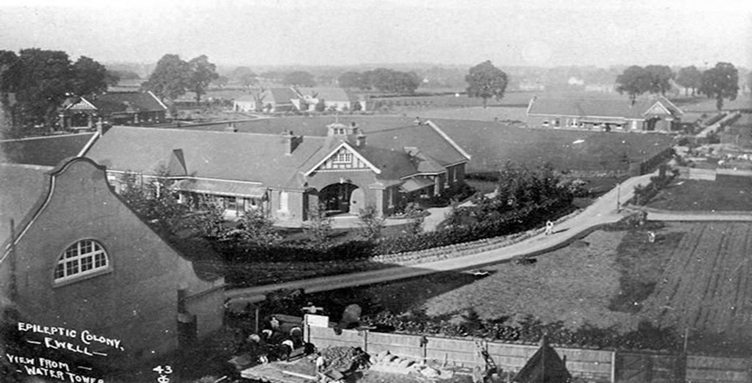
Ewell Epileptic Colony
EWELL EPILEPTIC COLONY
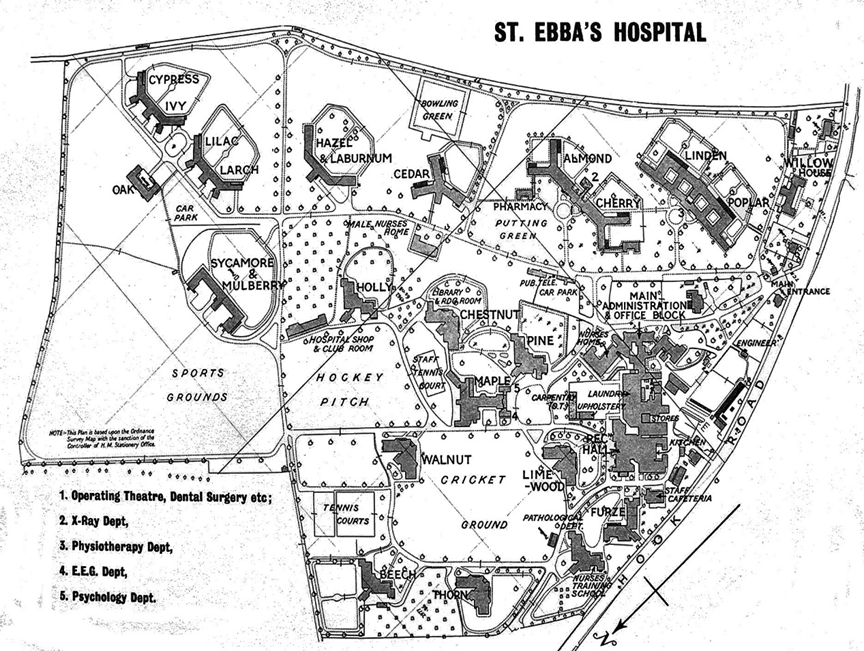
Ewell Epileptic Colony was opened in July 1903 and was the third group of low-level villa buildings which comprised the Horton Estate, known later as the Epsom Hospital Cluster. Each villa had accommodation for 38 male patients, with a veranda and porch enabling them to have access to the open air, regardless of the weather. These buildings formed a type of central village green. The villas were each named after trees, thereby attaching a bucolic air to the premises.
It was intended that The Colony would be self-sufficient, with the patients being engaged on the farm, in the grounds or in workshops, where they crafted simple items such as wire brushes. Female patients were more often engaged in the laundry or kitchens.
Although taken from a post WW2 plan, the above diagram shows the layout of the villas, auxiliary buildings and facilities amongst which the Colonists lived.
Female patients were accommodated in a separate villa housing 32 women, which connected to an administration block, kitchen and hall used for dining and recreation. A cricket pitch and sports field provided outdoor recreational
By the time the Colony had come into operation, attitudes towards epilepsy had changed and there was a growing perception amongst the medical profession that epilepsy was a form of neurological rather than psychiatric illness. The LCC Asylums Committee decided that patients with a mild form of the disease with no signs of insanity would benefit from colony life, so the concept for the Ewell Colony was born.
The aim of the colony was to provide an environment where patients could live in a setting which was less institutionalised and where they accessed gainful employment and fresh air. This must have been far removed from the atmosphere Grenville Margaret previously encountered in Cane Hill Asylum or Camberwell Workhouse.
Medical care for the condition of epilepsy was primarily the administration of bromide of strontium, which was effective to a certain degree in suppressing or reducing the instance and severity of seizures. Great emphasis was also placed on the importance of a well-regulated diet and exercise in an open-air environment. Regular bowel movements were encouraged and if not forthcoming, were remedied by use of laxatives or enemas. Although constipation did not cause epilepsy, it did seem to exacerbate the occurrence of seizures.
Colonists were weighed on a regular basis to ensure that they thrived and the number of seizures they experienced was also recorded. A distinction was made between diurnal and nocturnal occurrences, the latter seeming to be more frequent and severe in a number of patients.
GRENVILLE MARGARET JOINS THE COLONY
Grenville Margaret became a patient in The Colony on 14th November 1904 and is listed as an inmate there on the 1911 Census, taken on 2nd April. On admission she underwent a thorough physical examination and is recorded as being in good bodily health. Her weight was recorded as 9st 6lb but her height was not noted.
Her admission notes state that on being interviewed, she appears to be a pleasant amiable girl, very willing and proud of being industrious. Asked to calculate 12 x 13, she gives the correct answer without hesitation. The medical person interviewing her notes comments, “She gives an excellent parole”. Despite this, her condition is recorded as epileptic insanity.
Apparently neither her parents or siblings suffer from epilepsy, but her fits started in infancy. Her case notes throughout her residency suggest that her fits may have been worsened by her menstrual cycle. This condition is known as catamenial epilepsy, defined as a pattern of seizures that worsen at certain times of the menstrual cycle, thought to be because of changes in the levels of the hormones, primarily oestrogen and progesterone.
Recent studies suggests that catamenial epilepsy could affect around 4 in 10 women with epilepsy. More information can be found on the website www.epilepsy.org.uk/info/seizure-triggers/periods-and-the-menstrual-cycle.
GRENVILLE MARGARET’S CASE NOTES
The binders recording events of her twelve years of residency at The Colony contain A2 sized pages filled with tightly written notes, often difficult to read, about Grenville Margaret’s progress and behaviour. Often, single line entries give only information about weight and the number of seizures she experienced during a month.
Other entries are repetitive, characterising her as weak-minded, quarrelsome and uncommunicative. There seems to be no recognition that her seizures may have had a debilitating effect on her physically and mentally, thereby altering her behaviour and mood, despite often suffering more than forty seizures in a three-month period.
Any entries which do stand out are those which refer to other injuries or illness. On March 28th, 1905 she had her right palm lanced because of a small fluctuating swelling. It was noted on April 17th that her hand was not responding to treatment and that it caused her difficulties when doing housework, rendering her pace of work slow.
On 14th September 1906 Grenville Margaret began experiencing severe bouts of bloody diarrhoea, which made her physically weak. By 24th September she had a raised temperature and her weight had dropped to 7st 11lbs from her previously recorded weight on 22nd June of 9st 4lbs.
On 1st October her pulse rate was 100 and she was still weak. She was diagnosed with a lung infection and she was put on a milk and egg diet. On 3rd October the lung infection was still present though her temperature was recorded as 98 degrees, which placed it the normal range. On the 8Th October it is noted that she is to receive three pints of milk and three eggs in addition to her usual allocation of food.
In the following days she is restless and her temperature rises to 102 degrees. It is observed that “she makes no attempt to do anything for herself”. Little wonder given what she had been through.
From the end of October to the end of December 1906 there was a steady improvement in her health and she was put to doing light housework. Her weight was now 8st 12lbs and during the coming months returned to her pre lung infection levels.
The last notes found on Grenville Margaret are dated 24th September 1915. The Colony was by now being partially as a hospital for war veterans with psychiatric illnesses, so disruption of case notes and facilities was to be expected. Grenville Margaret died on 27th December, 1916, aged 35 years. Her death certificate notes that she had suffered from influenza for 2 weeks prior to her death.
Her previous address on her death certificate is shown as 4 Darrell Road, East Dulwich, which would suggest that when she discharged herself from the Constance Road Workhouse for a short period, she had lived with her father and brothers, who had by this time moved to the East Dulwich address.
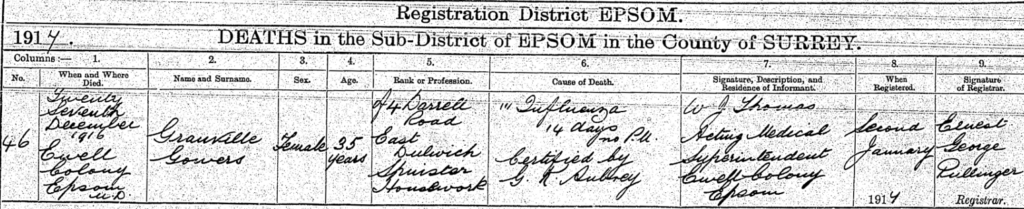
1916 Death certificate Grenville Margaret Gowers
NEXT OF KIN
Grenville Margaret’s case notes include details of her next of kin, the first two of whom were her father Thomas Snr and her brother Thomas Jnr. The third entry is for an aunt, shown as Mrs A Rushton of Camberwell. Born Annie Collins Briggs, she was the sister of Grenville Collins Briggs. She married Richard Rushton, a mercantile clerk in1879. Having given her details as next of kin she was obviously still interested in Grenville Margaret’s wellbeing.
Thomas Snr had remarried in 1907 and obviously had not updated his new address. Thomas Jnr had moved from Deptford to Lewes but had notified The Colony of his new address.
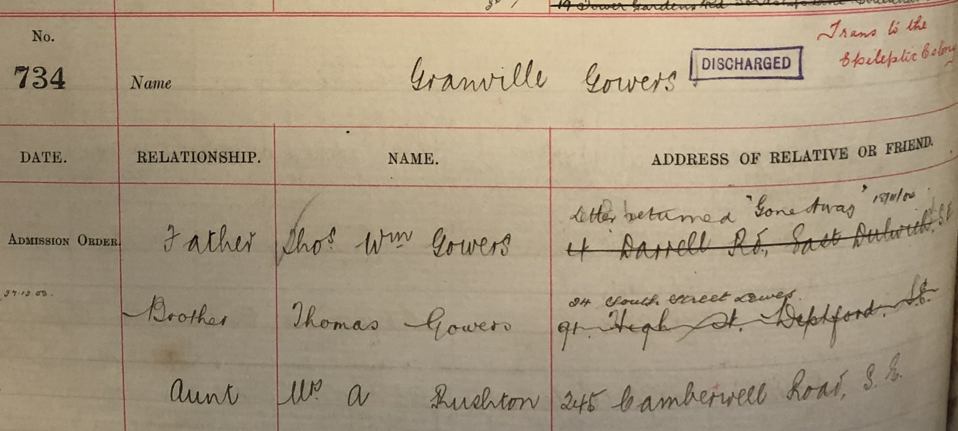
Details of Grenville Margret’s next of kin
The Gowers family after Grenville Margaret goes to the Colony
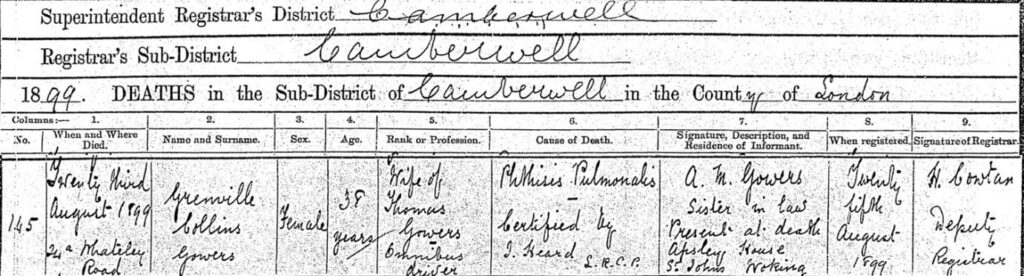
Grenville Margaret’s mother – Grenville Collins died, aged 38 years, on 23rd August 1899 at her home address of 24A Whateley Road, Camberwell. Her cause of death was Phthisis Pulmonalis (pulmonary tuberculosis). Her sister-in-law A.M. Gowers was present at the death and was the informant. Grenville Collins only had sisters and although Thomas Snr had two brothers, neither married to a person with the initials A.M. so no identity has been found for this lady.
Grenville Margaret’s father – After the death of his wife Grenville Margaret in 1899, Thomas Snr moved to 4, Darrell Road by the time of the 1901 census, now working as an omnibus driver. Grenville Margaret mentions this in her admission interview, so someone from the family is keeping her up to date with family matters. His sons Thomas Jnr, Frederick, Percy and Albert are still living with him. Thomas Jnr was working as a tea grocer, whilst his three brothers were still at school.
Thomas Snr re-married on 21st August 1907 to Margaret Pride. She was a 28-year-old spinster living in Camden, so it is unclear how they met. On census returns prior to her marriage, Margaret’s birthplace was shown as Lambeth, so it is possible they met when she was visiting relatives in Lambeth, or when she travelled on his omnibus. Margaret lived at 82 Park Place, Camden, her childhood home, where her father worked as a tobacconist.
In census returns after their marriage, Thomas Snr and Margaret were shown as living at this same address, their occupations being listed as tobacconist and tobacconist’s assistant.
Thomas Snr died aged 68 years, during the first quarter of 1927, in the registration district of Pancras. Margaret died in 1935, leaving an estate of almost £700, which today would be valued at approximately £35,000. It appears that Thomas Snr and Margaret did not have children.
SIBLINGS
Percy Sydney (b.01/09/1886)
- 1911 census – visitor at 26 Archdale Road, occupation – baker
- 1914 war service – baker on a merchant ship
- 1917 ship’s list – 20th February arrival from Canada on ship CARAQUET
- 1919 marriage – to Elizabeth C Harper 4Q Camberwell
- 1921 census – 13 Heber Road, Dulwich with wife Elizabeth, occupation given as ships baker (unemployed)
- 1923 electoral roll – 13 Heber Road, Dulwich
- 1939 register – 61 Rodwell Road, East Dulwich, occupation – baker
- 1945 electoral register – 53, Stonefield Road, Hastings
- 1956 death – 1Q in Hastings
Albert Stephen, January 1892
- 1901 census – 4 Darrell Road, East Dulwich, with his three brothers
- 1911 census – 77 St. Saviours Road, Croydon, with his brother Thomas William Jnr. Albert is shown as a visitor, who works as an assistant manager at a clothier’s shop. Thomas William Jnr is shown as a boarder at the premises.
No other confirmed records for Albert Stephen, but Ancestry UK does contain a family tree which indicates he may have travelled to New Zealand, remaining until his death.
Thomas Frederick William Jnr (b. 12th April, 1884)
1911 census – 77 St. Saviours Road, Croydon, with his brother Albert, who is shown as a visitor and works as an assistant manager at a clothier’s shop. Thomas Jnr is shown as a boarder at the premises, whilst working as a manager in a grocers shop.
Frederick William (b. 8th June 1889)
Because of Thomas Snr’s habit of duplicating names for his sons, it has been difficult to positively identify Frederick William or Thomas Frederick William Jnr and no further information has been found.
AUTHOR’S NOTE
The purpose of this profile was to give life to Grenville Margaret’s personality, after almost 125 years in an unmarked grave in a derelict cemetery. Given that she had lived in one institution after another from 1899 to 1916, there is little information other that provided by official records, which concentrate on medical and behavioural matters. This is no criticism on the staff at The Colony. No doubt they were as understaffed as NHS facilities are today.
It is clear she remained as part of a loving family until her mother was dying of tuberculosis. Her constant seizures put herself and her siblings in danger and one can only imagine the anguish her father endured in deciding to put her into the work house.
Her notes from The Colony show that when not affected by the after effects of her seizures, she liked to converse with other members of The Colony and socialise after completing her work. We will never know what her favourite subject was at school. Did she play hopscotch in the playground of Peckham Park School? Did she enjoy folding cigarette papers, thereby contributing to the household income? Did she ever have a sweetheart?
It’s sad to realise that had Grenville Margaret been born even 30 years later, she would have benefited from advances in treatment of epilepsy and been able to live a relatively normal life with her family.