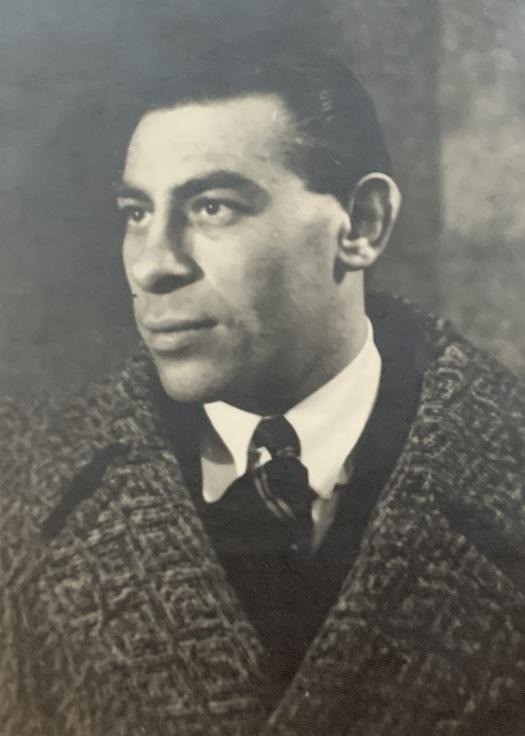
Back in 2023, in a chance conversation with Jeremy Harte, the curator of Bourne Hall Museum, Roger Morgan (a local researcher) learnt that the museum had copies of the correspondence from George Saunders’ widow with the Epsom and Ewell Borough Council.
They told of her dismay that her late husband’s Horton Cemetery headstone had been lost. Georgeis also mentioned by Jeremy Harte in the History page of our website.
In her letter dated 6th August 1984, she noted that he had been “an ambulance driver and drove through the worst bombing raids on London until he was injured” – the implication being that he was brought to Epsom as a patient to the war hospital.
She later indicated that she would be approaching the Commonwealth War Graves Commission about getting his wartime service and death appropriately acknowledged. That apparently did not happen, and George is not mentioned in the CWGC database. The widow signed the letters, “Doreen Saunders”.
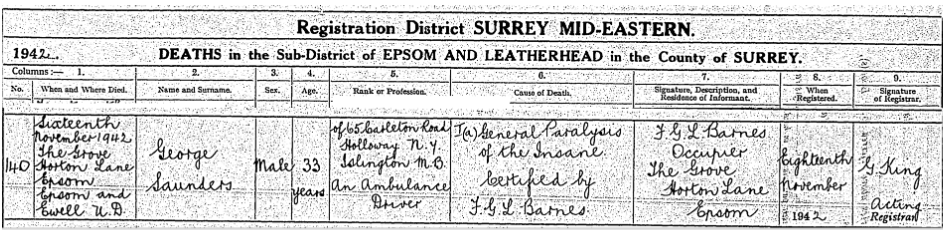
Roger’s assumption so far had been that, following his wartime injury, George had been taken to the Horton War Hospital – and so he obtained a copy of his death certificate. This makes no mention of any injury but records his death in The Grove as the result of “General Paralysis of the Insane”.
After Roger shared this information with me, I started looking for the facts about George’s life before his entry to The Grove/Long Grove Hospital. This proved frustrating as, apart from finding him on his marriage entry, and in the 1939 Register and finding his son John’s birth entry, I was drawing a blank.
Fortunately, I discovered that George’s daughter-in-law Muriel Saunders had recently started a family tree on Ancestry and after contacting her, I must thank her for shedding light on George’s real name and for her generosity in sharing photos and details of his short but fascinating life.
A Change of Name
George Saunders had in fact been born as Woolf Solomons, and his Jewish roots went back to Amserdam, Holland, Netherlands, where his grandparents Alexander Salomonis (1845 – 1922) and Esther de Jong (1845 – 1903) were born.
The family first appear in the UK with the birth of their eldest child Solomon Solomons in in 1868, in the registration district of Whitechapel in London. His birth was followed by the birth of Woolf’s father, Jacob, in 1869. In total, Esther gave birth to twelve known children between 1868 and 1890. All the children were registered with the surname Solomons. However, the 1871 Census still recorded the family name as Salomonis and that Alexander was working as a cigar maker to support his young family who all lived in Whitechapel.
Woolf’s father Jacob learnt his trade cutting upper leather and lining materials to exact measurements for boots and shoes and became a qualified journeyman ‘Boot Clicker’. He was aged 27 when he married Woolf’s mother Leah Cohen in 1896.
Jacob and Leah had eight known children – Henry born in 1899, Alexander in 1901, Samuel in 1904, Esther in 1905, Woolf (George) in 1907, Solomon in 1910, Julius in 1912, and Bahrend in 1914.
At the time of Woolf’s homebirth on 9th November 1907, the family was living at 48 Henley Buildings, a London County Council property in Mount Street, Bethnal Green.
George’s birth certificate
The 1911 census recorded that Jacob aged 41, Leah aged 36, and their children Henry aged 12, Alexander aged 10, Samuel aged 7, Esther aged 5, Woolf(George)aged 3, and 7-month-old Solomon were still living at the same address.
By 1921 the family had moved to 86 Temple Street in Bethnal Green.Woolf (George)was aged 13 and still in school. His fatherJacob was working as a Boot Clicker for Weintraub Boot and Shoe manufactures in Morning Lane, Hackney. Jacob died aged 63 on 24th March 1932.
A Wrestling Career
When Woolf(George)started his wrestling career, he dropped his birth name and became George Saunders, which is how he will be referred to from now. Even so, it seems that George was usually called Al by his family.
George also had ‘ordinary’ jobs including being a motor mechanic, a reception clerk, a film star’s body double, and an ambulance driver.
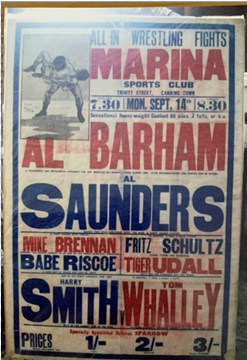
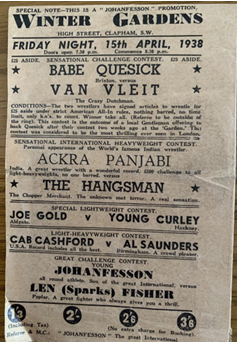
Above: St. Leonards on Sea (1935); Canning Town(1936). Information provided by members of the Wrestling Heritage Forum, who were pleased that George’s life story had been captured by the Friends of Horton Cemetery.
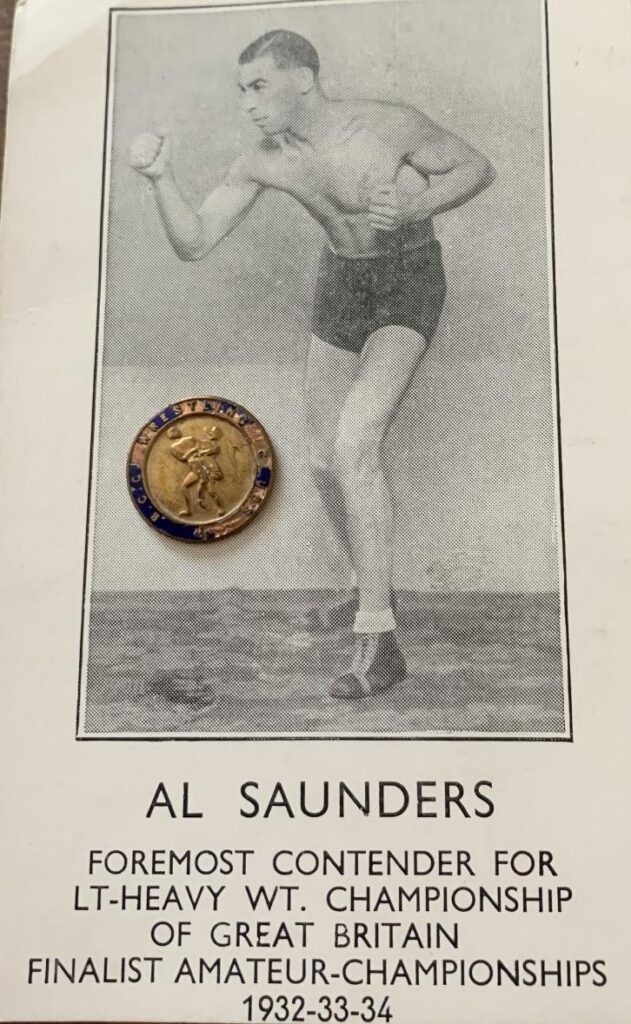
George used several aliases in his wrestling career including George Alton Saunders, Al Saunders, Sam Saunders, Pedro Silvain, and The Jewish Flash.
His career peaked when he became the foremost contender for the Light-Heavy Weight Championship of Great Britain and a finalist in the Amateur Championships in 1932, 1933 and 1934. [Light heavyweight is a weight division above 165 pounds (75 kg) and up to 178 pounds (81 kg), falling between middleweight and heavyweight].
Political Activity
Newspapers around England started reporting in February 1934 that nineteen members of the British Union of Fascists had been bought to court in Eye, Suffolk, under “Public Mischief” charges.
George Alton Saunders was named as one of the Blackshirts arrested on charges alleging that between 9th and 16th February they had conspired to “effect a public mischief in obstructing the seizure of pigs and cattle lawfully impounded for under distress for tithe”.
All the accused were committed for trial at the Central Criminal Court where it was alleged that they,
conducted themselves as an apparently organised force so as to cause alarm to His Majesty’s subjects; to cause public mischief by diverting the constables of the East Suffolk Force from all ordinary duties; and by their action inciting to the commission of crime and a breach of the peace and against the peace of the King, his crown and dignity.
During the trial, fifteen of the nineteen men accused wore the full uniform of their organisation.
From various newspaper accounts the gist of it was that the accused had, uninvited, entered Hall Farm near Wortham, Suffolk, and started digging trenches there across the entrances of the piggery and cattle sheds. They barricaded the trenches with vehicles and dragged felled trees across gateways to prevent the removal of the impounded animals. When the police arrived, it was said that the accused lit two 12-foot-high bonfires.
After hearing the full account, the judge advised the accused, who had all pleaded not guilty, that he was satisfied that they had meant no harm, but they had been previously ill-advised as to what they could legally do. He then bound them over to keep the peace in future.
George was listed in one newspaper as “George Alton Saunders, 23, motor mechanic, Fascist Branch Headquarters, Pembridge Villas, Bayswater”, but Muriel believes that George’s involvement with the Blackshirts was only for a short time.
Sir Oswald Moseley had founded the British Union of Fascists in 1932 and recruited a group of wrestlers/boxers as bodyguards, not realised that some of them were Jewish. So, when he turned onto the Jewish people, they turned away from Moseley and his cause. Moseley was imprisoned and the British Union of Fascists was forcibly disbanded in 1940.
In the News
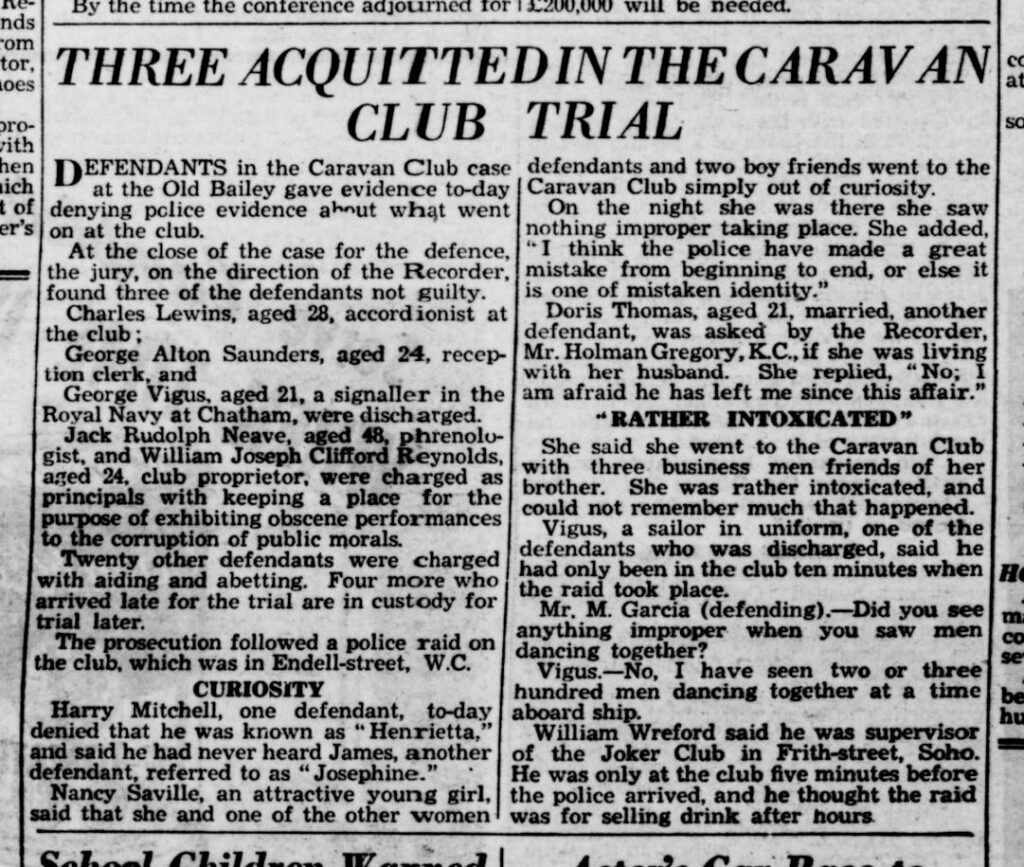
George made the newspapers again when they published articles in October 1934, with the headlines reading “Caravan Club Charges”.
In total, twenty-six men and women were on trial, including George Alton Saunders. Jack Rudolph Neave and William Clifford-Reynolds were charged with keeping a disorderly house and corrupting public morals.
The other defendants were charged with aiding and abetting.
When questioned, George described himself as aged 24 and a reception clerk at the club and said he had never seen anything improper happening there.
Under direction of the Recorder of London, the jury found George and two others ‘Not Guilty’.
Evening Standard 25th October 1934
More Wrestling Competitions
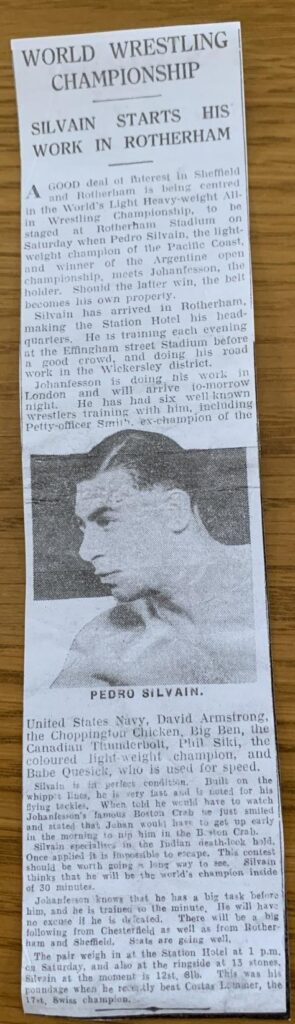
On Saturday 20th July 1935 George was billed as “Pedro Silvain, from South America, Light-Heavy weight Championof Pacific Coast. Winner of the Argentine Open Championship and Gold Belt 1934” when he fought Johanfesson (Joseph Sheppard) for what was advertised as the “‘All-In’ Light-Heavy-weight championship of the world”.
It took place in Sam Morton’s Stadium in Effingham Street, Rotherham. Under American Championship Rules, the match was to be wrestled in 10-minute rounds, and the match would be decided by 2 pin falls, 2 submissions, or 2 knock outs. I was not sure who had won, until a member of the ‘Wrestling Heritage Forum’ made contact and informed me that Johanfesson won that match in the fourth round.
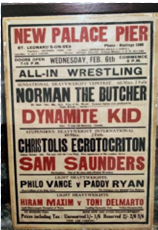
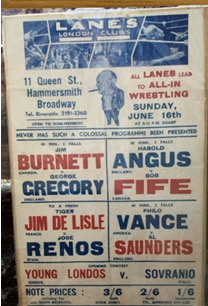
Muriel has shared with me several posters advertising his wrestling bouts; unfortunately, most are not dated with the year they were printed.
Above: Lane’s Club #2 London (1935) Information provided by members of the Wrestling Heritage Forum. More historical information was provided as follows,
Pedro Silvain was invented by Johanfesson (Joe Sheppard) for use on his shows at Rotherham. The promoter of the shows was Sam Moreton, but Sheppard booked all the wrestlers for him.
After their match Silvain also worked with Jack Quesick at Rotherham twice. Jack Quesick was Sheppard’s son, using his own mothers maiden name for wrestling purposes.
Basically Silvain was invented and built up with a back story to make these guys look good. He may not have been Pedro Silvain at any other venue. (Wrestling Heritage Forum).
Family Life
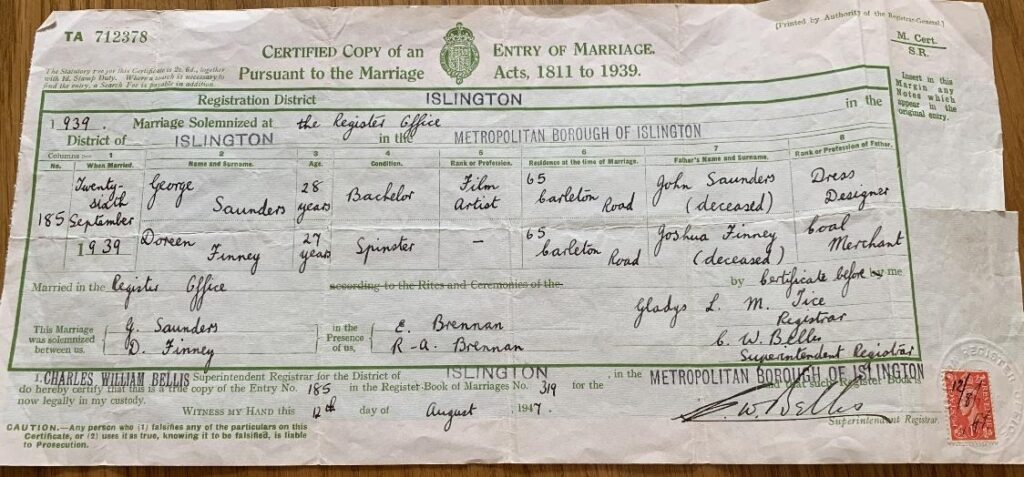
Aged 28, and using the name George Saunders, George married 27-year-old Doreen Finney, on the 26th September 1939 in the Islington Register Office. Doreen had been registered at birth as Doris and had been born in Rochdale, Lancashire, on 28th July 1911.
George gave his deceased father as ‘John Saunders, Dress Designer’, and Doreen gave her deceased father as ‘Joshua Finney, Coal Merchant’.
At the time, George gave his occupation as ‘Film Artist’. This was, according to Muriel, because he was a regular stand in for the American film actor George Raft, as well as being a wrestler.
George and Doreen’s 1939 marriage certificate
1939 Register
To issue wartime identity cards and ration books, the 1939 Register was taken on 29th September 1939. George and Doreen were recorded as both living at 65 Carleton Road, Tufnell Park, Islington. However, the 1939 Electoral Register recorded them living at the same address but as George Alton Saunders and Doris Saunders.
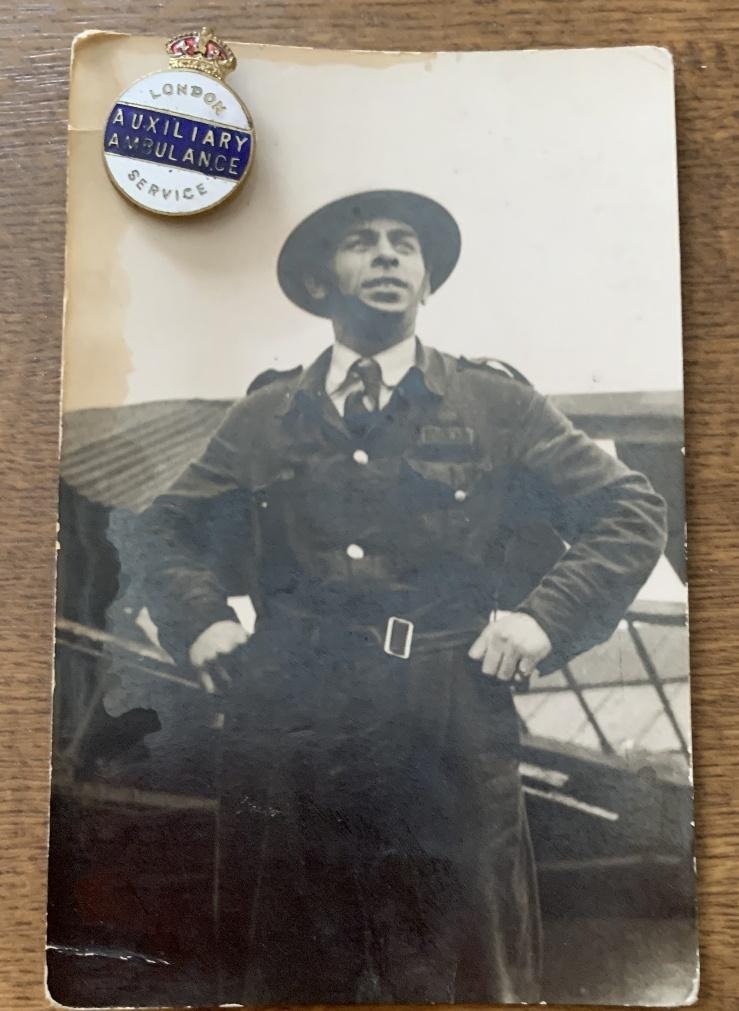
George was listed in the 1939 Register as being born on 9th November 1909 and that he was a “professional wrestler”, but with an additional comment noting that he was also an “Ambulance Driver” in the London Auxiliary Ambulance Service.
Doreen’s date of birth was recorded as being 28th July 1912, and later the words “Deed Poll 29.10.43 Savo Suddery” was added next to her name.
George in his London Auxiliary Ambulance Service uniform; inset is his badge
Injuries Sustained
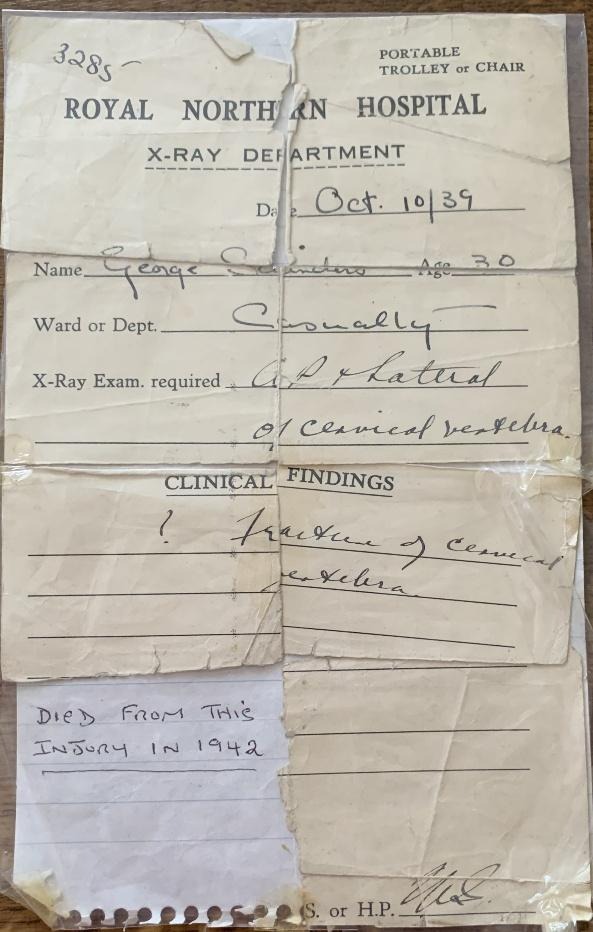
On 10th October 1939, after George was injured in a bout in the wrestling ring, he was taken to the Royal Northern Hospital where x-rays taken showed that he had a fractured cervical vertebra [neck bone].
X-ray report 10th October 1939
George and Doreen’s only child John David Saunders was born the following year on 16th April 1940.
During ‘the Blitz’, which lasted for eight months from 7th September 1940 to 16th May 1941, George was badly injured.
He was flung across a room during a blast that resulted in him being paralysed from the neck down. This resulted in him being admitted to Horton Hospital in Epsom.
Whether this was connected to his previous neck injury is unclear but most likely.
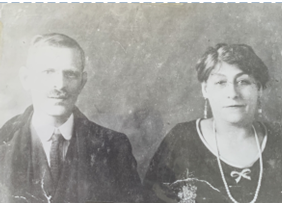
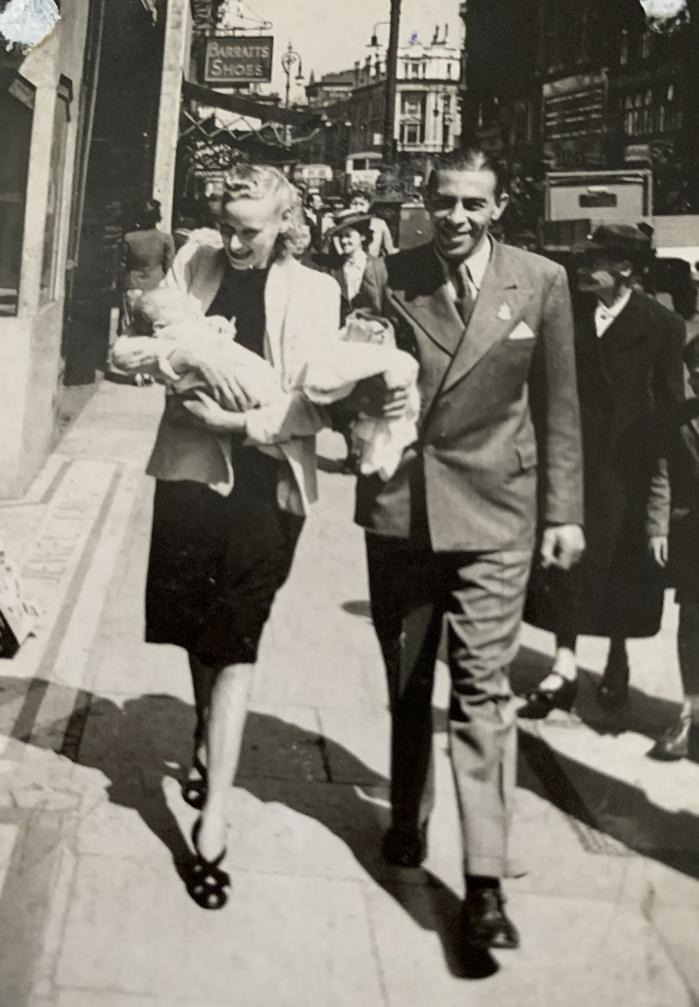
Doreen, holding John, and George shortly before his injury
Muriel related that,
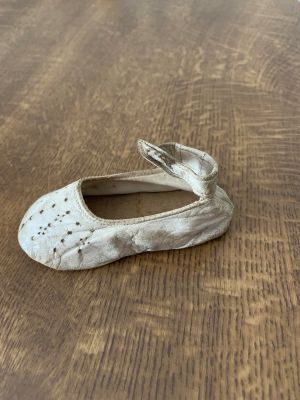
…. even though he was hospitalised, Doreen visited often, taking John with her. On one occasion on her way home, she noticed John was missing one of his little shoes. Thinking the one he had on would be of no use, she threw it away. It was after George had passed away that John’s other little shoe was found under George’s pillow. I still have that little shoe.
More recently, Muriel has said about the shoe, ‘I treasure it like gold.’
George died on 16th November 1942 in Long Grove War Hospital in Epsom, Surrey.
Although his death certificate states he died from General Paralysis of the Insane, his family strongly dispute this, plus it must be said, would he have been capable of driving an ambulance if he was in the final stages of this disease?
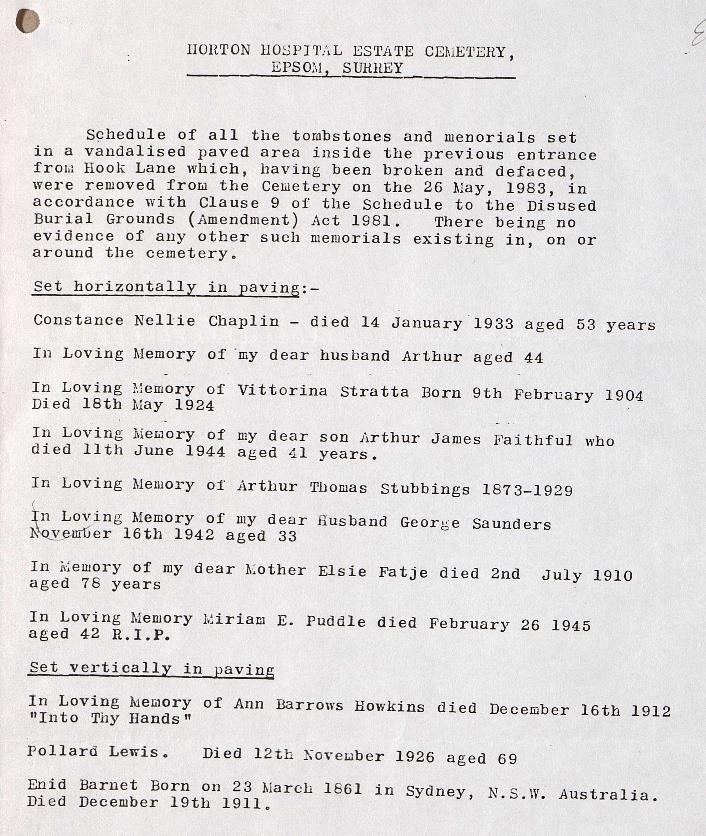
After George’s body was buried in the Horton Estate Cemetery in grave 2426a on 21st November 1942, Doreen arranged for a headstone to be placed on his grave with the following inscription:
In Loving Memory of my dear husband George Saunders November 16th 1942 aged 33
Muriel also added,
One thing I remember is that by the side of where George is buried, there was a yew tree growing. It was rumoured that the yew tree had been planted over a grave of a female and it would never die. How true that story is I can’t say. Doreen always said she knew the exact spot to George’s grave was by seeing the yew tree.
Doreen’s life after George’s death:
As previously mentioned, there was an amended update made to Doreen’s entry on the 1939 Register, and on 29th October 1943, Doreen changed her surname by deed poll to Savo. The reason being that Doreen was living with Antonio/Anthony Savo, known as Tony, who was a parquet floor layer, a talented musician, and married to someone else.
In 1944, Doreen gave birth to their daughter Rosina Francesca. Between 1945 and 1951 the London Electoral Registers recorded Doreen Savo as living at Flat 12, 117 Blackstock Road, Islington.
Muriel writes that
Before George passed away, he asked his best friend [Antonio Savo] to take care of Doreen and John, they lived together for a while and then Doreen became pregnant with Rosina. That’s why she changed her name by deed poll to Savo. However, they parted and Doreen was left to bring John and Rosina up alone.
As they got older, Doreen would find employment that had living accommodation with the job. Unfortunately, Doreen became seriously ill, and she lost the accommodation and the children went into an orphanage. As she recovered, she would visit them as often as possible. Whilst the children were in the orphanage, they became friends with two children, Edward and Gloria Suddery. Between them they devised a plan to introduce their parents, long story short, Doreen and Charles married to make a home for the children”.
In 1953, Doreen was living at 37 Horn Park, Woolwich, along with her future husband Charles Henry J. Suddery. They were married in the Lewisham registration district in 1954 and were living at 11 Farley Road, Lewisham; by 1955 they had moved to 88 Blackheath Hill, Lewisham.
Muriel continues,
Being unable to secure a house in London, they moved up to Bury in Lancashire where Doreen’s half-brother lived. The reason they later moved to Loughborough was that after Rosina finished teacher training college, she gained employment in Loughborough and so Doreen and Charles moved to Loughborough where they ran a boarding house for overseas students.
By this time John and I were already married in 1964, and we made the move to Loughborough in 1971.
Muriel wrote of their visit south to see her father-in-law George’s grave in the Horton Estate Cemetery:
Doreen was devastated when we took her to see George’s resting place and found it absolutely overgrown ………..As for the headstone, I can’t remember where and when I noticed it, but apparently the headstone for George was found along with others resting along the inside of the cemetery.
George’s headstone was one of eleven that were removed from the cemetery on 26th May 1983.
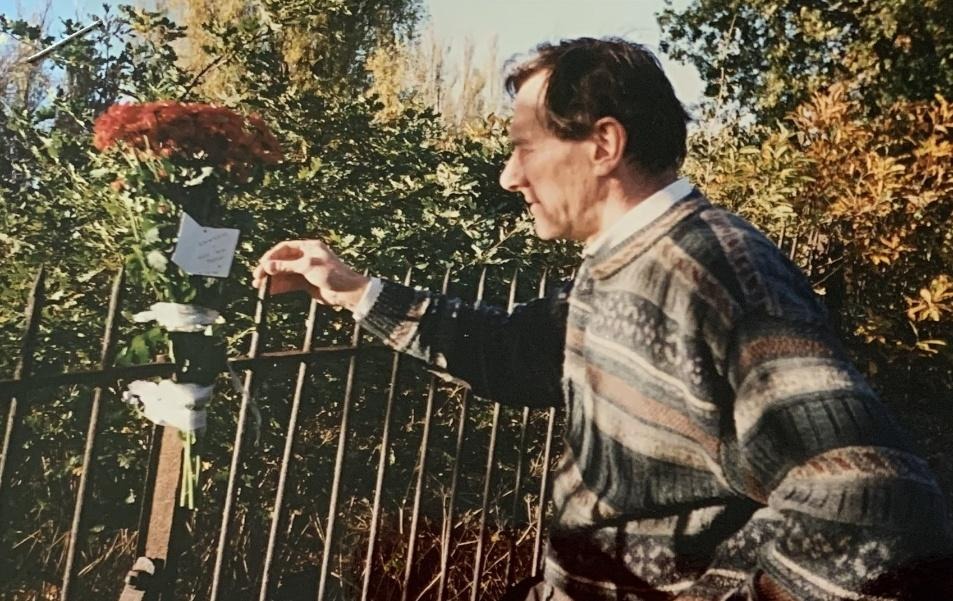
Doreen died on 6th June 1991 but later in 2002 John and Muriel, after donating £1,000 towards it, attended the unveiling of the granite memorial which was placed outside the boundary of the Horton Estate Cemetery in memory of all the people buried there.
Charles had died on 23rd October 1978.
Rosina had married James Matthews in 1966 and died on 20th February 2021.
John died on 15th March 2013.
John Saunders outside the railings that surround Horton Estate Cemetery
A message from Muriel:
As a family we are so grateful and proud that George Saunders and all the other families that have loved ones buried in the cemetery are not forgotten.
With thanks to Roger Morgan for instigating this research.
With grateful thanks to Muriel Saunders for sharing her memories and all the photographs used.
Copyright
If you use the published stories, partly or completely, written by volunteers of the Friends of Horton Cemetery charity (Reg. No. 1190518), please acknowledge the volunteer who wrote the story by name, acknowledge the Friends of Horton Cemetery expressly and its registration number, and include this link to the STORIES section of the website https://hortoncemetery.org/the…/horton-cemetery-stories/
Donate
Occasionally, people ask how they might financially contribute to our charity. There is a Donate link at the foot of each page of the website. All donations will be directed towards continuing efforts to restore and ultimately maintain Horton Cemetery. We thank you for your support.

 1
1
 0
0