
 0
0
 0
0
b. 1870/1-1911
Della – A tragic coincidence or convenience
Della Morrissy is buried in Grave 1524a in Horton Cemetery. Her death certificate tells us she was 40 years old. More importantly it tells us she was married and that her name was actually Bridget, but she was known as Della. An Irish girl who I think came to London for work. For the purposes of this story I shall refer to her as Della her preferred name.
Currently there is little known of Della’s early life. I found a potential entry for her in the 1901 census. There is a 27- or 29-year Cook working at the home of Henrietta Clarke a 74-year-old widow of 23 Stafford Terrace in Kensington. Recorded as Della Brady which was her maiden name. She hailed from Cavan in Ireland.
Della was the only daughter of Patrick Brady a farmer from Clondargan in County Cavan in the Republic of Ireland. It is a very rural area close to the border with Northern Ireland. There is in the 1901 Irish Census a Patrick Brady living at Clondargan Glebe, Stradone, Co Cavan with his sons John Brady aged 32 and Patrick aged 25. There is also a daughter-in-law named Anne aged 45 who is John’s wife. Patrick is a Farmer.
This possibly could be Della’s family. It has been difficult to trace her family with any certainty, as Brady is such a common name but this is the only Brady family at Clondargan I can find. Some family trees identity her mother as Rose Smith but I have no definite proof of this.
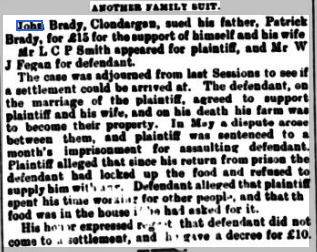
This newspaper article from the Cavan Weekly News dated 27 January 1900 throws some light on the family dynamics.
If this was Della’s family she must have been relieved not to be involved in such a fractious and tense situation.
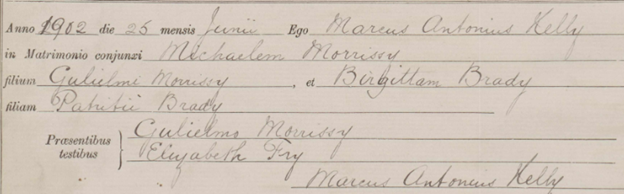
Della married Michael Morrissy on 26 June 1902 in a Roman Catholic ceremony.
A copy in the church’s registers of Della’s marriage to Michael Morrissy on 26 June 1902 held at The Roman Catholic church of St Mary’s in Cadogan Street in Chelsea.
St Mary’s Roman Catholic Church in Cadogan Street
A newspaper article published in The Saturday Record (Ennis) on 19 July 1902 confirms the marriage.
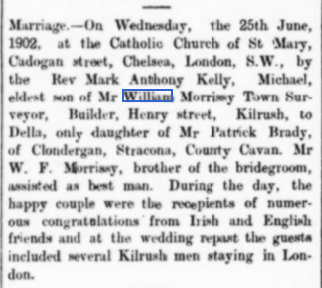
It confirms that Della was the only daughter of Patrick Brady of Clondergan, Stracona, County Cavan and that Michael was the eldest son of William Morrissey who was the Town Surveyor of Kilrush.
It is recorded as a happy event with several Kilrush men travelling over from the west coast of Ireland for the event. The town of Kilrush is in the far southwest of the Republic of Ireland.
Michael’s mother Mary had died in December 1901 at his hometown. Newspaper reports show all the family attended.
I could find no connection with Della and Michael before their marriage, so I imagine that they must have met in London.
Living in Wandsworth
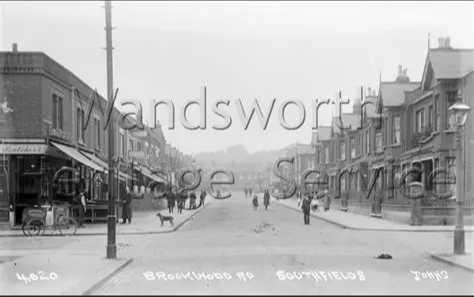
Records from Wandsworth Infirmary state the couple moved to 101 Brookwood Street in the Southfield area of Wandsworth in April 1904.
Michael was working as a Journeyman Carpenter, which meant he was paid on a daily basis.
The Electoral Registers show that this was Michael’s address up to 1908. The area was developed in the 1890s, so the homes would have been recently built. Booths Poverty maps describe the area as a mixed area, meaning there were some people who were comfortable but there were also poor families.
A photograph of Brookwood Road courtesy of Wandsworth Borough Services.
Little is known about the early years of the couple’s marriage, and it is not until the events of 1907 unravel that we find out all is not well.
The events of 1907
On 18 August 1907 Michael’s father William suddenly died in Ireland as reported in the Munster News on 24 August 1907.
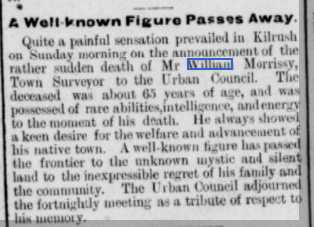
The Kilrush Herald and Kilkee Gazette dated 23 August 1907 reported details of his funeral which took place on Tuesday 20 August when he was interred in the family vault in Shannakyle Cemetery.
There would not have been time for his sons who lived in London to attend as it would have taken around 24 hours by train and boat to get to Kilrush.
How quickly Michael received this news in London is unknown but at that time a telegram could be sent from Ireland to London in under an hour. If a letter was sent by standard mail, it would be received the next day. So presumably someone would have sent news quite quickly to Michael and Della.
Della Enters the Wandsworth Infirmary
On and around 22 August 1907 Della started to display symptoms of what was described as acute and violent mania.
On 29 August 1907 Della was brought to Wandsworth Infirmary by Relieving Officer R O Rutherglen from her home address of 101 Brookwood Road. Michael must have contacted the Relieving Officer with his concerns about her behaviour. On 30 August 1907 she was judged to be insane as seen by James Henry Brown JP. Her husband called in and made this statement.
“This patient is my wife. I was married as Michael Morrissy, a carpenter to Della Brady at the Roman Catholic, Cadogan Street on 26 June 1902. We went to live at my present address in April 1904 and have lived there continuously ever since. I cannot make any offer of payment at present as am out of work. I told Mr Rutherglen this. We have no children” (A search in the General Record Office records confirms there were no children).
The margin notes confirm no funds and that she was settled in Wandsworth. The decision was made that Della would be sent to Long Grove Asylum in Epsom.
Della’s reception order reveals the state of her health. It stated that the attack started about a week prior to the 30 August 1907. She was clean and was in a fair bodily condition.
Examination revealed she was covered in recent bruising and abrasions. Both eyes were blackened. She had bruising on her right chin and abrasions and bruising to the left side of her chin. She had bruises and abrasions to her left and right arms, in particular her left forearm. A few small bruises on her back and one on her abdomen. There were also small bruises on her legs and thighs. Had she inflicted these on herself or had someone tried to restrain her in a violent manner?
It states she was violent to those around her.
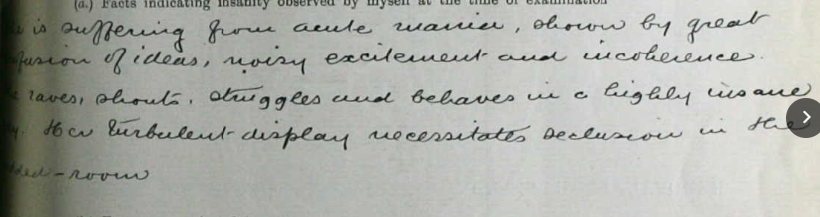
It reads that “she is suffering from acute mania, shown by great confusion of ideas, noisy excitement and incoherence, raves and shouts, struggles and behaves in a highly insane manner. Her turbulent display necessitates seclusion in a padded room”.
What caused this sudden violent change in her mental health? We will never know for certain.
By 30 August 1907, Della was moved to Long Grove Asylum in Epsom.
Michael Moves to Ireland
On 7 September 1907 there were newspaper reports that there was “much canvassing” in Kilrush for a new town surveyor. Michael Morrissy was in the running with a prospect of success but had decided to remain in London in his present position in London and announced his retirement from the election.
But Michael must have had a change of heart because on 23 October 1907 and 1 November 1907 there were reports of 2 applications of candidates for the Kilrush Town Surveyor. Michael and a Joseph Brews of Ballyona House of Kilrush.
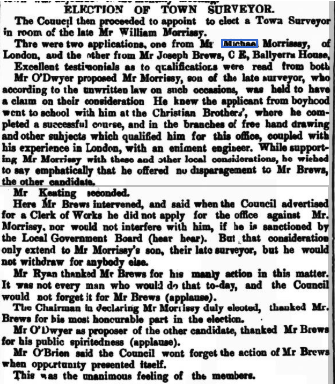
The article shows the report from The Kilrush Herald of 1 November 1907.
So, Michael was duly elected to follow in his father’s footsteps. On 9 November there was a further call for more testimonials and on 14 December 1907 the appointment was sanctioned with a salary of £25 a year. Michael wrote from his home in Southfields that he would be accepting and would take over the following Friday or Saturday.
By the end of the year Michael had moved back to his hometown minus his wife who was now a patient in Long Grove.
Long Grove
There is evidence in the unindexed records for Wandsworth that in 1908 Michael was paying 5 shillings a week towards Della’s maintenance, but it looks like only 10 shillings were received. From further ledgers it does not look like any further payments were made by Michael for his wife’s care.
The 1911 Census records Della by her initials only as a patient of Long Grove from Ireland. Her illness started when she was 36 years old.
Della’s death and the informant
Della survived for nearly 4 years at Long Grove. She died on 23 May 1911 of Dysentery (Ulcerates Colitis) which she had had for 3 weeks and Lobar Pneumonia of 4 days duration. Her death certificate confirmed she was the wife of Michael Morrissy of 101 Brookwood Road, Wandsworth a journey man Carpenter.
Michael is listed as the informant of her death and the certificate is dated the 27 May 1911 the same day that Della was buried. Michael’s address was given as his 101 Brookwood Road in Wandsworth. We know that by now Michael was living in Kilrush and it would have taken him at least 24 hours to get to Epsom. However Della had been ill for 3 weeks so he would have had time to come to England before she died.

This raises more questions about Michael and Della. Did he really return when he heard of her illness in Epsom? As he was in London when she died, he was able to register her death and stay to see her buried at Horton Cemetery? Or another scenario occurred to me that perhaps he sent his brother John (Jack) who was living at the Brookwood Road address to impersonate him?
Della was buried on 27 May 1911 in Grave number 1524a of Horton Cemetery.
The 1911 census entry for 101 Brookwood Road shows a Morrissy family were living at this address but not Michael. It was a John Morrissy aged 36 a Carpenter and Joiner from Kilrush, Ireland. His wife Mary aged 37 also from Ireland and their 3 children Mary aged 5 who was born in Fulham, Daniel aged 3 and John aged 7 months both born in Wandsworth. This was Michael’s brother.
Michael Morrissy’s life in Ireland after Della.
Michael was the primary beneficiary and executor of his father’s estate which amounted to £70 and 11 shillings which is approximately worth £9000 to £10,000 in today’s money (based on 2024/2025 data)
Why did Michael say he had no employment to the Relieving Officer – so he would not pay for her care? Yet, he told the Kilrush council on 7 September 1907 he had a job in London. On 23 October 1907 he said he had experience in London with an eminent engineer. What was the truth?
Michael arrived in Kilrush in late December 1907. He lived in the family home in Henry Street with his brother Henry aged 28 and sister Bridget Delia aged 21.
Newspaper articles show he soon settled into his role as Town Surveyor. Things were not smooth sailing as numerous newspaper articles stating his first year in office was tempestuous and difficult as he locked horns with Thomas Learhinan the Town Overseer. They quarreled over work practices and man management.
By May 1908 Michael was forcibly questioning the Urban council as to why his suggestions for sanitary improvements made soon after his arrival had not been acted on. Throughout the year there was friction between Michael and the other officials. By December the Chairman of the council remarked that the meetings had been peaceful and harmonious until the current Town Surveyor arrived.
Michael was in court in January 1909 where an employee alleged that Michael had assaulted him. The case was dismissed but there is evidence that Michael had used violence.
By March 1909 things came to a head, and the Local Government Board had to intervene as things between Michael and Thomas Learhinan the Overseer were grave. There were Charges and Counter Charges. Irregularities were found on both sides. It was recommended that Michael was unfit for the office of Town Surveyor and that the role of Town overseer should cease.
Despite all the trouble Michael had caused, the Council voted that they would retain his services. I think this was partly because of his late father. Thomas Learhinan’s job title was changed to that of Sanitary sub Officer.
Indeed, things did improve after this point but only for a few months. After reading numerous articles about Michael’s role as Town Surveyor, it showed Kilrush Urban Council meetings were often heated and difficult. Michael was normally at the centre of this discord. He was forever at odds with everyone. Michael was a forthright man who clearly did not like to be questioned. There are many instances where he seemed to rub people up the wrong way.
An acknowledgement of Della’s death in Kilrush
This appeared in The Clare Champion of 1 July 1911. Minuted at a meeting of the Kilrush Town Tenants.
.
Michael is mentioned a couple of times in the Petty Sessions records. On 19 June 1911 for being in a licensed premises after closing time and on 10 June 1912 for using threatening language towards Thomas Nagle of Moore Street. Neither the complainant nor the defendant turned up. Thomas was also a member of Kilrush Urban Council.
Michael Marries Again
According to an Ancestry tree Michael remarried on 26 November 1912 a lady called Susan Collins. This is supported by later newspaper articles stating Michael had a son called William.
Susan was a 28-year-old shop assistant working for her cousin in Kilrush.
During 1913 there was further controversy when there was a dispute over the ownership of Michael’s home in Henry Street. It resulted in his family being evicted, and Michael was bound over to keep the peace and imprisoned in Limerick for a few days. Somehow the matter was resolved amicably and legally, and the Morrissy’s were restored as owners of their Henry Street home. The whole town came out to celebrate.
Susan and Michael had 5 children between 1913 and 1919 and Susan died in December 1921 aged only 38 leaving Michael with a young family.
Michael continued to fall out with members of the council. In 1917, they sought to dismiss him once again, saying he ignored their requests and only turned up once a month to collect his cheque. He did nothing for the town. It was said that at every meeting he caused trouble and despite being asked to resign he refused to do so and allegedly instructed his solicitors to send threatening letters to members of the council. Again, his friends managed to save his job with an assurance that Michael would follow instructions.
However, there is evidence that Michael continued to argue with the council as he always had done.
Micheal continued as Town Surveyor until early 1933 when the council reported he was ill and could not conduct his work. This went on until he resigned in February 1935. His son William and brother Jack supported a claim for him to receive a pension for his 27 years’ service to the town even though he was a part time Officer. This was granted by the Local Government Board. There is a burial in December 1958 in Kilrush for a Michael Morrissy – this may be our man.
All this information has been gleaned from reading hundreds of Newspaper articles about Kilrush and Michael Morrissy.
The Morrissy family
Michael was the eldest child of William and Margaret Morrissy. I have traced 8 younger siblings.
As we have seen earlier, William Morrissy was the town surveyor for Kilrush. Prior to this, he was a builder and was responsible for many works in Kilrush. He traded as A Morrissy and Sons. His father before him (Michael) was also a builder in Kilrush.
It is unclear exactly when William became the Town Surveyor but by the late 1880’s he was involved in everything. In 1899 he fell out with the council over harbour improvements and went to London. However, within months he was back in Kilrush working again as Town Surveyor and Engineer. And after completing work at the Workhouse, he was appointed as their Engineer in 1901. This was after a dispute with the previous Matron over stocktaking discrepancies.
He was also an Auctioneer operating out of his address in Henry Street. He also seems to have organised funerals of important people in the Town. It seems as if he was “Mr Kilrush”.
Michael’s siblings
It appears that John (Jack) and William Morrissy came to London prior to 1901. This may be why Michael followed them later.
In 1901 John and William were boarding at 1 Little Ebury Street in St George’s Hanover Square in London. Both were Carpenters from Ireland.
John known as “Jack” married Mary Clancy in 1904 and after living in the same street as William (Strathville Road in Wandsworth), he moved into Michael and Della’s home with his family after Michael went back to Kilrush. I found a blog written by Jack’s granddaughter which confirmed that the family moved back to Kilrush in 1915 living in a small cottage.
William married Ellen Meaney in 1905 in Kilrush. They lived at 13 Strathville Road in Wandsworth all their married lives. They had no children. William died in 1948.
Bridget Morrissy Michael’s sister went to America, but the remaining Morrissy siblings stayed in Ireland.
The Brady family
It has proved difficult to find out anything with certainty. Della’s father must have died between 1901 and 1911 as he is absent from the later census. A family tree on Ancestry shows Della’s older brother John remained in Clondargan. His first wife died in 1915 and he remarried and had one daughter. This tree states John died in 1946. Della’s younger brother Patrick junior died unmarried in 1915 aged 38. I cannot substantiate any of this.
Authors Thoughts
Della and Michael were both Irish but had very different backgrounds. Della, came from a very rural background whereas Michael’s family were highflyers in a busy town. Michael came to London possibly after his mother’s death and probably met Della there.
Sadly, there were no children of the marriage. Little is known about their relationship until 1907. The sequence of events in that year unraveled tragically for the couple. Within days of Michael’s father dying suddenly in Ireland Della became so ill that Michael called for the Relieving Officer to take her to the Infirmary where she was very quickly declared insane. It was said that this was her first attack.
This is a tragic coincidence. There is no evidence that Della ever met Michael’s father, so I am not sure grief was the cause.
Then there were Della’s recent injuries. The nature of these injuries is concerning, and there is no explanation as to how they were sustained.
Why did Michael say he had no work when very shortly afterwards he was in the running for his father’s job in Ireland and he was telling them he was happy to stay in London working for his employer? He then changed his mind but said he had worked for an eminent engineer whilst in London but wanted to be running for his father’s job. Michael was also the executor and beneficiary of his father’s will. How did this all sit with his childless marriage?
Was the marriage happy? We don’t know. The couple were Roman Catholic, so divorce was out of the question. Did Michael feel that he could not or would not take Della with him back to Ireland? Or did Della refuse to go? Was there a disagreement? What I have discovered about Michael is that in my opinion he was not a man to disagree with. On the other hand, I know nothing of Della’s personality.
Did all this upset cause Della to become so confused and distraught that she had to be restrained. How had this sudden illness manifested itself at the time of her father in laws death? Did she have a nervous breakdown? I have so many questions.
Within months Michael had gone to Ireland to start his new life. He did contribute to Della’s care for a couple of months during 1908 but this stopped.
Newspaper articles suggest that Michael was nothing like his father and was a controversial character. The Urban Council meetings were never the same once he arrived in Kilrush. At every opportunity he challenged people. They tried to get rid of him twice but somehow, he survived. He lived off his father’s reputation and if all the hundreds of articles are to be believed he was a very difficult and manipulative man. But on the other hand, he did appear to have some loyal friends who helped him to keep his job.
So, what did this mean in terms of his relationship with Della? Did her failure to produce a child upset him? He could not divorce her but was her mental illness an opportunity for him to get her into an institution? She was according to her Reception Order severely disturbed.
I wonder what he told them back in Ireland about her absence, but Della’s death was acknowledged in Kilrush so they knew about her. Then there is the question of whether he did register her death. Did he make the long journey from Ireland when she was ill and stayed for her burial? Michael could not have had funds to have her buried or did not want to pay for her burial elsewhere, so Della was buried in a pauper’s grave number 1524a in Horton Cemetery. Or did he ask his brother to register her death posing as him?
I can’t help wondering whether Della’s journey into Long Grove was a result of living with this difficult man. Was her illness a convenient way for him to move on and get on with his life? Or was he the cause? But then if he did return to England when she was ill and possibly attend her burial does that suggest another aspect to their relationship we don’t fully understand. We may never know.