Angelina CANNON
As a genealogist I always give newcomers to this fascinating hobby one bit of advice – always look at original documents and never rely on transcriptions or family trees. So, when I started researching Angelina’s life leading up to her burial in the Horton Estate Cemetery, that is just what I did, I looked at her burial record below, saw that she had been aged 70 when she died, giving her a birth year of around 1833.
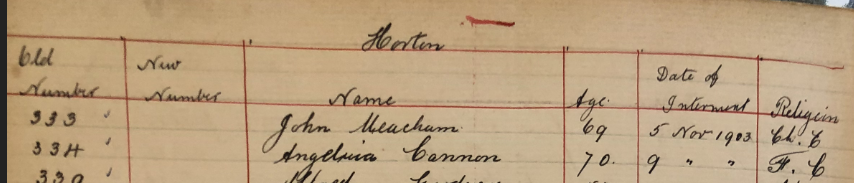
Horton Estate Burial ledger
Using this information, as per usual, I created a new Ancestry family tree and after spending the morning and part of an afternoon looking for any records relating to Angelina, I knew that something was just not adding up.
Yes, I had found her admission entries to the workhouse and asylums, and her removal & settlement entries, but no birth, marriage, or census records. So, what was going on? My other advice to newcomers is that sometimes “less is more” and so I started removing some of Angelina’s information from the Ancestry search engine;
- Removed her first name and did the search again – not helpful.
- Replaced her first name and removed her surname and did the search again – not helpful.
- Replaced both names but removed her year of birth and BINGO!
By doing this, the search threw up her Find a Grave® burial entry, which gave me an interesting fact – Angelina was not aged 70 when she died but was only 28, giving her 1875 as a year of birth.
Not wanting to rely on this transcript (as per my own advice!), I sent for her death certificate below, which confirmed that the official who had written in the Horton Burial ledger had indeed made a monumental typo.

Angelina’s death certificate
Genealogy is addictive, time-consuming and thoroughly satisfying when you finally hit through a brick wall!
The story of Angelina Cannon (1875 – 1903)
Angelina was born on 26th May 1875 in Thame, a pretty village with a thriving market in Oxfordshire; she was the seventh child of nine known children born to Amos (1833 – 1904) and Mary Elizabeth (1836 – 1895) Cannon.

Angelina’s birth certificate
Her father Amos had been 22 years old when he married 19-year-old Mary Elizabeth Wilkins on 13th September 1855 in her local parish church in Kingston Sutton, Northamptonshire. Amos was a sawyer by trade from Long Crendon in Buckinghamshire, and this was where Mary gave birth to their first child George.
- George Edward (1859 – 1945)
- James (1863 – 1863)
- Susan (1866 – after 1901)
- James (1869 – 1936)
- Martha Ann, twin of Harry (1872 – 1872)
- Harry, twin of Martha Ann (1872 – 1945)
- Angelina (1875 – 1903)
- John Ernest (1877 – 1937)
- Thomas (1881 – 1924)
During the early 1860s Amos was also the publican of the Angel Inn, a 16th century coaching inn in Long Crendon. His name appeared with amazing regularity in the local newspapers regarding illegal lock-ins and allowing drunken behaviour in his disorderly house. Unsurprisingly, by the end of 1865 he was bankrupt and given orders to quit his license, but maybe the Angel Inn is where Angelina’s name derived from. It would also seem from the various newspaper reports that Angelina’s father had a temper on him and was also a thief and poacher.
The 1881 census was taken on the evening of 3rd April and Angelina, aged 6, was living with her parents and brothers James, Harry, and John at 1 Park Terrace, Thame.

1881 census
Her brother George was then living in Kings Sutton, Northamptonshire, with their maternal grandmother Sarah Wilkins, and working as a boatman. He later moved to London and married Amelia Gilson on 1st June 1884.
In November 1883, Amos was summoned by the School Attendance Officer for failing to send his children to school, and the local newspaper reported the story on 13th November.
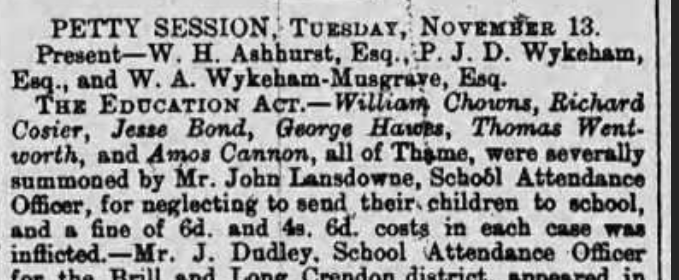
Bucks Herald newspaper
Things were not happy in the Cannon family and on 17th September 1887 Angelina’s mother bought a complaint against her husband claiming that he had struck her several times in the face because she had refused to wash his shirt. Amos was bound over to keep the peace for 6 months and himself in a 10-shilling bond.
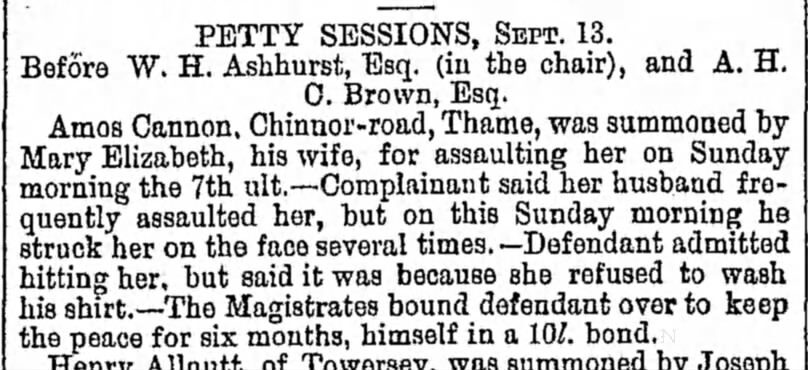
Jackson’s Oxford Journal 17th September 1887
Unsurprisingly, when the 1891 census was taken on the evening of 5th April, Angelina’s father Amos was no longer living with his wife and was living on his own means with an 84-year-old widow named Eliza Cannon.
Angelina’s mother Mary was living at home in Park Street with only her younger sons James, John, and Tom with her.
Angelina had finished her schooling and was living and working as a 16-year-old domestic servant in the Spread Eagle Hotel, a former coaching inn dating back to the 15th century situated in 17 Corn Market, Thame.
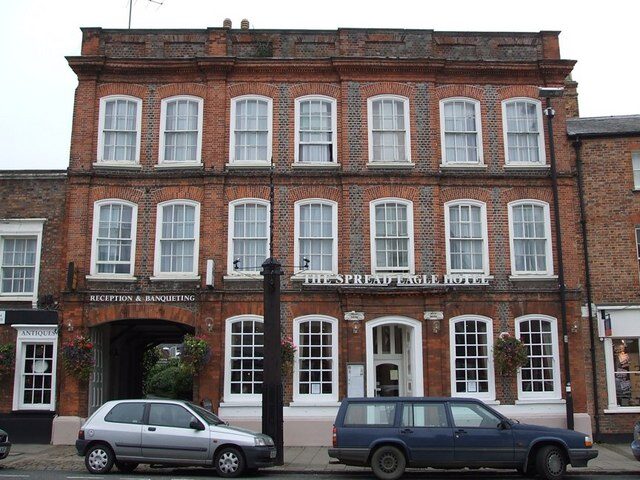
This modern photograph of The Spread Eagle Hotel in Thame
was taken by Rob Farrow and licensed under Creative Commons Attribution-ShareAlike 2.0 (CC BY-SA 2.0).
By 1891 her brother George was working as a corn porter on the London Docks and living with his family in Southwark, Bermondsey.
Sister Susan was away working as a housemaid in the Royal Caledonian Asylum, Islington. She married Thomas Guttridge the following year and had a daughter. As no death record has been found for Susan, she may have remarried after her husband left her; he remarried, possibly bigamously, in USA in 1905.
Brother Harry was not living at home the night that the 1891 census was taken, and his whereabouts have not been found, but the following year he married Esther Ada James in Wycombe, Buckinghamshire and eventually they moved to Sheffield in Yorkshire.
It must have been a sad time for Angelina and her siblings when their 60-year-old mother Mary died from natural causes in her home, 55 Park Street, on 22nd May 1895. Her body was buried in the Thame parish churchyard on 25th May 1895.

Mary Elizabeth’s death certificate
It is possible that it was after their mother’s death that Angelina went to live for a while with her brother Harry and sister-in-law Esther and found work there in Yorkshire as a domestic servant. The address on Angelina’s death certificate was 21 Gt. Pond Street, Sheffield, and this was the address that her brother and sister-in-law were living at when the 1901 census was taken.
Angelina must have returned south as on 2nd May 1900 her name was entered into the UK Lunacy Patients Admission Register. It recorded that she had been admitted into the Springfield Asylum in Wandsworth but was recovered enough to be discharged on 9th February 1901 just before the census was taken. Where she went to is unknown, but her elder brother George may have taken her in. George was away from home when the 1901 census was taken on the evening of 31st March, but Angelina was recorded as being a visitor to his home. She was recorded with her sister-in-law Amelia and her nephews and nieces, as living in 280 Hanover Buildings, which was one of five block tenements built to provide clean, structured housing for the local working-class dockworkers in Horselydown, London.
Sadly, this time with her family did not last and Angelina was admitted into the St Marylebone parish workhouse system. The St Marylebone Parish Guardians decided that as she was a non-resident of their London parish, that she should be sent back to Sheffield. On 20th June 1901 she was sent north and admitted into the Wadsley Lunatic Asylum in Sheffield, Yorkshire.
Records indicate that she was discharged nine months later and sent back south where she was admitted as ‘not improved’ on 19th March 1902 into the care of the Horton Asylum in Epsom, Surrey.
As previously seen, her death certificate states that she was aged 28 when she died there on 3rd November 1903. After a post-mortem, her cause of death was found to be from phthisis, an old medical term for pulmonary tuberculosis, which was a leading cause of death in asylum settings due to the close knitted living conditions.
Angelina’s body was buried in grave 334 in the Horton Estate Cemetery on 9th November 1903. I would like to think that some of her siblings were at her grave side on that day as on 11th November, her death was mentioned in The Bucks and Aylesbury News.
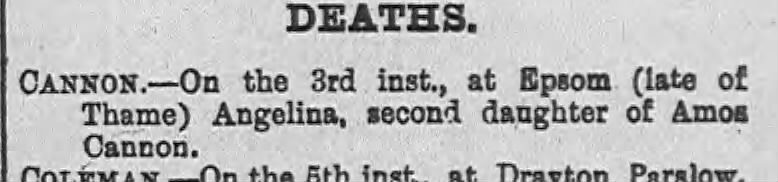
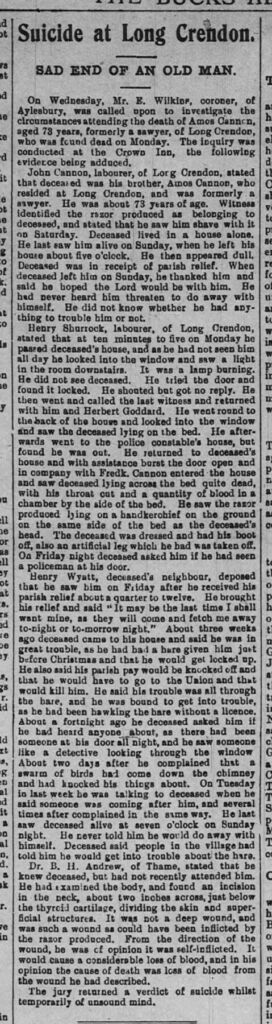
The following year Angelina’s father Amos was aged 73 when he committed suicide whilst temporary of unsound mind. Newspapers seem to think that it was over the stealing and hawking of a hare.