What’s the 100yr rule?
26 August 2026
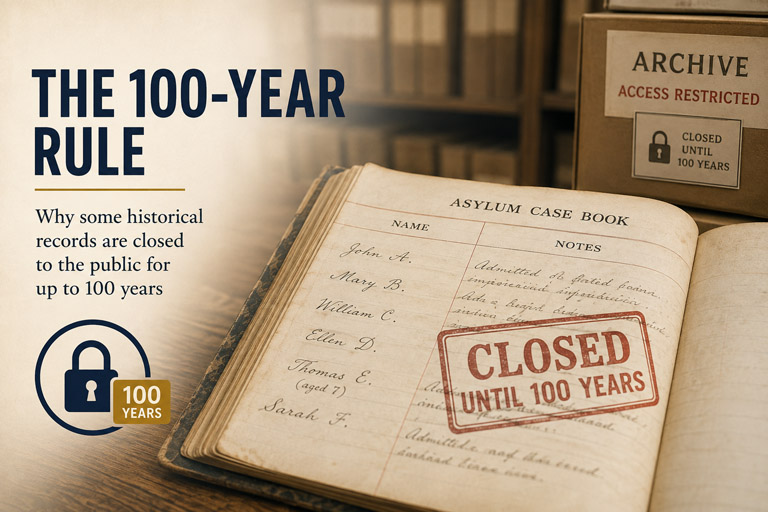
The 100-year rule is commonly used by archives to protect sensitive personal information.
Records containing information about identifiable people may be closed to the public if those people could still be alive. When an archive does not know whether someone is still living, it will often assume a lifespan of 100 years.
For example, an asylum casebook may contain detailed and sensitive information about many different patients. If some of those patients could still be alive, the casebook may remain closed to general public access.
This can mean that an entire volume remains unavailable even if most of the people mentioned in it died many years ago, because information about just one potentially living person may still need to be protected.
Why 100 years?
The 100 years is essentially a practical way of estimating a person’s lifetime.
Imagine that a casebook contains information about a young child. Even if the record itself is very old, that child could potentially have lived for many decades afterwards.
Once 100 years have passed from the relevant date, an archive will normally be able to presume that the person has died, unless there is evidence that they are still alive.
This is why historical patient records containing identifiable information are commonly closed to general public access for around 100 years.
It is worth remembering that 100 years is not an automatic rule covering every archived document. The exact period of closure depends on what information the records contain and the legal and confidentiality issues involved. Proven relatives may also access the private information by way of request to the archive.
What does this mean for research?
The 100-year rule does not mean that we cannot research or write about people who are known to have died.
Where we can establish that a person is deceased, we can use historical records to research and tell their story. However, we still need to be careful about information that could identify people who are alive today.
For example, our research might lead us to the children, grandchildren or other descendants of the person we are researching. We should not assume that because their ancestor’s story is historical, information about living family members can automatically be published as well.
In our work, we therefore avoid identifying living people unless we have their explicit permission to do so. This allows us to tell the story of the deceased person while respecting the privacy of their living relatives.
In simple terms: the 100-year rule does not stop us telling the stories of people from the past. We just need to make sure that, in doing so, we do not inadvertently reveal private information about people who are still alive.