Eleanor GEERE
This story has been written by a family member, Jeremy Geere. Eleanor’s husband Richard was a brother to his great great great grandfather. It is powerful because of the family oral history it records. We learn what happened to Eleanor’s descendants.
Introduction
Eleanor died 14 March 1907 at Horton Asylum aged 79 and was buried in the Cemetery there. The cause of death was given as senile decay. Her occupation was recorded as charwoman, widow of an unknown person of 2 Upper Well Alley, Wapping in London’s East End.
Records show she had been resident at the Colney Hatch Asylum from 12 May 1871 to 3 February 1903 (1). She presumably was transferred to Horton in 1903 and probably the staff at Horton would have known little or nothing about her. A long- forgotten stranger.
Eleanor did though have many children and grandchildren alive at the time of her death who probably had no knowledge of her whereabouts or even that she was still alive. All that was known by the son of the youngest child is that his father and siblings had grown up in an orphanage in London and then sent to work as children in the cotton mills of Bolton.
So, what was her (and their) story?
Birth and childhood
Eleanor was born in Arundel and baptised there 31 March 1828, the daughter of David and Hannah Christopher (2). Her father was a labourer.
She was the youngest of 7 children (3) and her mother died a few months after her birth, buried 22 October 1828 at Arundel (4). Her father remarried two years later (3) to a wife who died in 1837. David died in 1855 in Arundel aged 70 (3).
No trace can be found for him in the 1841 Census. His children appear to have been scattered. In 1851, he was in the workhouse. In 1851, Eleanor is probably the Ellen Christopher living as a 12 year old with the Ruff family in Amberley in 1841 (5) and the Ellen Christopher servant living in Westminster in 1851 (6).
Marriage and married life
Eleanor married on 12 May 1851 at St Andrew, Bethnal Green in the East End of London to Richard Geere, mariner. No occupation is shown for her, she is shown as living at 24 Seabright Street next door to her husband, with David Christopher, a sawyer named as her father [7].
Her name is given as Ellen, and she was able to sign her name in full – unlike her husband. They had numerous children:
- Samuel David in 1853,
- George Richard in 1854,
- Mary Ann Eleanor in 1856,
- John Thomas in 1858,
- Annie in 1863,
- Christopher in 1865 and
- James in 1867 [3] along with William who died in 1863 aged 2.
- The last child’s birth was registered as Robert James Geear born 8 July 1867 at 10 Upper Well Alley, Wapping. His father ‘s occupation was given as rigger, and it was his mother who was the informant. He was baptised 28 May 1869 at Bromley, Middlesex, father given as a mariner. In contrast, the other children were baptised soon after birth.
Loss of husband and children
On 3 May 1869, Ellen and James were admitted to the Bromley branch of Stepney workhouse and listed as destitute [8] [9]. The register states that on 6 August 1869 James was sent to Limehouse. So, he was baptised whilst staying at Bromley workhouse. The register records Ellen as the wife of Richard Gear, a rigger so at that point in time he was believed to still be alive. A discharge date of 3 February 1870 is given for Ellen.
The other children John, Ann and Christopher were admitted the same day to the Limehouse children’s branch of Stepney workhouse from Wapping parish [10]. The register notes their mother was in Bromley. The older children Samuel, George and Mary must have already been put out to work and avoided the workhouse.
The children were discharged on 3 February 1870 “at mother’s request” when she was discharged from Bromley. But they were all readmitted on 9 February 1870. On 7 March they were again discharged at mother’s request but readmitted 3 days later on 10 March 1870. In both February and March, Eleanor was admitted to Bromley and the children to Limehouse [11] [12].
Eleanor clearly wanted to live outside with her children, but it proved too much for her. It seems that after 10 March 1870 Eleanor remained institutionalised for the rest of her life and perhaps never saw her children again. It is heart-breaking.
No record of any of the younger children’s discharges have been found but it is known they were sent to work in a cotton mill in the Bolton area.
What happened to Richard, her husband?
It is not known what happened to Richard, Eleanor’s husband. He simply disappears. If he was a mariner, the immediately obvious explanation would be he was lost at sea, leaving his widow destitute. No record has been found for his death on land or at sea. The alternative is that he deserted his wife and disappeared. Given the 1869 workhouse entry this is perhaps the actual reason. Perhaps he sailed away never to be heard of again leaving Eleanor not to know what had happened to him or if she would ever see him again.
The asylum years
The loss of and/or uncertainty over her husband, along with having her children taken away from her, was probably the cause of Eleanor’s mental health breakdown. The way inmates were treated by the workhouse system was almost certainly a contributory factor.
No evidence is available to us to enable us to determine to what extent it was a genuine breakdown rather than a case of being simply labelled by a harsh regime.
Admission to Colney Hatch
She was admitted to Colney Hatch lunatic asylum on 12 May 1871. It is estimated that there were over 21,000 people in the London asylums by 1901. Of these:
- 2538 at Colney Hatch
- 2436 at Banstead
- 2225 at Cane-hill
- 2466 at Claybury
- 2532 at Hanwell
- 1435 at Heath
- 641 at Manor (Epsom)
A Catastrophic Fire – Gallantry and Devotion
The fire occurred on 27 January 1903.
The Morning Leader January 28th 1903
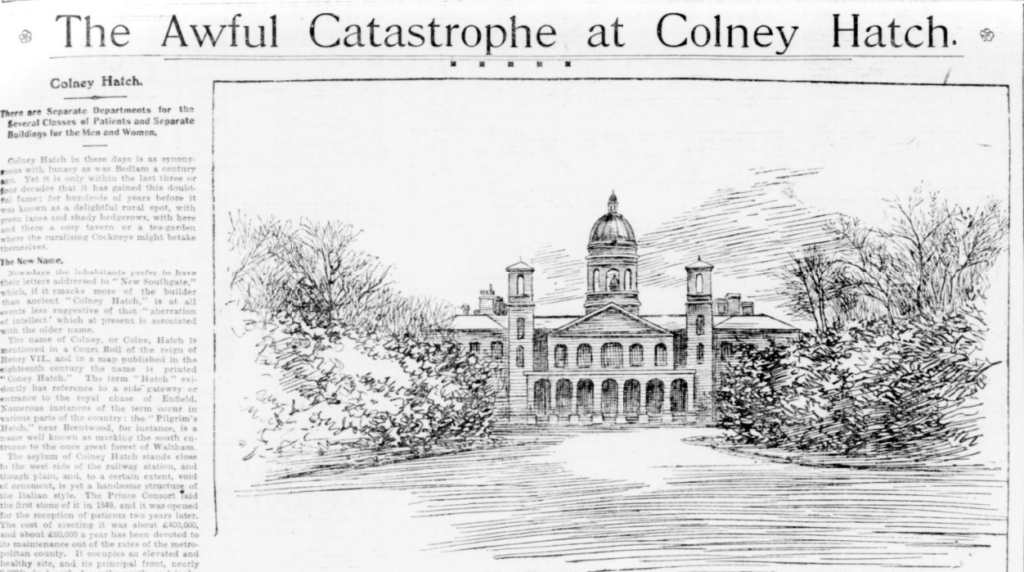
Colney Hatch Asylum in New Southgate, operated by the London County Council, was an institution housing over 3,000 of the “pauper insane”. The facility had been identified as at significant fire risk by authorities — many of the inmates were housed in temporary timber wings, and the complex was famous for its long corridors.
In 1903, the inevitable happened. One of the timber wards caught fire and, aided by strong winds, the conflagration spread. The asylum’s fire-fighting ability was limited, and the local fire authorities had to dam a stream to raise sufficient water for dousing.
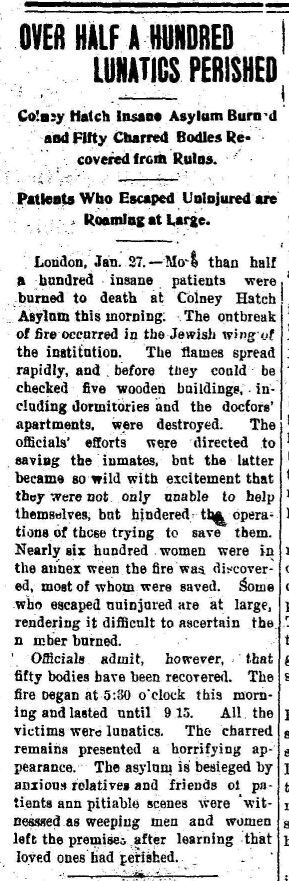
A press report from the Boston Evening Transcript paints a very grim picture of the ensuing tragedy, reporting that many inmates had died in the fire. There were also some who escaped from Colney Hatch. Did Eleanor witness the fire I wonder? The referenced article does make for grim reading both in relation to the fire and to the treatment of so called lunatics generally. (source: https://londonist.com/2012/09/londons-forgotten-disasters-the-colney-hatch-fire)
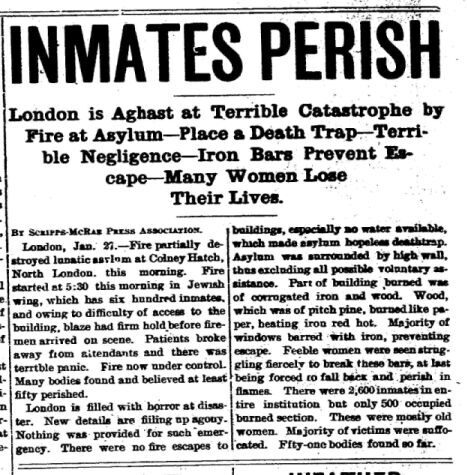
It is interesting to note how the staff were recognised for their efforts to save the patients.
The Globe February 13th 1903
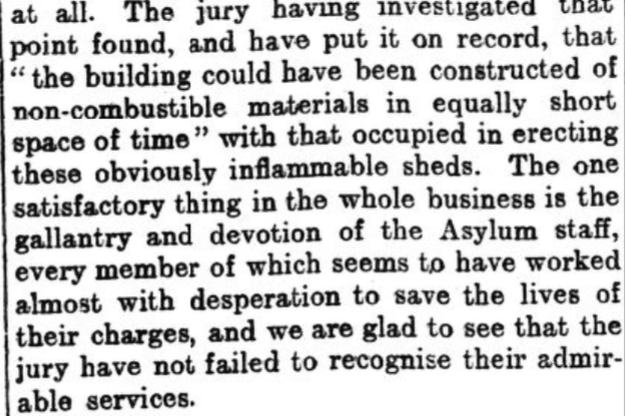
The actual reason Eleanor left Colney Hatch and arrived at Horton appears therefore to have been prompted by the fire. No records have been found for her long stay other than her admission record for Horton.
No records have been found for her long stay other than her admission record which records she left Colney Hatch (presumably for Horton) on 3 February 1903.
This date is significant as it was just a few days after a terrible fire that occurred at Colney Hatch on 27 January in which 51 inmates died mostly older women [13]. The fire occurred in a wooden annex that housed nearly 600 women. It seems likely that Eleanor was one of the women in the annex who survive the fire. Because of the loss of accommodation, new homes would have needed to be found, and these seems to be the reason why Eleanor was transferred to Horton. She spent the last four years of her life at Horton.
Death and burial
As recorded above, she died in 1907 aged 70 with senile decay recorded as the main cause of death. She was buried in the cemetery attached to the asylum.
Her children – her legacy
Despite their difficult and impoverished childhood, Eleanor’s children all did well in life and were each highly regarded by their peers.
Samuel David Geere (1853-1907) ended up in Killamarsh, near Sheffield where he worked as a coal miner. He was a lay preacher at the local primitive methodist church. He died in a rock fall while at work and was buried at Killamarsh. There is a large headstone there in memory of Samuel, his wife and all but two of his children.
George Richard Geere (1854-1884) remained in London’s East End and worked as a lighterman on the River Thames.
Mary Ann Eleanor Geere married and had many children. She remained in London’s East End.
John Thomas Geere (1858-1945) remained in the Bolton area. His son William was three times President of the Bolton Town Council. His obituary records he held a similar position in Bolton labour party and that he had given long and faithful service to the trade union movement in the town.
Annie Geere (1863-1944) remained in the Bolton area as a spinster.
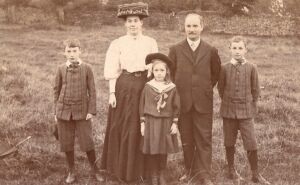
Christopher Geear (1865-1932) retained the spelling of his surname shown on his birth certificate.
He worked as a post office worker/missionary out in China but suffered from mental health issues, dying at Littlemore Asylum just outside Oxford.
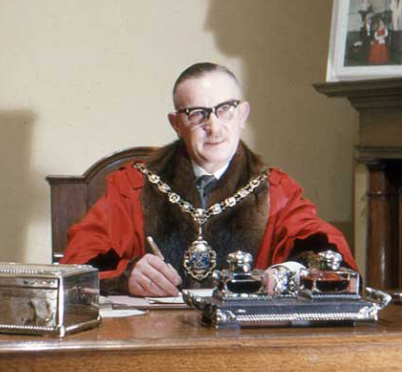
James Geere (1867-1932) remained in the Bolton area. One of his sons (James Wilfred) was Mayor of Farnworth for a time.
My father James was born in the London area …. all four of them (John, Annie, Christopher and James) were resident in an orphanage.
In the late 1800s, the cotton industry was developing rapidly in the north of England. A man by the name of Wm Heaton & Son built a new mill in a village north of Bolton called Lostock and Wm Heaton recruited a large number of child employees from orphanages.
(In relation to Christopher) he was a missionary out in the far east and sent his sons here to be educated. He must have progressed up the social ladder, for two of his sons were educated at Oxford University.
My father remained in the labouring class throughout his life; he was a clean-living man, teetotal and a good Christian. His sister Annie became a well-read person devoted to the Christian faith.
His brother John improved himself greatly, became a member of Bolton town council and was a member of management of the Co-operative Society.
Extracts from letter from James Wilfred Geere (grandson of Eleanor) [14]
Conclusion
Eleanor’s husband Richard was a brother of my (Jeremy Geere) great great great grandfather. Jeremy has had contact with many of Eleanor’s descendants and holds extensive correspondence from members of the family. Eleanor may have been overlooked and forgotten in her lifetime, but it is good that through this site her story can be told.
Sources
- The National Archives of the Uk; Kew, Surrey, England; Commissioners in Lunacy, 1845–1913. Lunacy Patients Admission Registers, Series MH 94; Piece: 21
- West Sussex Record Office; Brighton, England; Sussex Parish Registers; Reference: Par 8/1/2/1
- Ancestry online trees along with birth, marriage and death registrations.
- West Sussex Record Office; Brighton, England; Sussex Parish Registers; Reference: Par 8/1/5/1
- Class: HO107; Piece: 1092; Book: 1; Civil Parish: Amberley; County: Sussex; Enumeration District: 8; Folio: 19; Page: 13; Line: 13; GSU roll: 474671.
- London Metropolitan Archives; London, England, UK; London Church of England Parish Registers; Reference Number: P72/AND/012
- HO107, piece number 1484, folio 47, page 5, 16 Tichborne Street, Saint James Westminster.
- London Metropolitan Archives; London, England, UK; London, England, Workhouse Admission and Discharge Records, 1764-1921; Reference Number: STBG/L/132/06
- London Metropolitan Archives; London, England, UK; London, England, Workhouse Admission and Discharge Records, 1764-1921; Reference Number: STBG/L/133/01
- London Metropolitan Archives; London, England, UK; London, England, Workhouse Admission and Discharge Records, 1764-1921; Reference Number: STBG/L/119/45
- London Metropolitan Archives; London, England, UK; London, England, Workhouse Admission and Discharge Records, 1764-1921; Reference Number: STBG/L/133/01
- London Metropolitan Archives; London, England, UK; London, England, Workhouse Admission and Discharge Records, 1764-1921; Reference Number: STBG/L/119/46 (NB Christopher is missing from the February discharge but must have been discharged as he was readmitted 6 days later with his siblings)
- https://www.thelondonarchives.org/blog/the-fire-at-colney-hatch and contemporary newspaper reports.
- Private undated letter from James Wilfred Geere to Jeremy Geere sent in or around 1987. He was a son of James Geere 1867-1932.