
 1
1
 0
0
b.1881-d.1913
Information provided by Hayley Latter
This story is inspired by Hayley Latter who heard tales of Eliza’s past through family folklore. Eliza is Hayley’s 2 x Great Grandmother, and she is laid to rest in Horton Cemetery. Hayley has asked if we could find out more information about her time at Long Grove and how she came to be there. Whilst no case notes from Long Grove are currently available for Eliza, I have been able to piece together her story.
All details of this story have been put together with information kindly provided by Hayley and additional research by myself.
Who was Eliza Annie Coulbeck?
Eliza Annie Coulbeck was born on 6 July 1881 at 41 Heath Road in Battersea. She was the daughter of John William Coulbeck and Eliza Hodgson/Hodson/Hudson Warriner. She was their sixth child, and she was baptised on 28 August 1881 at St Paul’s church in Clapham.

Eliza’s birth certificate
Eliza’s Parents
John William Coulbeck hailed from Normanby in Lincolnshire and he was the son of James and Anne Coulbeck. Born in 1851, he was one of 6 children born to the couple. John’s father James died when John was only 10 years old. He was admitted to Lincoln Asylum on 8 June 1861 and died just 19 days later on the 27 June.
Eliza Hudson Warriner was born on 27 August 1854 in Boston, Lincolnshire . She was the daughter of Elijah Hudson/Hodgson/Hodson Warriner and Sarah Handley. Newspaper articles suggest that Elijah deserted the family in 1858, and a search of birth certificates suggest that there was possibly another child born to this family. A possible son called William in 1856 was born in Peterborough, but I have not been able to confirm this.
By 1871 Elijah and Sarah were back together, but their daughter Eliza was not with them. There is a mysterious girl named Susan Lee aged 19 who was described as their adopted daughter. I have not been able to find anything about this.
John William Coulbeck and Eliza Hudson Warriner married on 16 October 1871 in Lincoln. After their marriage, they settled in Lincoln and in the next 10 years their family rapidly expanded, and the places of their births show the family moved around quite often.
Rapidly Expanding Family
Children born to the couple in this period were-
- William Henry born in the September quarter 1872 Lincoln
- Sarah Ann born in the December quarter 1874 Caistor
- John born in the September quarter 1876 Eccleshall Bierlow
- Sam born in the December quarter 1877 Lincoln
- Ada born in the March quarter 1880 Wandsworth
1881
By the time of the 1881 census, the family were living at 41 Heath Road, Battersea where Eliza was born. The family are recorded as John aged 29, a bricklayer, Eliza his wife aged 26. The children are William aged 8, Sarah aged 6, John aged 4, Samuel aged 3 and Ada aged 1. Eliza was born later on in the year.
The street is no longer there as it experienced extensive bomb damage in World War 2 and is now replaced by Heather Close. Originally the street housed two story terraced houses that faced directly onto the street. Clapham at the time was rapidly growing, and as Eliza’s father was a Bricklayer, his skills were sought after wherever the family went.
Following the birth of Eliza Annie the next 10 years saw a further five Coulbeck children arrive. However, the family did not remain in Clapham as the births of Edward and James show. It is not clear what prompted the move back to Lincoln, but they seem to have lived there for 2 or 3 years.
Edward was born on 12 March 1883. A check of his birth certificate proves he is child of the couple and shows the family had moved back to Lincoln,

Poor Edward died in July 1883 and is buried in Newport Cemetery in Lincoln.
James was born on 10 August 1884 at 4 Albany Street in Lincoln.

I have found a burial for a James Coulbeck dated 20 February 1891 in Southwark aged 6, I believe this is our James, as he cannot be found in any later census records for the family.
By 1886 the family came back to London, living in Battersea and a further three girls were born.
- Hesse December quarter 1886
- Lillie June quarter 1888
- Alice Emma September quarter 1890
1891
The census for this year finds the family living at 169 Wickersley Road in the parish of St Phillips in East Battersea. John William is now aged 59 working as a Bricklayer. His wife Eliza aged 36 and their surviving children William H aged 18 also working as a Bricklayer, Sarah aged 16 who is a Domestic Servant, John aged 14 who is learning Bricklaying, Sam aged 13 a shop assistant, Ada aged 11, Eliza A aged 9, Effe aged 4, Lilla aged 3 and Alice E aged 10 months all scholars.
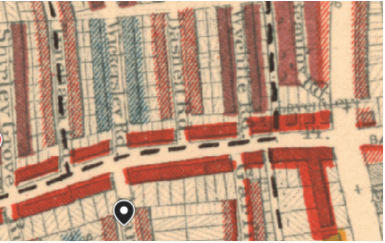
Booths Maps showing Wickersley Road (Highlighted with the blue hatching) which was just off Lavender Hill. Booth described the street as “poor with wages between 18 to 21s a week for a moderate family”. By now Eliza’s Warriner grandparents have moved to London, and they are also living in Wickersley Road.
The Electoral Roll shows the family moved to 75 Wycliffe Road in Battersea around 1893 and in 1897 they moved to Sterndale Road.
A marriage at an early age for Eliza
The next chapter in Eliza’s life raises some questions. She finds herself on the Isle of Thanet in Kent. She was only 16 years old. She could have been in service or another explanation could be perhaps she was living with a friend or relative. The only connection I can find to this area at this time is a girl named Laura Amy Turner who married Eliza’s brother John in 1899. I can find no reason for Eliza to be in this area.
Somehow, she met Henry Thomas Taylor who was 3 years her senior and they started a relationship. On 23 December 1897 aged 16 years and 6 months, Eliza married Henry Thomas Taylor at Dover Register Office, Kent. She was pregnant with her first child Florence Isabel Taylor.
A copy of Eliza’s marriage certificate reveals she stated she was 17; however, she would have still been considered a minor and would have needed parental consent. At that time this rule was strictly enforced, and a Registrar could not issue a marriage certificate without written consent from a parent or legal guardian. We must assume consent was given.
The witnesses were Sam Coulbeck, Eliza’s older brother and Annie Blanche Coulbeck, who was the wife of William Coulbeck, Eliza’s eldest brother.
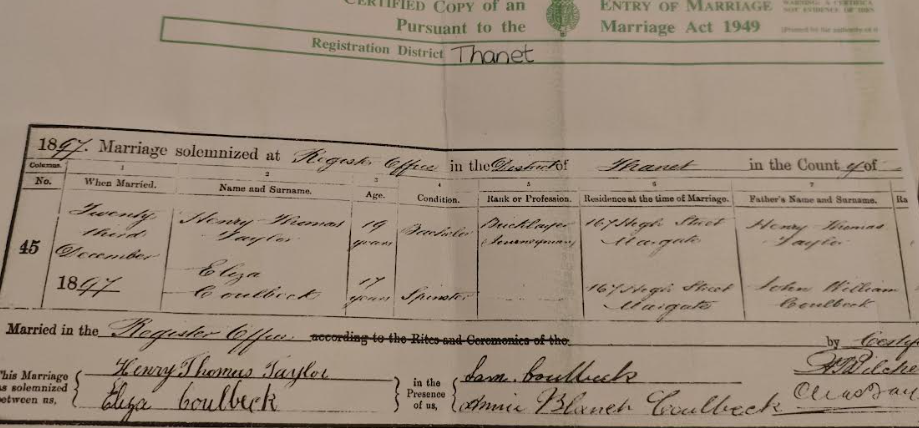
A copy of Eliza’s marriage certificate.
Henry Thomas Taylor was born in Dover, the son of Henry and Charlotte Elizabeth Taylor nee Parsons. Henry senior was a tailor, and they lived for many years at 170 Clarendon Place. There is no connection with Eliza’s paternal grandmother Ann Taylor who came from Lincoln. It is just a coincidence.
Eliza’s Children
Eliza and Henry’s first child Florence Isabel Taylor was born on 1 June 1898 at 180 Clarendon Place in Dover. Just before her mother’s 17th birthday.

She was named after her father’s sister.
1901- Where was Eliza?
Eliza was not at home on the night of the census. Her husband Henry and their daughter Florence can be found at the home of Henry’s parents at 170 Clarendon Place in Dover.
But where was Eliza? She certainly was not with her husband or her parents. I have searched the census for Dover and checked whether she was at the workhouse or the hospital and could find nothing. There are several reasons why she cannot be found. It is possible that there is a transcription error or that she simply fell through the net. Other possibilities could be she was in an institution somewhere and perhaps only her initials were used as was often the practice.
At present this remains a mystery.
Where were the rest of the Coulbeck family?
Sterndale Road in Battersea in 1901 was the home of the Coulbeck family and their relatives. Eliza’s parents and siblings were living at number 29 alongside her Warriner Grandparents, Elijah and Sarah.
Also living with the family there was a young man named Edward Spain widowed aged 21. He is described as a son-in -law. He was in fact a bachelor who was to marry Ada Coulbeck later in the year. At number 31, her brother John and his family can be found.
Looking at Booths Maps it shows that Sterndale Road was also a poor area to live.
The family would stay connected to this street on and off for the next 20 years.
The 1900s- tragedy
The first decade of the twentieth century hopefully brought some happiness for Eliza but sadly it also brought an enormous amount of tragedy.
It seems as if the Taylor family moved to London in 1902. This can be proved by the school admission records for Florence when she was admitted to New Road School on 7 July 1902; her address was 29 Sterndale Road, the home of her grandparents.
On 21 September1903 Eliza and Henry welcomed a son named William Bradlaw Verlong. (this was probably an error as this was altered to Vernon) He was named after one of Henry’s brothers.
He was born at 29 Sterndale Road, the home of his maternal grandparents.
.
Another son, Ernest Charles was born on 10 August 1906 at 29 Sterndale Road. He was another child who was named after one of Henry’s siblings. Little Ernest died aged 3 months old of marasmus (severe malnutrition) with diarrhoea and vomiting which had lasted for about a month. Ernest died at 21 Stockdale Road, just around the corner from Sterndale Road.
Edward’s birth certificate.
On 3 December 1907, a daughter called Lily Alice was born. The only child of the family who was not named after her father’s siblings.

Lily was born at 11 St George’s Street. The electoral registers in Battersea show Eliza and her family had moved away from Sterndale Road and were living in a slightly better area. Her parents were also living in the same house. St George’s Street was just around the corner from Southolm Street. They were in the parish of All Saints Battersea very close to the railway line.
A Tragic Death at Work
On 17 May 1910 Eliza’s father John died from cancer and heart failure. Given that Eliza and her family lived with her parents at 19 Southolm Street, this must have been a blow for her. The year however was to end with even more sadness when Eliza’s husband Henry died on 29 October 1910 because of an accident at work.
The death certificate states he died in the Goods Yard of the London, Brighton and South Coast Railway Station on Sullen Road in Battersea. The cause of death was “shock from compression of the heart as a consequence of being crushed between the buffers of two coal wagons which were being shunted”.

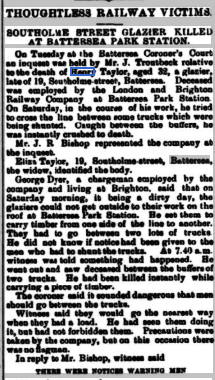
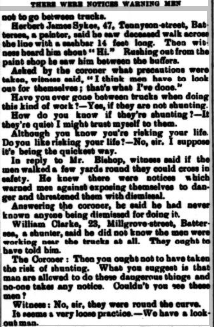
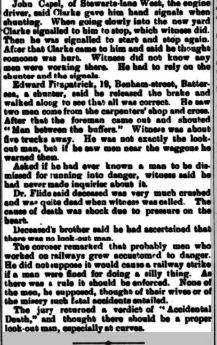
Below are the details of the inquest as reported in the South Western Star newspaper on 4 November 1910. It makes for very sobering reading and shows there was little regard for health and safety. The workforce was very much expected to look after themselves with very few checks. The headline alone suggests that the coroner thought Henry was thoughtless in his actions and that as a result, he lost his life.
Inquest Report
A series of factors led to this poor man’s demise. Henry was working as a casual glazier and was working inside due to bad weather. The men had not been advised to stop going between the tracks, and on this day, there was no flagman assisting with the shunting and the shunter was not told that there could be staff moving between the tracks.
Fellow workers testified that it was a practice that most people followed as it was the quickest way to move things around. Although there were signs on display telling workers they would be dismissed if they were found to be moving between the tracks. Witnesses said they were not aware of anyone being dismissed for this activity.
Henry was working out of sight around the curve, and the shunter could not see him. Henry’s brother testified that there was no look out man. The Judge ruled it was “accidental death” but felt that if there were rules, they should have been enforced and that the railway workers had become accustomed to working with danger. They probably gave little thought about what might happen.
The article reveals that poor Eliza had to go and identify the body. It is said by her family that this experience quite understandably caused some kind of mental breakdown. The poor young woman was only 29 years old, widowed with young children. The article described her as being 19 but this is incorrect. It is such a harrowing tragedy that she had to bear whatever her age.
The Register of Railway Employee injuries and deaths gives us some more information. The accident occurred at 07.40am and it explains that Henry was carrying a sash bar from the store to a locomotive shed. He had to pass between a number of wagons. As he did so, the wagons closed up as a result of being shunted.
The accident was attributed to the poor position of the carpenter’s store which meant the men had to pass through an area where wagons were being shunted.
As a result of the accident, it was recommended that the store be moved to a safer place or take steps to prevent the men from crossing whilst shunting is taking place. This was a summary of events reported to the Board of Trade on 31 December 1910. I can find no record of any compensation being paid through the Union but as Henry was employed as a Casual Glazier, he probably was not a Union member.
Life after Henry’s death
By the time of the 1911 Census, Eliza, now widowed, was living at 31 Southolm Street in Battersea with her three children in 2 rooms. Eliza aged 29 was working as a dressmaker, Her children Florence Isabel aged 12, William Bradlaw Vernon aged 7 and Lillie Alice aged 3.
The census records that she had had 6 children, 3 of whom had died. I have only been able to trace the birth of 4 children and one death. Perhaps Eliza had a couple of miscarriages.
Sharing the address was her mother Eliza Hudson Coulbeck and her younger siblings Alice, Arthur and Ernest. So, Eliza was not on her own which bearing in mind her mental health was fragile is some comfort.
They shared this property with 2 more families.
Sadly a few months later Eliza’s mental health declined to a point she could not carry on.
The workhouse and the Asylum
Luckily, her Reception Order, showing details of her examination of her mental health, has survived. Eliza had been in Wandsworth Union Infirmary, St John’s Hill when concerns were raised. How long she had been there is unknown, but the medical practitioner was called for and he deemed poor Eliza was of unsound mind and she was to be sent to Long Grove Asylum.
The details from the Reception Order
Eliza Annie Taylor – female – aged 31 years – widowed of no occupation. Her religion – Church of England. Her address 31 Southolm Road in Battersea.
It is not known if this was her first attack. All that is known is that it has been going on for a few weeks, and the cause was not known. She was not epileptic or suicidal or a danger to others “she has not shown herself as such at the infirmary”.
Her relatives are listed as her brother Sam Coulbeck of 121 Dorset Road in South Lambeth and her widowed mother Mrs Eliza Coulbeck – no address was given for her.
There is an asterisk at the bottom of the page with a sad and worrying note.
“Three children of patient – aged 14, 9 and 4 are at 31 Southolm Street, Battersea”. One hopes that Eliza’s mother was still living at the same address, so the children were cared for.
It goes on to note Eliza had a few nits in her hair, and her bodily condition was fair with a slight bruise on her knee.
Facts indicating insanity, observed by the doctor at the time, of the examination were, “She is noisy, incoherent, and restless. Her conversation is mostly obscene and rich in profanity. She is unclean, and too insane to minister to her own wants in anyway”.
No other comments were added by any other medical person. No other thoughts as to how she came to be in this sad state were given. Things were desperate for Eliza. She sounded scared and confused.
Admission to Long Grove
So, after this decision, poor Eliza was admitted to Long Grove Asylum on 24 November 1911. Sadly, there are very few case notes that have survived for Long Grove. At this current time there are no known notes for Eliza, so I cannot comment on what specific treatment she may have received.
She died less than 2 years later on 12 September 1913. Her death certificate reveals she died of Pronephroses of 3 months duration and gangrene of the lung of 4 days duration. Pronephroses is a serious infective condition of the kidneys. Without antibiotics, it would not have been treatable.
Eliza was buried on 16 September 1913 in Grave 761a in Horton Cemetery.

What happened to Eliza’s children?
It is believed that the 3 children were taken in by various family members until they were old enough to fend for themselves. From what I can gather, Florence and William stayed in Battersea, probably with their grandmother.
Florence Isabel
Florence Isabel was 14 years old when her mother went into Long Grove. It seems she stayed in the area as her marriage certificate of 4 August 1918 shows she was living at 73 Sterndale Road. Her groom was Albert George Smart, a 21 year old bachelor. Both were munitions workers. The marriage took place at St Andrews in Battersea. The witnesses were Frank Bell and Private A Coulbeck (her Uncle Arthur)
Albert had been discharged from the army in 1917 as he had been buried by a shell in France and had an injury to his left leg which left him with a deformity, and he had to wear a special boot.
By the time of the 1921 census Florence and Albert had moved to 6 Vicarage Place in Margate. They now have a young son Albert Ernest aged 1 year and 11 months. They later moved back to Battersea and then later to Surrey. The couple had 6 children.
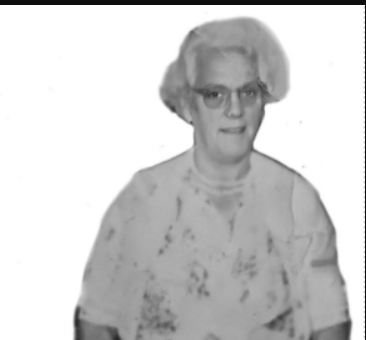
Florence with one of her sons and grandchildren.
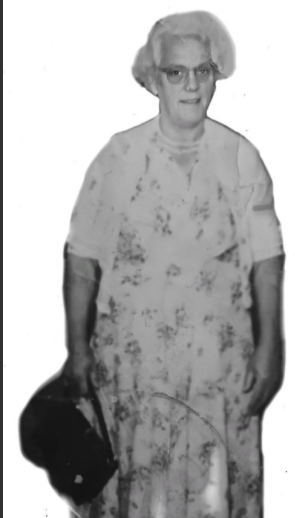
Photos given with Kind permission from Hayley Latter. Florence is her maternal grandmother.
Florence died in 1962.
William Bradlaw Vernon
William was only 8 years old when his mother was admitted to Long Grove. He seems to have stayed with his maternal grandmother. He was to die at the young age of 12 years old at the Salford Royal Hospital but his address was given as 68 Sterndale Road in Battersea. This was the home of his grandmother Eliza Hudson Coulbeck.
The poor lad died of a cut on his leg and tetanus. Why was he in Manchester? It is possible that he was transferred there for safety reasons or so that he could have specialist treatment. During World War 1 some children were sent north as it was considered a safer place.

Lily Anne known as Lilian
Lilian was so young when she lost both her parents, but she was taken on by Eliza’s sister Ada and her husband Edward Spain. She was living with them in 1921 at Swandale Cottage, in Margate, recorded as Lilian Alice Spain aged 13 years old. She was later known as Lilian Taylor-Spain.
Lilian married William Frank Pressley in Margate in 1926. Together they had a family and remained in Kent. Lilian died in 1956,
Eliza’s mother
Eliza Hudson Coulbeck was to suffer more family loss before she passed away herself. She had moved to 68 Sterndale Road by 1914 and sadly, her son John was killed in action in World War 1 on 3 May 1915. The facts suggest that Eliza’s older children lived with her and her grandson William was to die in 1916 aged only 12. Eliza died on 18 July 1918 of Influenza, Morbus Cordis (Heart Disease) and Syncope. (loss of consciousness). She was 63 years old.
Eliza’s siblings
As Eliza had 11 surviving siblings, I shall mention their stories only briefly here at the end of Eliza’s story.
William Henry who was born in 1872, married Annie Blanche Whiley on 25 May 1896. He was a Bricklayer for most of his life, like his father. They had 4 sons. After a brief spell of living in Lincoln, they lived most of their lives in Wandsworth. William died in 1953.
Sarah Ann born in 1874 married Robert Smith on 7 June 1896. They had 3 children and remained in south London all their lives. Sarah died in 1929.
John Henry who was born in 1876 is possibly the reason why Eliza was in the Thanet area of Kent. He married Laura Amy Turner in 1899 who came from Margate. Shortly after their marriage, they moved to Battersea and lived next door to John’s parents. Sadly, they had twin girls Ivy and Violet born in 1901 who died only a few months old. The couple went on to have 4 more children.
John died in World War 1 on 3 May 1915 at Ypres. He is commemorated on the Menin Gate. Laura lived in Margate for the rest of her life with fond and loving memorials to him appearing in the papers many years after his death.
Sam born in 1877 in Lincoln. On 11 April 1903, he married Ellen Puddle. His occupation is that of a bricklayer like his father and brothers .
Clapham Observer 11 February 1903. Just before his marriage, Sam seemed to act out of character and got into trouble with the law. In 1911 Sam and his family were living at 26 Southolm Street right by Eliza and her children, so I imagine that Sam was keeping an eye on them when Henry died.
Sam did join the War Effort and served in the Army and spent 3 months fighting in France. He suffered shell shock but was discharged due to flat feet and the fact he was blind in one eye. This was a disability that originated from an injury during boyhood! How he became enlisted in the first place is amazing. He died in 1940.
A transcript of Sam’s obituary from the South Western Star newspaper dated 19 January 1940.
“Passing of Mr. S. Coulbeck fought with 23rd London Regiment Overseas.
The funeral of Mr. Sam Coulbeck, of 47 Dagnall-street (formerly Chatham street), Battersea Park-road. who died In St. James’s Hospital on Sunday last week, took place on Saturday at Streatham Park Cemetery. Mr. Coulbeck was 62 years of age.
Born in Lincoln, he was brought to Battersea by his parents when he was a few years old. After his marriage in 1902 to Miss Ellen Puddle, a daughter of the late Mr. and Mrs. Frederick Puddle, of Sterndale-road, he lived for some years In New-road (now Thessaly-road).
For the past 22 years his home was at what is now Dagnall Street. Eighteen months ago, he underwent an operation in Battersea General Hospital, and was transferred to All Saints’ Hospital. Lambeth. On the day after his birthday. December 12, he was taken ill again. He was admitted to St James’s Hospital on December 26.
When the war of 1914-1918 broke out, Mr. Coulbeck joined the 23rd London Regiment and went overseas. In 1917, he was invalided home suffering from shell-shock. His widow, three sons, and a daughter survive him. Principal mourners at the funeral were:
- the widow,
- Mr. and Mrs. B. J. Coulbeck,
- Mr. and Mrs. L. Coulbeck (sons and daughters-in-law),
- Mr. and Mrs. Winter (Son-in-law and daughter),
- Mr. R. Coulbeck (son),
- Mr. and Mrs. William Coulbeck ( brother and sister-in-law).’
- Mrs. Childs (sister);
- Mrs. Ramell and Mrs Puddle (sisters-in-law),
- Mr. and Mrs Crome (old friends),
- Harold and Alex Winter (grandchildren). and Renee.
There were a number of floral emblems They included a gates of heaven from the widow, a chaplet from neighbours, and a large bunch of flowers from Mr. Pryer, of Messrs. F. Fryer and Co Orkney-street, Messrs. F. C. Bowen, of 259 Battersea Part-road, carried out the funeral arrangements”.
This obituary helps us understand and confirm the background of the Coulbeck family.
Ada who was born in 1880. She married Edward George Spain on 5 August 1901 who had previously been living at her parents’ home after deserting the army on 14 February 1901. Ada and Edward informally adopted Eliza’s youngest daughter known as Lilian and she lived with them in Margate, Kent. Edward died in 1935 and Ada soon remarried Sydney Barron, a man 25 years her junior.
The marriage was not a happy one. Within a year Sydney was sent to prison for a month for violently assaulting Ada. The judge granted a separation order but in June 1937 there was a newspaper report that Sydney had deserted Ada so he went back to prison. On 20 August 1938 that Ada was again seeking maintenance and a separation order was granted. The 1939 Register shows the couple were back together again living at Avondale Cottage in Margate. Sydney appears to a violent young man who expected Ada to give him money for drink and horse racing and when she didn’t there were awful consequences. It appears she frequently let him back into her life.
On 1 June 1943 Ada was killed by a German hit and run bombing raid on Margate which killed 10 civilians. She was 63 years old. Her husband Sydney died just 6 months later serving in the war effort in Italy aged just 38. He is buried in Bari War Cemetery in Italy.
Hesse, Essie or Esse was born in 1886. She married Arthur Frederick Brooker in the April quarter of 1908. The couple lived in Battersea and emigrated to Australia sometime after 1915 after the deaths of their 2 daughters Violet and Lena. Esse died in New South Wales in 1965.
Lillie born in 1888 worked as a servant in 1911 to a retired clergyman in Regents Park. She married in the July quarter of 1916 John J Benfield, a Railway employee. Both Lillie and John died in 1918 within a week of each other.

Lillie’s death certificate shows she died of a blood clot in her lungs. John’s Railway records show he died of influenza. Both could have been victims of the Spanish Flu Epidemic.
Alice Emma who was born in 1890 married Ernest Harold Stent in October 1912. They emigrated to Australia before World War 1 and had a family. Alice died according to family trees in 1925 and Ernest in 1926.
Arthur born in 1893. In 1921 he was still a Lance Corporal in the Army Infantry. The following year he followed some of his siblings to Australia on 5 August 1922. He married and had a family there. Arthur died in 1962.
Rose the youngest of the Coulbeck girls, was born in 1895. In 1911 she was working as a Housemaid for Stanley William Lambe a Draper in Pimlico. On 17 June 1917 she married Frank Childs, a 39-year-old widower. By 1921 they lived in Sterndale Road in Battersea with sons Leonard Coulbeck who was born to Rose before her marriage in 1916 and Frank Childs aged 3. From the records I have been able to trace Frank died in 1938 and Rose left for Australia on 21 June 1949. Rose died in 1981.
Ernest the youngest Coulbeck child, was born in 1896. He was 16 years younger than Eliza and possibly she had already left home before he was born. He was only 16 years old when she died.
During WW1, he signed up and joined 23rd London Regiment and in 1921, he was resident at the Wimbledon Common Camp alongside his brother Arthur. His rank was that of a Sergeant. He married Alice Amelia Shaw in April 1920. He died on 12 June 1952 aged 56.
Although I have briefly looked at the lives of Eliza’s family, their stories tell the tale of how the times affected them. Four of her brothers fought in World War 1. One did not return, and another was discharged with shell shock. Her mother, her sister and brother-in-law were probably victims of the Spanish flu pandemic. Her sister Ada was a victim of domestic abuse and would meet her death as a civilian in World War 2.
Several of the Coulbeck children emigrated to Australia presumably in search of a better life.
Authors Thoughts
Hayley’s story about her ancestor proved to be an intriguing and tragic tale. In her short life she experienced a great tragedy, which her family say ultimately led to her breakdown and death. With Hayley’s input and some additional research I found this indeed proved to be the case.
Eliza came from a large family which was not uncommon at that time and her father probably moved to London to find regular work. Although they lived in a number of locations in Battersea that were poor and deprived Eliza’s father, John appears to always have worked as a bricklayer. He must have found it hard to provide for his large family. At this time in London there was great expansion and a lot of building work to provide housing for the growing population.
It is unclear how Eliza came to be in Dover at the age of 16 where she met Henry Taylor and became pregnant at a very young age. The couple would return to London and seemed to live in the same house as Eliza’s parents for nearly all their married life. I do wonder why this was. Was Eliza heavily dependent on her family?
Sadly, their marriage was cut short by Henry’s fatal accident which highlighted the disregard for health and safety. The newspaper article proves what family folklore has handed down – that poor Eliza had to identify her husband’s body which must have been horrendous for her. Although she appears to have lived in the same house as her mother and some of her siblings after her husband died the support did not seem to stop her from going into a mental health crisis.
It was possibly her mother and her brother who took her to the infirmary as it said she could not look after herself. From there, it was only a short step into Long Grove Asylum. From the comments made by the Doctor at the time Eliza sounded scared and confused and unable to look after herself, let alone her children.
Her mother and siblings must have been worried about her and possibly did not know what to do for the best. The Doctors would have lacked the medical understanding at the time to diagnose or understand the cause of her problems. We may never know what treatment Eliza received in Long Grove.
Ultimately, she died not due to her mental health but of an infection in her kidneys that could not be treated as the benefits of antibiotics had not yet been discovered.
Eliza is not forgotten by her family and her story lives on and remembered by the generations that came after her and thanks to Hayley her story can now be added to our records. A young woman struck down by insurmountable grief.