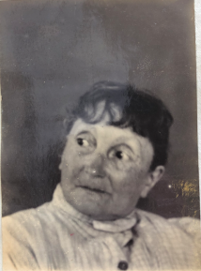
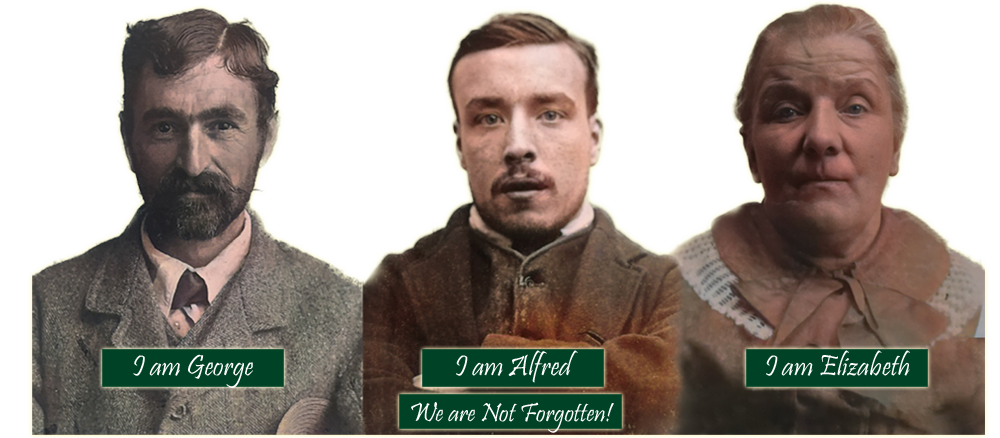

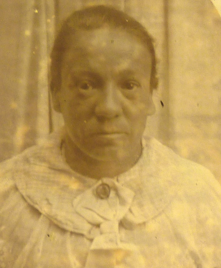
 0
0
 0
0
b. 1879-d.1916
Annie was born in the March quarter 1879, in Lambeth. She was the fourth child born to Edmund Robert Fisher and his wife Maria Richards. Edmund and Maria were married on 19 May 1867 in Portland, Dorset where Edmund was a Prison Warden at Portland Prison.
Take a moment to read this piece if you can, which illustrates life in the prison at the time Edmund was working there.
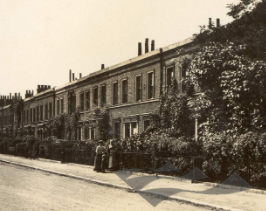
By the time of the 1871 Census, the family had moved to Lambeth.
They were lodging at 33, Trigon Rd, Lambeth which is just behind the Oval cricket grounds.
Booth’s poverty maps rated this as ‘fairly comfortable’.
Whole Family Enter Workhouse
On 31st Oct 1880 the entire family were admitted to the Gordon Rd Workhouse, Camberwell.
“In 1878 the Camberwell Board of Guardians constructed a new workhouse on Gordon Road. It was intended to house 743 able bodied inmates. Males chopped wood or broke stones; while females were employed in laundry work.”
It really was Christmas day in the workhouse, for they were not discharged until the following year; meanwhile Annie, aged 2 years had been admitted to the workhouse infirmary.
Maria discharged herself on 4 Jan 1881, apparently alone. On 22nd Feb 1881 Laura was admitted to the Brighton Road Poor Law School in Sutton and then, on 29 March 1881, Edmund Robert and his son Robert were discharged, ‘At own request’. https://www.workhouses.org.uk/SouthMetSD
1880s
The 1881 Census finds them living at 30 Hollington St, Camberwell. Edmund is now working as a house painter and Maria, Ada, Laura and Robert, born in Lambeth and registered in the June quarter 1872, are all shown.
Annie remains in the infirmary as shown below, and either Laura did not stay in the school she was sent to or, Edmund added her in her absence.

Thankfully it would seem that the family is more stable at this point.
On 14 June 1882 we find that another child had arrived. Florence Maud was baptised on this date along with Sister Annie born 1878, at St Michael’s and All Angels, Southwark. They are still living at 30, Hollington St, Camberwell, and Edmund’s occupation is given as painter.
Hollington Street and the two parallel streets, Sultan St and Beckett St, were notorious; Booth classed it as very poor, chronic want, lowest class, semi vicious.
The police notebooks give a grim picture of deprivation and overcrowding and says that the inhabitants were “mainly Irish, Cockney, general labourers”. Behaviours noted included “drunk, rough, wife beating, assaults, but no criminals.”
You can see the dark blue and black legend on the map. Looking through the 1881 Census and it appears that everyone is working in some capacity.
Booths maps cover the period 1886-1903 when the family lived continuously in Hollington Street.

https://www.bbc.co.uk/programmes/p08qygjn/player
This is trip down memory lane for a lost London Street. Hollington St was bombed out in WW2 and no longer exists.
Annie’s mother dies
Sadly Annie’s mother Maria, died aged just 42 years on 12 Oct 1888. Her address given was 50 Hollington Street and Jane Laragay was shown as present at death.
Maria died of Phthisis, pulmonary tuberculosis.

Our final census, 1891, can only be found on Family Search and shows Edmund H Fisher, born Hertford, a widow, working as a ‘paper hanger’, with his two daughters, Florence M, age 11 years and Annie age 13 years.
Edmund Dies
The next document we have is Edmund’s death certificate. He died on 24 Oct 1899 from Bronchitis. The certificate also gave us some useful information.
Ada had married and was now Mrs Smith and Edmund received a pension from service in the Rifle Brigade.

A Refuge for Annie – 167 ins and outs of workhouse
Unfortunately for Annie this is when her life really took a downward turn.
We find her on the 1911 Census as an inmate of the Constance Road workhouse; she is 31 years old, single and a charwoman.
Following the death of her father in 1899, Constance Road had become a refuge for Annie. I have found 167 entries on Ancestry documenting her regular ‘ins and outs’, a term given to people who were admitted and discharged on a daily basis.
From about 1902 until being admitted to the Ewell Epileptic Colony in July 1913 Annie was termed by the workhouse as ‘destitute’ and would be admitted, generally in time for breakfast and then discharged ‘on her own account’ later the same day, sometimes recorded as a servant, or a charwoman but always, destitute. On only one occasion, in 1902, was a note made of ‘fits’.
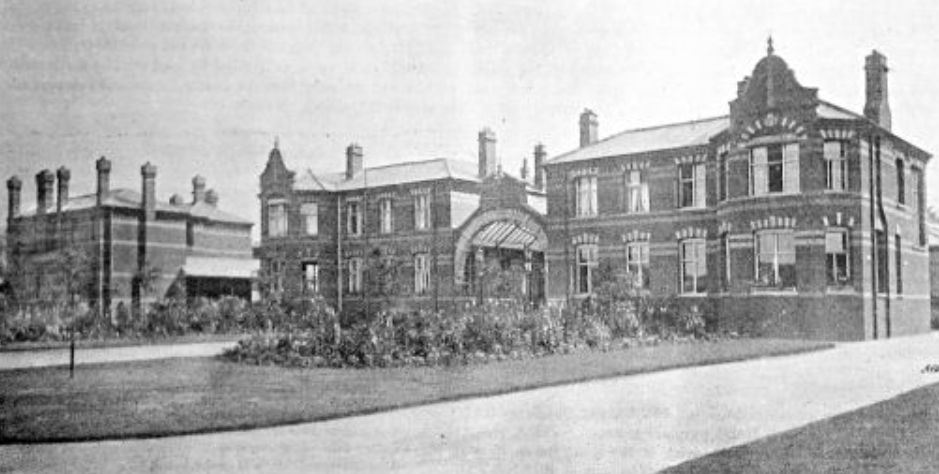
Constance Rd workhouse built by the Camberwell Union in East Dulwich, opened in 1895 and could house 898 inmates.
Annie’s Account
We don’t know what happened to Annie’s siblings following her father’s death.
Ada did not marry until 1903 and I have been unable to track down any positive information about the others.
As you will see, when Annie entered the Colony she was a very unreliable witness to the facts of her life. She said that she had one brother, who we know to be Robert, and one sister, possibly Ada who did live on and have a family of her own. Or, possibly Florence who was the youngest in the family.
Ewell Epileptic Colony
Unfortunately the case notes book for the time Annie spent in the Ewell Epileptic Colony seems to be missing but thankfully I managed to track down four pages of loose notes at the Surrey Archives, so we are able to continue Annie’s story.
At the time she was admitted to the Colony, it had been open only a few months and was seen as a new and better way of caring for those with epilepsy. Housed in bungalows rather than large wards, patients were expected to work in some capacity for the good of the whole community.
Annie was admitted to the Colony from Constance Road WH on 1 July 1913.

She was said to be destitute but there was no mention of fits.
The initial notes say that she is fully conscious of her change of abode, “after a stay of 15 years, so she states, (but where is not noted) she does not know the day or the month of her birthday and cannot say whether Christmas day is in the month of December or not. Her memory is evidently defective and her expression vacant”.
The doctor who admitted her noted that, “little information of value can be obtained from her owing to mingled stupidity and deafness”. She can apparently read and write but only reached standard 1 at school. Annie says that both her parents are dead and she believes that she has one brother and one sister.
On 7 July 1913 Admin note to C in L (Committee in Lunacy). Simple, weak minded and dependent. Memory impaired and intellectually she is poorly developed. Fair health but sparsely nourished. Very deaf. Weight 5st 12lbs.
Annie seemed to settle and is later said to be content working in the laundry. As the month’s progress her fits seem to increase and it is noted that, when she is “in the fitty zone” she is very depressed, but at other times gives no trouble”.
In Jan 1914 it is reported that she had suffered 80 fits in the past quarter and that her medication was to be changed from Potassium Bromide to Strontium Bromide.
Unfortunately this seems to make her noisier and violent and in February she has to be transferred to Laurel. *It is difficult to be sure but I believe that Laurel dealt with difficult, violent patients whilst Pine was more of an infirmary ward.
In April it is reported that she has had 178 fits, mainly of the major kind, an increase since her medication was changed. “Potassium Bromide keeps the fits down but increases the depression”.
*This is not the first time this has been noted when reading patients notes.
The doctors, who have limited medication at their disposal, are faced with a balancing act, alleviate the depression or allow the fits to increase.
In April, Annie spent another spell in Laurel due to “excited and abusive conduct” and was returned briefly to Laurel again “with some difficulty” in May, after becoming very quarrelsome and fighting with Alice Rich.
In June 1914 the report to C in L states that she was “suffering from Epileptic insanity with a considerable degree of congenital defect”.
As time passes Annie becomes disorientated and begins accusing the nurses of throwing water over her, and other patients of saying spiteful things about her, quite possibly based upon aural hallucinations. These spells seem to become a regular occurrence although she is still said to “work well in the laundry”.
1915 brings no change to her mental state although her fits do seem to have become fewer and in April only one minor fit in the past quarter is noted.
The hallucinations continue throughout the year but fewer fits continue to be reported.
This continues into 1916, the year of her death, and nothing of note is mentioned until 13 Oct 1916 when we are told that the ‘patient had a sharp attack of Influenza, temp 104. Moved to Pine, much pain in head and neck and seems very feeble.’
October 20th “much worse. Is having a diet of milk and broth and medication. October 21 “Gradually became more feeble and died quietly at 7.30pm”. Certified cause of death – influenza.
Annie was buried in Horton Estate Cemetery in grave 2212 b on 26 October 1916. With no personal information recorded and no mention of her in the visitor’s address book, we cannot know if Annie ever received any visitors or if anyone attended her funeral.
**Her life seems to have been one of poverty and, from an early age, institutionalisation. Combined with her deafness it seems unsurprising that she was “mentally poorly developed”.
Annie’s Family.
There is very little information to be found about Annie’s mother. She was born in Mitcheldene, Gloucestershire and from the 1851 Census, it is likely that her parents were Thomas and Ann Richards, living at 2 Hump or Pump Hill, East Dean, Gloucester.
Nothing further is found until her marriage to Edmund Robert Fisher in 1867 in Portland, Dorset. Her life with Edmund and her death have been told above.
Annie’s father Edmund Robert Fisher came from Hertford in Hertfordshire. He was born in 1833 to Edmund Fisher and Sarah Cooper. His father, Edmund, was a “carrier” and ran a business with his brother Benjamin until they dissolved the partnership on Ist Jan 1837. (Before the spread of the railways, carriers were the means of transport for goods of all kinds both locally and around the country.)
Edmund was again declared insolvent in 1841 but he obviously gained employment with a carrier again because on 23 Sept 1843 his sudden death is reported in the Hertford Mercury and Reformer.
“ From the evidence of Benjamin Fisher, brother of the deceased, that about quarter past eight o’clock in Saturday morning he went up to the deceased who was standing close to his wagon on Bull Plain; deceased had been giving directions about some goods and furniture; he said, “Oh dear! Oh Lord! and fell down upon his knees, and then upon his face; ” The doctor was called and declared that “the deceased had died from a rupture of a blood vessel near the heart.” A verdict of “Died by the visitation of God” was returned.
Edmund was apparently “much respected” and an appeal was made to the townspeople to help the widow and family.”
A death for Sarah Fisher was registered in June 1844 leaving their children as orphans. The 1841 Census showed that they had five children living at home at that time. Following the death of both parents we find that, in Nov 1845 the Board of Guardians decided upon an application “from Joseph Fisher, on the part of one of the three orphan children of the late Edmund Fisher (all of whom received a weekly allowance from the parish of All Saints) for the payment of nursing and lodging during her recent sickness from the smallpox. The case was deferred.
As you can see Annie’s father didn’t have the best start in life, and like many young men in his situation when he was 21 years he joined the army. Initially with the 4th Middlesex Militia in 1853, he then signed up for “a limited engagement” of 10 years 4/12months.
His attestation papers say that he was paid a £4 bounty and joined the 46 Regiment of Foot, which later became the Prince Consort’s own Regiment of Rifle Brigade.
In his service career he served in the Crimea, Corfu and the East Indies and was awarded the Crimea Medal with clasps for “Alma” and “Inkerman,” and the India Medal with clasps for the North West Frontier (1864).
Twice promoted to Corporal and then reduced to Private, he was finally dismissed on 1 July 1865. Perhaps it was this life that led him to become a Prison Warden, a similar kind of regimented lifestyle.
** Authors note