
 1
1
 0
0
b.1890-d.1916
Thomas’s parents
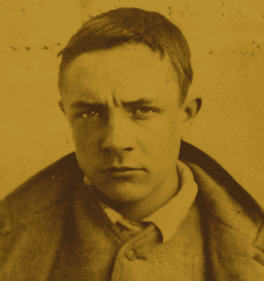
Thomas William Colley was born in the Sept Q of 1890, registered in Lambeth, Surrey. His father was Thomas Colley (1863–1910) and his mother was Adelaide Mary Burrows (1863–1936). The only records we have of Thomas Snr are the 1901 Census when they were living at 73, Laburnum Street, Shoreditch. Thomas Jnr is shown as 9 months old and Thomas Snr’s occupation is given as riveter.

Later that same year we have young Thomas’s baptism which took place privately in the Evalina Hospital, Lambeth on 24 July 1891. The address given here is 13 Frear St, Southwark Bridge Rd, Lambeth. Presumably Thomas was seriously unwell and an emergency baptism was called for.

However, Adelaide Burrows and Thomas Colley were never married as Adelaide was already married to an Alfred Cheek (1881-1916).
Today we might say that young Thomas Colley’s family life was dysfunctional but I think no more so than many young people today.
Thomas’s mother
Here is the story of Adelaide Mary Burrows, Thomas’s mother.
On 7th June 1881 Adelaide married Alfred Cheek at St Thomas’s Church, Bethnal Green. Alfred was 19 years and Adelaide just 18years.
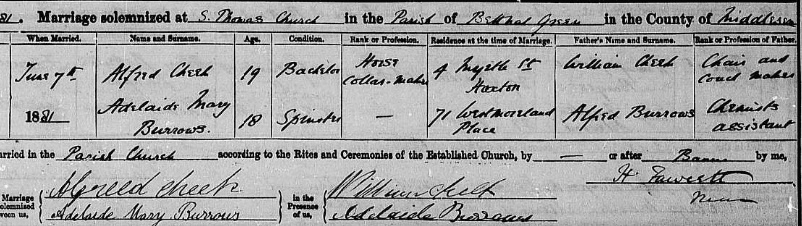
It would appear that Adelaide was already pregnant as a son was born in the Sept Q of that year, Alfred William Cheek. Sadly young Alfred died in 1886 and our subject, Thomas Colley, says in his notes that he thinks he had a brother who died of convulsions before he was born.
In 1885 we find Adelaide aged 22yrs and young Alfred in the work house where she says she is the wife of Alfred C, deserted.


We later learn that in fact Adelaide had left her husband Alfred in Liverpool because he ill treated her. She returned to London to live with Thomas Colley.
Adelaide never saw her husband again.
Just two years later in the 1901 Census we find Adelaide, now calling herself Adelaide Drewitt, living with William Edward Drewitt, and her son Thomas now 10yrs. (Don’t forget the name, he reappears later)

Three years later, on Sept 27th 1903, Adelaide marries Benjamin Harris (1855 – ?) at St Augustine’s Church, Hackney, claiming that she is a widow. Young Thomas would have been about 12yrs at this point.
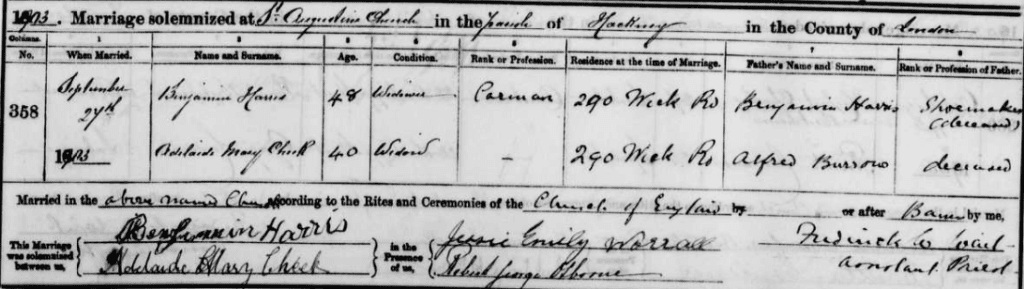
In May 1906, we find Adelaide in court charged with bigamy. She says that she had run away from her husband in Liverpool eighteen years ago because he ill treated her, but she had recently found that he is still alive and now her current husband, Benjamin Harris, is threatening to have her “put away,” so she has gone to the Police to admit to bigamy.
The case goes to court but they need two witnesses to the marriage, so they bring Alfred’s father to court in an ambulance, despite him being on the “danger list” the previous week. He swears that his son, Alfred Cheek, is still alive and that he saw him last year. As the only other witness, Adelaide’s mother, has died there is not enough evidence to take the case forward and no action seems to have been taken.
However, it was just before this, in Feb 1906 that Thomas William Colley was admitted to the Epileptic Colony in Epsom. Could it be that, anticipating a jail sentence or at least a trial, Adelaide arranged to put her son into safe care fearing for him if he were left alone. It is also interesting to note that Benjamin Harris did visit Thomas once, in April 1907.
https://www.findmypast.co.uk/image-share/b738a9b8-0203-4692-b8e5-11f9c757ea84
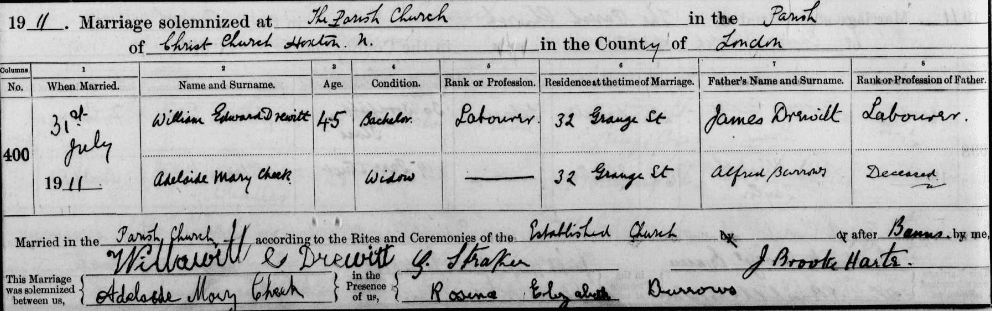
Amazingly in the 1911 Census we find Adelaide Cheek living alone at 32, Grange Street, Hoxton. She says she has been married for 30yrs and is an out of work Gollywog doll maker, but on 31st July 1911 she marries again, to William Edward Drewitt, (Remember him?)
She is now shown as a widow! Perhaps she was. There is one death for a Benjamin Harris in June 1910 so that could be him although the birth dates don’t quite match.
However we do know that on 31st July 1911 at Christchurch, Hoxton, Adelaide Cheek marries William Edward Drewitt.
Adelaide states on Thomas’s admission note that he is the third child in a family of four. I have found the first, Alfred born 1881, died 1886 but apart from Thomas Colley I cannot account for the other two children who, she says, are all dead. It was a long and difficult search as I cannot be sure which name she was using at the time.
All this made me wonder, what sort of life did Adelaide Mary have before she married? And that opened a whole new story.
Thomas’s grandmother
Adelaide Mary’s mother, Adelaide Sophia Boyer (1831 – 1903) married Alfred Burrows in 1862. Alfred had already been convicted of fraud and been sent to Newgate Prison in 1859.

It appears that this was a violent and abusive marriage and that Alfred was adulterous, as can be seen when Adelaide filed for divorce in 1879.
Alfred Burrows appears to have been a ‘chemist’ according to various documents, and in the 1871 Census they are shown as having a servant, so presumably they had a reasonable standard of living.
She says that she had six children with Alfred but that all but two had died leaving Adelaide Mary 16yrs and Albert Edward 7yrs, who was, according to his mother, “born with facial damage due to his father’s violence whilst he was in the womb”. Despite all the evidence of the abuse she had suffered the case was dismissed. Apparently at this time ‘A man could divorce his wife for one instance of adultery but a woman could only obtain a divorce if her husband was physically cruel, incestuous, or bestial in addition to being adulterous.
https://www.ancestry.co.uk/imageviewer/collections/2465/images/40243_636897_3738-00000?pId=29656
This was the life that Adelaide Mary saw as she was growing up, that could help us to understand some of her lifestyle choices.
Happily for Adelaide Sophia she later, in 1889, married a man called William Cheek (1837 – 1906) himself twice widowed, and it was William’s son Alfred Cheek, bn 1862 to his first wife, who later married Adelaide Sophia’s daughter, Adelaide Mary Burrows (our Thomas’s mother) in 1881.
This is a complex story, but my lingering questions are, how did Adelaide Sophia find the money to file for divorce in 1879 when divorce among the lower classes was virtually unheard of? How and why, when she died in 1903 did she manage to leave £84 to her son Alfred when all her other children still appear to be alive.

Thomas’s admission to the Epileptic Colony and his medical notes
Returning to our subject, Thomas William Colley was admitted to the Epileptic Colony, Epsom on 16th Feb 1906, just two months before his 16th birthday. He was said to be “violent at times and tired of life”. His occupation was given as ‘factory hand’ His care was chargeable to Hackney.
His mother, then Mrs Adelaide Harris, gave her address as 5, Hemfray Street, Hackney Wick. She gave this information about Thomas’s history:
He came from a family of four, three brothers and a sister, all dead, so possibly five children. His epilepsy started in infancy with remission until the age of 14yrs. He had Chicken Pox at 6mths and Measles at 8mths, which “Held him back from walking.” Then when he was 11yrs old he had Chorea, (‘A neurological disease characterized by jerky involuntary movements.’)
In early life he also suffered from malnutrition leading to rickets.
His mother says that “His father was alcoholic, his maternal uncle had Epilepsy and his maternal grandmother was insane.”
He left school at 14yrs having attained level 6 so in theory he could read, write and do maths, but his school thought he, “Had a poor house.” Thomas was earning his own living until six months ago despite having one or two fits each week from the age of 14 yrs 6mths. Previously there were no warning signs but now he says, “He has pain in his head.” Adelaide says “He was in Southwark Children’s hospital for a week at about 9/10mth old following a fit. (Could this have been the rheumatic fever talked about later?) Presumably this is when they had him baptised privately.
His habits are said to be steady and regular although he is “Sullen, passionate and excitable. Always wishes he was dead.”
The medical certificate, signed by John Joseph Gordon states that Thomas is “Depressed, tired of his life and wishes he were dead.
Violent and dangerous to others at times. Homicidal impulses, he attacks those nearest to him without any cause. Dirty in his habits, says he is “Subject to Epileptic fits”
Diagnosis; Insanity and instability with loss of self control.
On admission Thomas is in good general health but has an “Impaired heart.” (“Probably a slight degree of Rheumatic heart disease with Hypertrophy.”) He is small at 5’2” with Grey eyes, Light hair and a “Slightly troubled expression.”
Mentally he seems to have no difficulty with current events although “He cannot say why he should be brought here.” He can tell you his personal details and the time and year. Conversation is limited to replying to questions. No hallucinations or delusions, he is not noted as restless, noisy, dirty etc and his sociability is average.
When Thomas first speaks to his doctor we hear a little more of the story of his life. He says that his father is a “(Chain) horse man”. (He could be referring to Benjamin Harris who, at his marriage gave his occupation as a carman who would have worked with horse and wagons.) He says his mother is “Steady,” but that his father “Gets drunk weekly on payday but is kind to him.” Thomas says that he had a bad fall whilst at work in a glass factory, when he cut his head on a table and since that time his fits have caused him to stop work and that his mother has had to give up work because he cannot be left. “His fits cause him to feel depressed but not always. Dark curly gypsy type hair.”
Conditions and surrounding were explained to him and a good parole obtained. (We are unsure what this means exactly, possibly that he is able to move about and work outside.) For more about hospital life and treatment click on the link. Hospital Cluster – St Ebba’s – Epsom & Ewell History Explorer
Thomas appears to settle to life in the Colony and is reported in Feb 1906 as “Working well at gardening, appears content – no evident depression.” This continues until June when we are told that he is “Rather simple minded, works out but tends to shirk.”
In August we hear that he has “Tattooed an anchor and his initials on his own arm and that of Colonist Green using black ink.” At this point his heart is found to be abnormally enlarged but no treatment is given.
In November his notes say that his fits have increased, “Is very overbearing and querulous with other colonists. When spoken to about it he used bad language to attendants. He is still working well on the farm.
The New Year, 1907, brings further deterioration in his personality; he becomes “Morbidly irritable, being unable, as he himself confesses, to restrain himself from, striking a blow whenever provoked.”
This increase in fits and general deterioration continues and at various times he is noted as having a considerable malaise and confusion after fits. Thomas is still working on the farm and is said to be polite and well behaved as a rule. His general health is satisfactory.
The yearly report for that year reiterates that Thomas is “Epileptic with insanity. Simple minded, confused and irritable after fits. The post Rheumatic Cardiac Hypertrophy is progressive – certified as still of unsound mind and a person to be detained under care and treatment.”
The reports throughout 1908 start to say that Thomas is sly and untruthful and that there is an increase in the frequency and severity of his fits. He is becoming “More dull mentally and is too much in the company of colonist Tidyman,” presumably thought to be a bad influence.
By May of 1909 Thomas is on medication, and later he has a couple of spells in Pine, the medical ward. The second of these was for earache which he says was caused by his ears being full of earwigs.
1910 brings numerous bouts of extreme confusion during which he remains helpless and bedridden. One day in May he became confused, restless and agitated and began to undress himself out at work and fumbled in the lining of his clothes. Asked why, he would not reply for some time then said his clothes were full of earwigs.” Suddenly in July it is reported that he has had no seizure for nine weeks but is mentally unchanged.
A fall in October appears to have been the start of a new problem and in January 1911 it is noted that he has, “Fewer fits but is falling regularly.”
He was still working on the farm but his fits were increasing and in July he sustained a black eye whilst fighting with Colonist Nightingale.
Thomas’s health deteriorates
Things seem to have deteriorated again and by September it is reported that Thomas is “Confused, but knows his name and speaks of A.K.Yeates.” On the 2nd Sept he is reported as “Delusional last night, says he is ruptured in four places and sewn up with string.”
On the morning of the 31st of the month he suffered five major fits, until that time he had been “Singularly free of fits,” and he was transferred to Pine in a padded room on account of extreme restlessness. He recovered quickly and was sent back to Elm Villa.
1912 brought more ups and downs, fall and fits although he was still working on the farm. In March he was put to boot making, pulling the waxed thread through, but June brought another increase in his fits and he now needed to be in bed for a few days afterwards. In July it is reported that “He has to be attended to in all ways.”
In August he is transferred to hospital (Pine?) following a series of fits and given and “Soap and water enema with good results,) this appears to be a regular treatment when fits got worse. In October Thomas is back working on the farm but is “Slow in intellect and takes a long time to answer questions. He eats anything that comes his way – onions, turnips at the farm.”
Sadly this is the pattern of Thomas’s life throughout 1913. Fits, falls and fights cause minor injuries. The official report says that “He is dull, stupid and has impaired memory. He has recurrent attacks of acute confusion with hallucination and delusions and frequent Epileptic fits. General health, fair. The final notes in the case book are in early Nov 1913 saying that he was “Struck by Colonist Ford causing a slight cut over eye.
Soap and water enema given, and put into a sided room. Two days later “he is less noisy this morning, still confused.” Transferred back to Elm, recovered.
Thomas’s death
For the next two years Thomas’s life continued in this way. He was backwards and forwards to hospital and is regularly noted as “lost and confused.” His general health, which had previously been steady, began to deteriorate until in on Jan 26 1916 we are told that he had been in bed for the past six or seven weeks and that his general health was “much impaired.” He has lost two stone in weight and weighs just 6st 3lb 14oz.
On the 6th Feb 1916 it was noted that “He has been failing these past few days and died this morning.” Cause of death Epilepsy.

Thomas was buried in the Horton Estate Cemetery on 11 Feb 1916 in grave 2008a

Thomas was visited regularly by his mother in the first couple of years but this tailed off to a yearly visit which stopped completely in 1913.
Perhaps it was just too hard to see her son as he deteriorated. There is no note of anyone attending his funeral.