
 0
0
 0
0
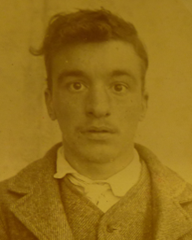
b. 1889-d.1912
The information I had on this young man was very sparse, the only clue to his family was his father’s name and an address in Ramsgate, Kent. There was no mother’s name or details of siblings, except he was the youngest of four. We were told he was born in Chelsea and had spent almost half of his life in institutions.
Jones, is as we know, not an uncommon name and, even when later I had access to his case notes and they told me that his father was a “butler,” I was still led down many dead ends. It was only when I discovered that his mother’s maiden name was Mulany that I could find the correct marriage for his parents. Five years on, this is my third attempt to write Robert’s story, however, I now believe this to be the true story of his life.
Robert was born in Chelsea in 1889 in the district of Kensington. No baptism has been found.

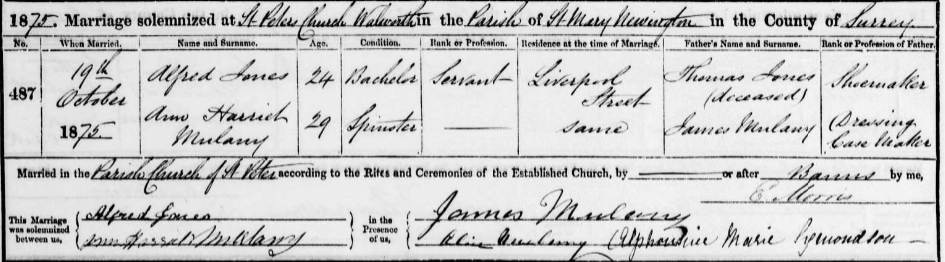
His parents were Alfred Jones and Ann Harriet Mulany, who were married on 19th October 1875, at St Peters Church, Walworth, Surrey. Ann was four years older than Alfred and we can see that Alfred’s father, Thomas, was a shoemaker, now deceased. Ann refers to herself in all later documents as Harriet.
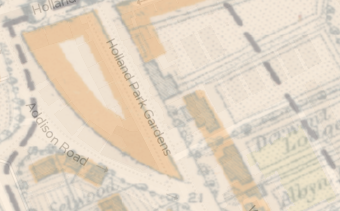
The 1891 Census shows Harriet and her four children living at 27, Holland Park Gardens, Kensington, substantial property in a very upmarket area which they appear to occupy alone.
It is designated on Booths poverty maps as “Upper middle and upper class wealthy.
”Harriet is 46 years old. Alfred John is 14 years and already working, Thomas Gould is 12 years, Catherine 8 years and Robert is just 1 year old.

Alfred is not shown with his family but at his place of work, 4,Onslow “Houses” (address as appears on Census, but now seems to be part of the prestigious Onslow Gardens/Square area.) in Kensington, not far away from his family. Alfred is shown as one of five servants working for a widow, Blanche Clough, and her unmarried daughter. His place of birth is given as Richmond, Surrey,
Ten Years Later
We next find Harriet in the 1901 Census living at 39, Dartmore Street, Kensington. Alfred and Thomas had left home. Catherine is 16 years old and working as a shop assistant and Robert is 11 years and still at home, although it is at about this time, April 1901, that we know he was admitted to St Piers Epileptic Colony in Surrey. At no time is there any mention of his problems on the census.

Alfred is not shown but we find him at his place of work, 57 Holland Park where he is “Butler” to the Hanson Family from Canada.
Robert Enters Ewell Epileptic Colony
Robert spent about 6 years in the Lingfield Colony before being returned to the Kensington Infirmary where he stayed for 3 years before moving to the Ewell Epileptic Colony in 7 June 1910.

When he was admitted to the Colony, his father, Alfred, gave his address as 23, Westcliffe Terrace, Ramsgate, Kent. He said that his wife was dead although Robert later told the doctor that his mother disappeared, and is supposed dead, “she had been a heavy drinker.” Sadly there were no records in the Colony’s visitor’s book for Robert, so I have not been able to find out when and why his father was living in Ramsgate.
On Robert’s admission the doctors observed, “There are indications of insanity. He says, “I am going to be the people’s king.” He hears imaginary people talking and has loss of memory for recent events. The attendant who accompanied Robert from Kensington Infirmary states, “Robert has frequent fits, he talks nonsense and requires supervision.”
Robert’s father Alfred, says that there was nothing unusual in his early development. He had his first fits at about 3 years old and that they are very frequent at night. He has attended out patients at the Epileptic hospital, in Paddington. He is “excitable at times and violent to others during his fits.” He is an abstainer, (from drink.)
Robert is 5 ‘9 ” tall and weighs 9st 1lb. He is well nourished and, apart from a scoliosis which affects his respiration, he is fit and well. Mentally his speech is slow and deliberate, reactions very slow. His memory is poor and his attention wanders after a short time. His conduct appears good but his willpower is rather weak. No delusions or hallucinations noted.
Diagnosis…Imbecility with Epilepsy.
Following his admission on 7th June, Robert is kept in bed until the 13th of the month, possibly due to two major fits. He appears “quiet and amenable, childish for his age and with a slight epileptic drawl.” He tells the doctor that at the age of about 9 years he had a fall and hit his forehead and nose and became unconscious. He says his first fit came after this, which differs from his father’s statement. He was “never able to have much schooling, reaching the 4th standard. Can read a few lines of prose and write a sentence slowly dictated a few works at a time by the age of 12 years.”
At this point, Robert was sent to Lingfield Epileptic Home and spent 6 years there, principally working on the farm. At 18 years he was sent to Kensington Infirmary , where he spent 3 years before coming to the Ewell Epileptic Colony. His fits continue regularly, he is a poor worker, childish and can interfere with any argument.
Robert becomes aggressive
In October 1910 , Robert was involved in fighting with another colonist and using very bad language. And again, in December, during a fight he “picked up a broom and struck a colonist”, although it is said that the colonist was probably, chiefly the aggressor”.
In 1911, Robert was assessed as, “slow, stupid, really partially stuporose. Reasoning powers slow, can do 13×2 but not 2×13. Does little work. In April we hear that he is “doing light dormitory work but very slow.
In May 1911 we learn that “General knowledge very limited” (**unsurprising after so many years in institution I would have thought.) “Thoughts limited to a very few and very simple matters.” He is “hyper religious.” Robert has no recollections of hallucinations or of stating he was to be a king. He does not think he could make a good king. He states that, “all seem to be against him.”
By 1912, Robert was doing very little work in the villas and was quarrelsome and impulsive at times, but much quieter than he used to be. On 11th February he became noisy and on retiring last night, after returning from the recreation hal,l he would not undress himself or allow the attendants to help; he assumed a threatening attitude and picked up a spittoon to throw at the attendant but was prevented by two colonists. Robert was very restive and was placed in a single room with difficulty, three attendants were present.
Next morning, 12th February, the colonist was full of complaints and grievances but no injuries were detected. On the 16th, Robert was transferred to hospital and put to bed. He continued to be confused and quarrelsome. By the 23rd, there was no improvement. “The patient remains stuporose and requires tube feeding. He has a high temperature and is in a weak and feeble state.”
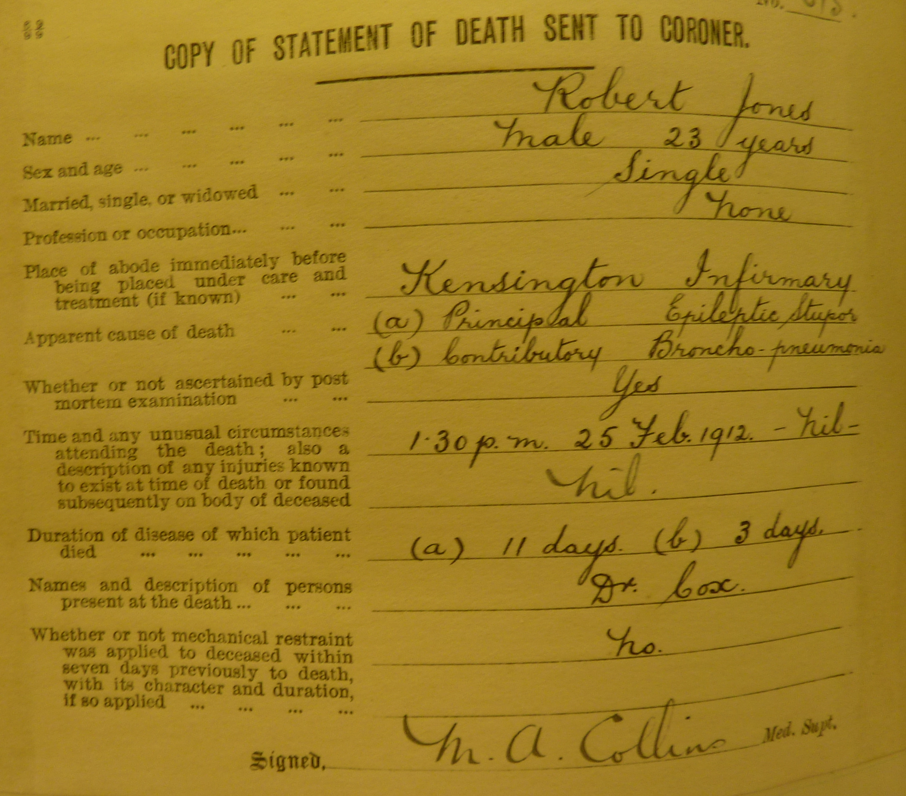
By the 25th February, his condition had worsened and is said to be grave and critical. He deteriorated from 1.20pm and died at 1.30pm.
Robert was buried in the Horton Estate Cemetery on 29th Feb 1912 in grave 1359b.
We have no way of knowing if his father was told of his deterioration or death, but would like to hope that he was able to attend his son’s funeral.
Robert’s Family

I believe that his father, Alfred, died in late June early July 1916, and was buried at St Mary the Virgin, Twickenham, on the 8th July.
According to Alfred, Harriet had died by the time that Robert went into the Colony in 1910 and I have found one or two likely candidates between 1901-1910 but, if she had “disappeared” at some point, and without knowing where she was living I cannot narrow the search down.
Robert’s Grandparents

Robert’s grandparents were Thomas Jones and Amelia Rivers and his father, Alfred was born on 10th Nov 1850 in Richmond Surrey.
However, after much searching I have been unable to find a marriage for this couple. Neither could I find any definitive births for either person.

I have found one probable death for Thomas as we know he died before Alfred’s marriage in 1875.

He was buried at St Mary Magdalen Church Richmond 1866. Following his death we find Alfred, his sister Fanny, and his mother in the 1871 Census living in Halsey Terrace, Chelsea.
Robert’s siblings
Alfred John Jones was born on July 11th 1876, he was baptised on 30th July at St Peter’s Church, Walworth Surrey. His father is shown as a Butler and they are living at 61, Gillingham Street. Walworth.

In the Sept quarter of 1898, Alfred married Emily Draper in the Reg District of St George, Hanover Square.
Emily was 3 years older than Alfred and was born in St John’s Wood, London. No marriage certificate has been found online.
In the 1911 Census, Alfred and Emily were living at 14, Osman House, Hammersmith with their 8 year old daughter, Winifred Edith Catherine born 17.5.1902. Also living with them are Alfred senior, said to be a widower of 60 years, and sister Catherine, a spinster aged 26 years.
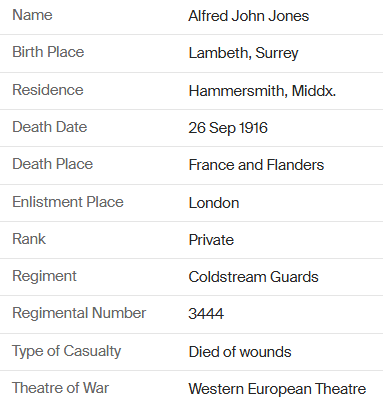
Alfred John’s occupation is shown as “Private soldier, officer’s servant.” On Winfred’s baptism entry in 1902, he is also shown as a soldier.
Alfred was called to active duty in the Coldstream Guards at the beginning of the war in 1914, and sadly he died on 29th September 1916 on the Western Front.
Emily and Winifred were still living at Osman House, Hammersmith in the 1921 Census until, on 3 June 1923, Winifred married Walter Harry Allin; they continued to live in the Fulham area where Winifred died on 25 December 1987.
Thomas Gould Jones was born in December 1878 and baptised on 13 June 1879 at Holy Trinity Church, Upper Chelsea. His father’s occupation is given as a butler, and they are living at 15, D’Ogly Street.

In the 1901 Census, Thomas is already married and living with his wife Gertrude Clara Pennifold, at 70, Pennard Road, Hammersmith. They had married on 21 January 1901 at St Stephens Church, Shepherds Bush.
Over the next ten years they spent some time living in Brighton Sussex but, by 1911, they were living in Battersea, at 38, Parkham Street. Thomas and Gertrude now have four daughters, Mable Barbara 7 years, Edith 6 years, Catherine Gertrude 3 years and Emily Harriet 3 months. Thomas is working at the Battersea Steam Laundry.
In 1913 we find the family living in Mortlake, Surrey when tragedy strikes and Thomas dies overnight, from double pneumonia.
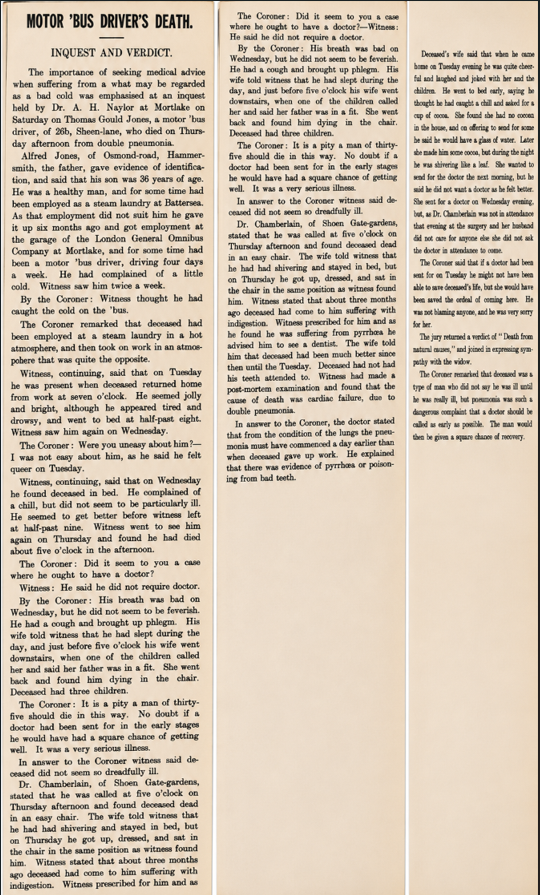
An inquest was held and reported in “The Herald” on 22 November 1913.
Thomas’s father, Alfred, was a witness at the inquest and said that Thomas had got fed up with the hot and humid conditions at the Laundry and had joined the London General Omnibus Company as a bus driver.
He had come home from work on Tuesday night, bright and cheery, although tired, but by the morning was feeling unwell and stayed in bed.
His wife wanted to send for the doctor but as their regular doctor was not available he said no. His father saw him again on the Wednesday and said he appeared to be feeling a bit better.
By Thursday he seemed to have improved and came down to sit in the chair, and it was there that Gertrude found her husband dying in the chair at about 5pm. **
The coroner concluded his report by saying that he felt that the death of a young man was sad. If a doctor had been involved earlier then the outcome may have been different in as much that it may not have saved him, but it would not have required the family enduring attendance at court.
He did not blame anyone and he sympathised with the widow.
Left now with four daughters under 9 years old to support, it seems that Gertrude was already a sick woman and just two years later, we find that Gertrude died from Tuberculosis on 27 January 1915. She appears to have been staying or living with her brother in Portslade by Sea.


Catherine Lydia Ann Jones was born on 8 Sept 1885, according to her school admission record as given by her father. However her birth was registered in the December quarter of 1884.
In 1911 she was still living at home and working as a shop assistant, but, in the June quarter of 1915, she married Edwin Caleb Clapton in the Reg District of Fulham. In December 1915, Edwin enlisted in the army and served until 1919. He served in Ireland, in 1916, during the time of the troubles and the Easter uprising. Following that, he served in France. No baptism or marriage certificates have been found online.
It would appear that Catherine and Edwin had no children as we find them in the 1921 Census at 21, Saunders Grove, Hammersmith. Edwin is a house decorator and Catherine is an office clerk. They are still living at this address at the time of the 1939 Registration, at which time Catherine gives her d.o.b. as 27 October 1884. Edwin died in October 1949 and Catherine in October 1956, still living in Hammersmith.
Author’s Notes
I have been surprised by this family. They seemed to have lived in some very comfortable areas, and certainly Alfred Senior was in service in some of the best houses, but I’m sure his salary wasn’t what might be needed to pay for such accommodation. Was there family money involved ?
However, the next generation did not fare so well and I was saddened by the losses that Robert’s father had to endure in his later life. His wife seems to have left him, and then died at some point between 1901-1910. His youngest son was admitted to the Colony in 1910 and died in 1912. His eldest son died suddenly in 1913 and his daughter in law followed not long after in 1915, leaving his four granddaughters orphaned.
Thankfully he never knew that his only surviving son was killed in WW1 in September 1916, as he himself died in July of that year.
Copyright
If you use the published stories, partly or completely, written by volunteers of the Friends of Horton Cemetery charity (Reg. No. 1190518), please acknowledge the volunteer who wrote the story by name, acknowledge the Friends of Horton Cemetery expressly and its registration number, and include this link to the STORIES section of the website https://hortoncemetery.org/the…/horton-cemetery-stories/
Donate
Occasionally, people ask how they might financially contribute to our charity. There is a Donate link at the foot of each page of the website. All donations will be directed towards continuing efforts to restore and ultimately maintain Horton Cemetery. We thank you for your support.