
 1
1
 0
0
b.1841-d.1913
Researching James proved interesting but with a common name, he was somewhat elusive to begin with. However, with the excellent support of a fellow researcher, much more did come to light, as time went by.
In addition, when we are lucky enough to have access to case notes, we sometimes find snippets of information which give us clues as to their previous lives; these assist research.
Admission to Horton
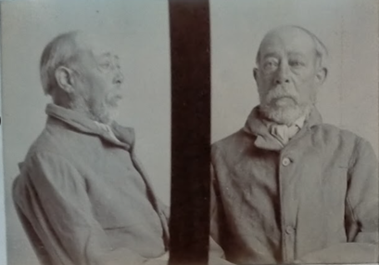
James had been admitted to Horton from the Fulham Workhouse, as a 73-year-old general labourer. He arrived on November 8th 1911.

The records stated that he had no known relatives or friends and, while this was his first attack, he did say that he had been suicidal. James states that on that same morning he had tried to jump from the window, we assume of Fulham workhouse, but other inmates had stopped him.
James was 5ft 9in but weighed just 8st 3lb. He had sandy coloured hair and had freckles. He is also noted as somewhat deaf
All in all, his story is already a sad one.
Further information from the case notes
We learn that, soon after entry to Horton on November 21st 1911, James is removed from the suicide risk list, which we can assume is some progress. He does however remain disorientated and depressed. He develops bronchitis and remains in bed for a period of time.
By February 1912, James was sitting up for up to two hours a day but was very depressed. Over the coming months his condition does not improve and he becomes increasingly feeble.
James died at 6.10am on January 2nd 1913. His death was attributed to senile decay and aortic disease. He was buried on January 9th and is buried in grave 222b in Horton Cemetery.
Research Clues
There are clues in James’s entry notes which provide signposts to his past life:
- James states that he had been in prison twice for theft.
- He was a widower without children.
- He alludes to his wife having a long illness and suggests his condition was caused by this.
- He says he had been six years in the workhouse (and had nothing to live for).
- He believes that he has been to parties at the House of Lords
Finding James Bates
For the 1911 Census for Fulham Workhouse, a James is listed as a widower and he matches the age exactly. It states that he was from Lichfield, Staffordshire and was a previous labourer. This was a good starting point for further investigation and the following was discovered.
Early Life
Thomas James Bates was born 21st January 1841 at Stowe Street Lichfield. His parents were Thomas Bates and Eliza Westward. Thomas Senior and Eliza Westward had been married on 9 Dec 1832 at St Michael’s Church, Lichfield.

Children of Thomas and Eliza Bates included:
- Ann born 1833
- William born 1835
- George born 1838
- Thomas James born 1841
- Harry born 1845
- Arthur born 1846
- Eliza born 1849
On the 1861, 1871 and 1881 Censuses, Thomas senior was a publican in Walsall, where most of the family remained. However, our subject, Thomas James Bates born 1841, must have left Walsall, eventually settling in London.
From here, we will refer to him as Thomas James, the name he was known by.
Thomas James Marries in London
Thomas James has yet to be found in the 1861 and 1871 Census, but on 30th June 1879 he married Elizabeth Yeldon, at St Thomas’s Church in the parish of Stepney. He was by then working as a labourer. Thomas James gives his father’s occupation as a publican, which confirms that this is our man.
In 1881, Thomas James was living with his wife Elizabeth at 15 King’s Head Court, St Bride. He was working as a potman; she was a dress maker.
In 1891, Thomas James and Elizabeth were living at 112 North End Road, Fulham. He was still working as a potman and she as a dress maker.
On 27 November 1893 the couple were living at 44 Dieppe Street, Fulham where Elizabeth died. Her cause of death was chronic bronchitis, asthma, cardiac disease and dropsy.
We have not found any children of Thomas James and Elizabeth which aligns with his case notes.
1901 Census
Thomas James was living at 10 St Alban Terrace, Fulham. He is renting a room in the household of James and Fanny Brooks. Thomas James is a widower and working as a labourer.
On 23 June 1902, Fulham Palace Road Workhouse records the admission of James Bates. He gives the same address as the 1901 Census and his friend Mrs Brooks at the same address. This same record also records his admission to Horton Asylum on 8 November 1911. https://www.ancestry.co.uk/imagevie…1537_214511-00047?usePUB=true&_phsrc=fgx33446
How sad that Thomas James was in the workhouse for so long. That is a long time and it must have been awful. Given, that on the day he transferred to Horton, he had tried to commit suicide, he did live a long time afterwards. Hopefully Horton provided better care, with some stability and safety, for the last years of his life.