
 0
0
 0
0
b.1888-d.1916
Annie’s family
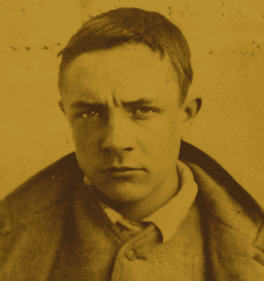
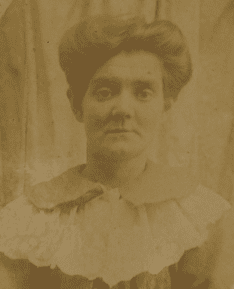
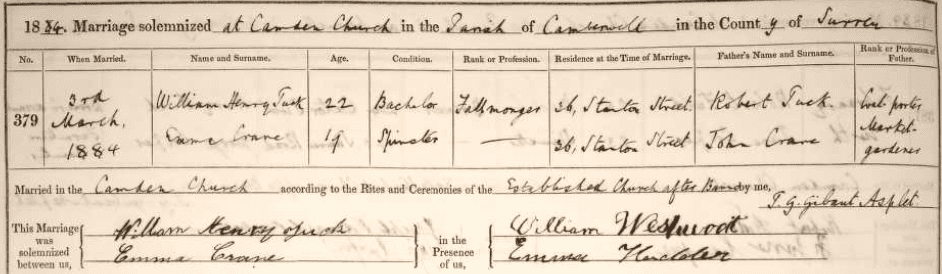
Annie Tuck was born on 8th March 1888 in Peckham. She was the third of seven children born to William Henry Tuck (1862 – 1911) and his wife Emma Crane (1866 – 1916.) William and Emma married on 3 March 1884 at Camden Church, Camberwell, William’s occupation was given as a ‘Fallmonger’ which I believe should read Fellmonger, someone who deals in sheep skins, probably removing the wool to ready the skins for tanning.
William’s father, John, was a ‘coal porter’ and Emma’s father, John Crane, was a ‘market gardener.’ William and Emma both give their address as 36, Stanton Street, Peckham.
By the time of the 1891 Census they had three children including Annie, although the eldest, James, does not appear on the census as he was staying with his grandmother. He was born on 2 Sept 1883 in Dulwich, five months before his parents married. Jane Emma was born in 1886 in Old Kent Rd. and Annie in 1888 in Peckham. They were still living in Stanton Street at number 41. Stanton Street was considered a ’Poor street’ in the Booth’s Poverty maps.
In 1901 the family are to be found in Jennings Rd, Camberwell with all but of one of their children. James is now 17yrs and a labourer in a brewery. Jane is 14yrs old and Annie is 13yrs and we know that she is already troubled. William Henry is 8yrs, born in1894. John Thomas is 6yrs born 1895 and the youngest; Elizabeth is 3yrs, born 1896. All three were born in Dulwich. Their last child, Henry Tuck was born in Mar Q 1905 just as the family’s problems were coming to a head.
The start of Annie’s mental health problems
On 18 Oct 1898 Annie was admitted to the local Goodrich School. The family were then living at 115 Landell’s Road, East Dulwich. At some point around this time Annie suffered a “great fright” which was said to have caused her Epilepsy. She was “chased by a boy who threatened to burn her with a lighted paper, Annie fell down unconscious and remained so for three days suffering eleven fits during that time and has fitted daily since.” Annie was then sent to a special school “for defectives” where she reached grade 3 which means she could read and write simple sentences laboriously. The family appears to have dealt with Annie’s seizures at home until on 20 Dec 1907 she was admitted to the Constance Road Work House, Camberwell with Epilepsy. Just over a month later on 31 Jan 1908 she was transferred to the Ewell Colony where she spent the rest of her life.


Admission to the Ewell Colony
The ‘Ewell Colony’, part of the Epsom Cluster of five mental hospitals, had been opened in 1903 to care for “the Epileptic insane of the Metropolis”. This new approach housed patients in a collection of villas, avoiding the stigma of living in a mental asylum. The treatment consisted of a specially regulated diet and doses of Potassium bromide, the first effective treatment for controlling epilepsy. The patients were expected to contribute to their costs by working on the hospital farm or in the kitchens, laundry or bakery all of which supported the Epsom cluster of hospitals.
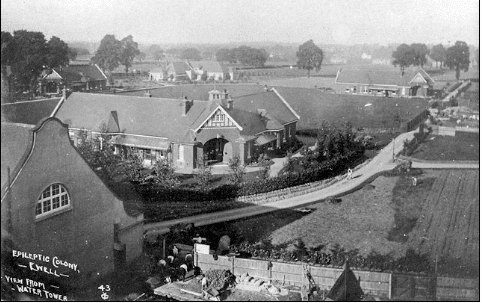
On being admitted to the Colony, Annie’ father’s address is given as 8, Bachelor Hall Place, Blue Anchor Lane, Peckham, later amended to 35, Garsdale Road, Hill Street, Peckham. It is possible that William had briefly moved out of the family home and into Bachelor Hall Place which seems to have been some sort of Methodist Mission.
Obviously the problems were resolved at some point and he moved back to Garsdale Rd.
A further note on 2 Nov 1911 states “gone away” and later “committed suicide”. I will give more details about this later.
Annie’s medical notes
When Annie was admitted to Ewell Epileptic Colony on 31 Jan 1908 her medical statement says that she is, “an epileptic who for days together does not know what she is doing.” She is said to be, “strange in manner and appearance and has weak memory and intellect.” Nurse Selsdon from the Constance Rd Work House Camberwell, who accompanied her, agrees and adds that “she is unable to do any work, is very depressed at times, shrieks and cannot keep still.” Diagnosis: Insanity with Epilepsy
It notes that Annie has brown hair and eyes and, an “old fashioned face” and that medically, she has vascular degeneration and some enlargement of the cardiac area. Mental state: Generally good, but slow. Reasoning and memory somewhat impaired from “general weak mindedness.” Good sense of propriety, sociability poor. Family: Mother and father still alive and strong and healthy, father not a drinker. No Epilepsy in the family.
On the 5th Feb 1908 in her first “Case Progress” notes, the doctor says that Annie must have an ‘Aura’ as she calls out that, “one is coming.” She describes this ‘Aura’ as “Having something alive crawling up from her insides to her throat.” Recently the severity of her fits has increased. She is poorly nourished and underdeveloped.
Later in the month we see that, “She is willing to be useful” and although “very childish,” she has been sent to work in the kitchens.
Over the next few months Annie seems to settle and be working well either in the kitchen or the villa, and has gained weight. In October of 1908 she is averaging two seizures a day of the minor type.
In Jan 1909 it is noted that Annie is “Very agitated and morbidly irritable as a result of the large number of seizures” 22 of the major type. Otherwise she is in good health and well nourished. This continues to be her condition through until August when there is a gap of two months in the records, but in October , for the first time Annie is put on medication and then again a gap of two months in her notes.
Annie’s state of health deteriorates in early 1910. It is reported that she “now needs direction and supervision.” She is in good general health, and well nourished, but is having a large number of seizures.
Again we have a gap in the notes and it is not until July that we find that she needs treatment for a sinus in the mouth. It requires daily “plugging” and this seems to cause some agitation. In October the doctor tests Annie’s field of vision and finds that it shows “considerable contraction, especially upwards and outwards.” Valerian, used for relieving anxiety and depression, is introduced to her medication. Her mouth is still being dressed daily and, unsurprisingly perhaps, she is said to be depressed and at times states, a “desire to be dead, but laughs at it soon after.” She has become slovenly and untidy. November finds Annie fighting and she is left bruised. Following two successive fits on the 21st November she is sent to Laurel Villa to go to bed in an open dormitory. She has been “scratching herself again, is unsettled, noisy, screaming and quarrelsome – Has kicked two fellow colonists.”
This state of mental disturbance continued into 1911 when on 12th Jan it is noted that “After a quarrel with B.Rolfe (? Patients are usually referred to as colonists and nurses as Nurse so I’m unsure who this might be,) she got a piece of a broken plate and inflicted a small scratch on her chest saying, she wished to “bleed to death.” She is sent back to Laurel where she appears to settle down.
Her medication had been changed during the previous month and in April another review of her medication and her fits, which seems to show that her mental condition improves when she is not taking “the Bromide”. Annie complains about a “fearful pain and tenderness in the left auxiliary region (armpit) but she is too fidgety to examine properly. She “wishes she were dead and in her box.”
Her eyes are causing more concern. Her pupils are unequal, fixed to the right and accommodation (the eye’s ability to automatically adjust its focus to see objects clearly at different distances) she can count fingers at 12” with left eye but not with the right.
She says that when she looks up with her right eye, two black balls “appear to watch her.” “She is not noticed on the ward to be blind, but is a good sewer.”

Annie appears on the 1911 Census for Ewell Epileptic Colony.
May 1st 1911: “Annie’s mother visited yesterday and told the nurse that the patient’s father had recently committed suicide.” Nothing more was noted to make clear if Annie was told this news, or by whom. The full story of Annie’s father will come later in the story but we know that he had committed suicide by cutting his own throat.
May 26th: “She has been talking, in a childish way of wanting a sharp knife, has been sticking pins in her nose to try to bleed to death and trying to break her finger. There is not value in her attempts however, which are all of a very childish nature.”
Author’s note: Can we assume from this behaviour that she had been told about her father’s death and its manner? What a trauma for an already very disturbed young women which, just from the written notes, seems to have been dismissed in a rather callous manner. Let us hope that there was an understanding person to help her. This visit was not recorded in the visitors’ book and it would appear that Annie received no other visits from her family.
July 22nd: “She scoffs at her ideas of cutting off her head this morning. She is bright and can see better with her right eye than her left and has forgotten about the black balls.” The cavity in her mouth has again started to give trouble.
In late August she is put to bed, “silly, punching herself about and hallucinations of hearing.” She is put into a single room again on Sept 3rd. “beating her chest. Too much hallucinated, replying to voices. Believes that others are writing post cards about her. She is taking Potassium Bromide which helps to control her fits but seems to make her mental symptoms worse.”
The doctors stop Annie’s Bromide but within three weeks her fits have returned with a vengeance. They seem to struggle to find a balance but are eventually able to reduce them.
On October 4th the nurse reports that Annie’s right arm was weak all of the previous day and that her speech was affected after seizure. “She had no loss of sensation, good grip with both hands but right hand awkward and co-ordination poor. There was no loss of power in her legs. Pupils fixed to light.”
October 24th: “After a series of 117 fits, the next week 18 minor and then just two Minor, followed by a week without any. “Still silly and picks at herself but on the whole, better without Bromide. No weakness in her right arm now but says she cannot see out of her right eye today.”
As 1912 begins we find that Annie is no longer on Bromide. “Feeble minded, usually well behaved but aggressive at times.” She is working in the general kitchen.
There are no major changes until July when it is reported that “she is now in poor health and condition.”
Annie is put back on the Bromide, which seems to be the only medication available but by April 1913 her fits are increasing and she is suffering periods of depression. Later that year she becomes “rather confused mentally and in consequence, irritable and troublesome.” She is transferred to Laurel complaining of abdominal pains.
Nothing more is noted until Jan 1914 when it is reported that “she has lost weight and looked ill at one point but now improving.” She is given extra milk and by April she is putting on weight.
On August 25th “Annie states that she wishes she were dead and last night inflicted several slight scratches on her chest. She is weak-minded and unstable and readily develops persecutory ideas concerning the other patients, probably a result of aural hallucinations as she believes the staff and patients abuse her and as a consequence she uses bad language in return. Works variably, mainly on the ward.”
Sept 14: Sent to Laurel. “She has actually scratched the charge nurse, becoming violent and abusive this morning. She accuses the staff of assaulting her but there is no evidence of this. She is liable to complain of ill treatment.”
By the 8th of that month Annie is “vividly, aurally hallucinated and states that she hears the A.M.O (Assistant Medical Officer?) worrying her all day. She is losing weight again although she is eating well”
1915 Jan: SR to C in L. (Which I now know means Senior Registrar to Committee in Lunacy.) By April of this year Annie weighs just 5st 10lb 5oz and has suffered 140 seizures in the past quarter. Amazingly by July her weight has rocketed up to 7st 10lb 12oz.. These variations of numbers of seizures continue throughout the rest of the year.
1916 Jan 27th: Doctor notes, “Suspect fits of depression.” By 28th March she had suffered 406 fits,
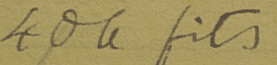
frequent chloral enemas given but with no result, one Morphia injection. Fits have ceased since 7.30am. 29th March: “Two more fits yesterday morning, died suddenly in the last one.”
Her death was certified as Epilepsy in her case notes but there is no information on the final statistics section of her file.

Annie was buried in the Horton Estate Cemetery on 3rd April 1916 in grave 2044 b

Annie’s family.
William Henry Tuck, Annie’s father, was born in Wapping on 3 Nov 1862. His parents were Robert William Tuck and Jane Hannah Wilmer. Robert was a Coal porter, probably working on the docks. William had four siblings and lived in Tower Hamlets. In the 1881 Census Robert and Jane were living at 36 Stanton Street, Peckham, the address shown on William and Emma’s wedding certificate.
William and Emma continued to live in Stanton Street in one room of number 41, until, in the 1901 Census we find them at 26, Jennings Road, which appears to house two families, a total of twelve people. This was considered a “mixed” area, with some comfortable and others poor.
By the time of Annie’s admittance to the Colony the family had moved back to their old area and were living in two rooms at 6, Garsdale Road, Peckham which, according to Booth’s poverty maps was rated, “very poor, chronic want”. The family were obviously going through an extremely difficult time.

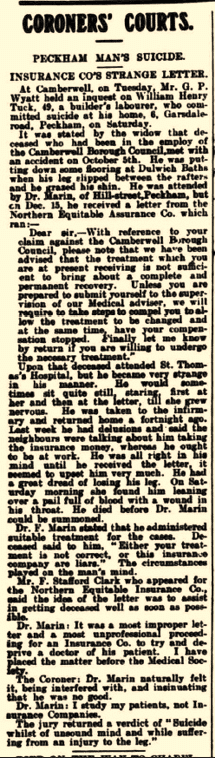
On the 18 February William took his own life. He was just 49 yrs old. It would seem that this whole episode and the threat of not being able to receive his compensation money to support his family tipped William over the edge.
Following this up a fellow researcher found a news paper report on the coroner’s findings. William was buried on 23 Feb 1911 in the Camberwell Old Cemetery.
The 1911 Census shows Emma still living at 6 Garsdale Rd with four children at home, the youngest just 6yrs old. She is earning money “charring”. William Jnr 18 yrs is a “flower seller, when able.” The census shows that William had suffered from Rheumatism and heart failure (possibly caused by Rheumatic Fever) since the age of 14yrs. John Thomas, 16yrs, is a van boy, and the two youngest are still at school. We cannot imagine that much money was coming into the house, although she may have had help from her two older children who were both married by this time.
Emma remarried on 22 March 1914 to Robert William Prop, himself a widower.
Sadly Emma died on 1 Nov 1916; she was buried in Camberwell Old Cemetery.
Robert Prop lived until 1952, and in the 1921 Census was living with his five children. In the 1939 register he and several of his children are found living next door to Emma’s eldest son James and his wife Mary, in Acorn Place Camberwell. Robert lived until 1952, and is buried in the same cemetery as Emma.
James Tuck. Annie’s eldest brother was born on 12 Sept 1883. In the 1891 Census we find him staying with his grandmother, Jane Tuck, at 2 Canal Row, Camberwell.
In 1894 he is admitted, age 10yrs, to Cold Blow Lane temporary school by his father William. It is noted that his previous school had been, a “truant school,” so it would appear that his younger years were not easy. In 1917 James married Mary Anne Prop, his stepsister by his mother’s marriage to Robert Prop. They appear to have had at least four children losing one at 2yrs old. They lived all their lives in Camberwell. James died 17 Oct 1947 and is buried in Camberwell Old Cemetery. I have a probable death for Mary in Mar Q 1947, buried in Southwark, most probably in the same cemetery.
Jane Emma Tuck. Born on 25th Apr 1885, she married on 16th Apr 1905 at St George in the East church, Tower Hamlets. Her husband was John Selston, an Engineer; they went on to have four children. In WW1 John served in the Rifle Brigade in France and on his return worked as an assistant selling fruit and veg. Jane died in 26th Feb 1938 and John on 29th Aug 1944. They are both buried in Camberwell New cemetery, Southwark.
William Henry and John Thomas Tuck. Annie’s two younger brothers have been difficult to tie down. We know that they were both still living with their mother in 1911, William was 18yrs, born 1893, and unwell, and John was 16yrs old, born 1895. I have found one possible death for William in June Q 1915 in Southwark but the certificate is not available in a digital format. However John Thomas died in Sept Q 1912 as seen below.

Portal Pyaemia: The infection typically originates from another site in the abdomen, such as the appendix, colon, or gallbladder, and spreads to the portal vein. Before antibiotics, portal pyaemia was often fatal.
Elizabeth Tuck. Born 29th Aug 1897, she married in Jan 1916 to Charles Stocker and continued to live in Garsfield Road, Peckham. The 1921c shows that Charles worked for the Port of London Authority as a general labourer in the docks. They appear to have had four children. They lived all their lives in the Peckham area and both lived to good age. Charles died in Oct 1978 ages 84yrs and Elizabeth died in Nov 1987 aged 90yrs, they were both buried in Southwark, probably in the Camberwell New Cemetery, Southwark.
Henry Tuck. Born 1905. In the 1921 Census, Henry is living with his sister Jane Selston. Henry married on 28th Dec 1930 to Florence Alice Lewis. His address was 4, Garsdale Rd, Peckham and his occupation is given as “shop assistant. They appear to have had just one child, a son called Henry born in June Q 1932 who seems to have died in the same quarter. The electoral register for 1939 shows them living at 62 Furley Road Peckham, one road over from Garsdale Road, but I have not been able to find them on the 1939 register. Florence died on 18th April 1956 and Henry on 8th June 1977. They are both buried in Southwark, probably in the Camberwell New Cemetery.
This is a sorry tale, especially for Emma. In 1908 her daughter Annie was admitted to the Colony. In 1911 her husband committed suicide and then in 1912 John Thomas died. In 1914 there was some hope of a happier life when Emma married Robert Prop but then within a year, if I am correct, her son William Henry died, in 1915. Sadly Emma herself passed away in 1916.